
India Pharma Outlook Team | Monday, 07 September 2026
ProtExtent Biosolutions Pvt Ltd (PBPL), a biotechnology start-up based at the DBT-ILS Bioincubation Centre in Bhubaneswar, is making a strategically important move: the next major opportunity in vaccines may not be captured by producing another high-volume commodity vaccine. It may be captured by supplying the technology that allows many vaccine developers to build better candidates, faster.
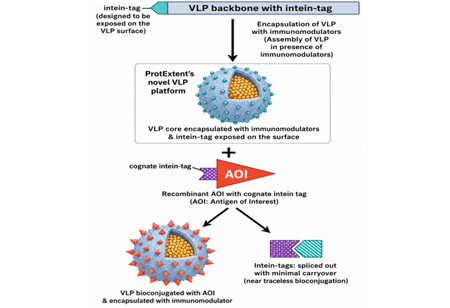
That logic sits at the heart of PBPL’s patented virus-like particle (VLP) platform, protected in India under Patent No. 601201 and disclosed internationally in patent family WO2025248564A1. The platform combines two functions that are usually treated separately: modular, site-specific attachment of an antigen to a pre-assembled VLP surface through intein-mediated protein trans-splicing, and encapsulation of immunomodulatory factors inside the VLP core. In simple terms, the particle is designed to display the immune target on the outside while carrying an immune-programming payload on the inside.[1]
For PBPL, the scientific proposition is important. The business proposition may be even more consequential.
A VLP is a nanoscale particle made from viral structural proteins but lacking the viral genome needed for replication. Because its surface can mimic the repetitive geometry of a virus, a VLP can present antigens to the immune system in a highly organized array. This principle already underpins major vaccine successes, including hepatitis B and human papillomavirus vaccines, and VLP architectures are an established part of modern vaccinology.[2] Yet converting a promising antigen into a stable, manufacturable VLP vaccine can still demand substantial protein engineering.
The bottleneck PBPL wants to remove
Traditional chimeric VLP design commonly places an antigenic sequence directly into, or fuses it genetically with, the capsid protein. This can work extremely well, but every new antigen may change capsid folding, solubility, assembly, particle stability, epitope accessibility or expression yield A construct that succeeds with one antigen therefore does not automatically become a reusable platform for the next.[3]
Chemical conjugation offers another route, but can introduce its own development burden: control of reaction chemistry, conjugation heterogeneity, orientation, residual reagents and the compatibility of the reaction with structurally sensitive antigens. Other modular protein-tag systems have elegantly simplified VLP decoration, demonstrating why “plug-and-display” is such an attractive design philosophy.[3,4]
PBPL’s patent takes a different route. Its VLP backbone carries one member of a split-intein pair, while the antigen of interest carries the cognate intein partner. When the purified components are brought together, protein trans-splicing is designed to excise the intein fragments and create a covalent linkage between the VLP and the antigen. This is site-specific, efficient and “near traceless”, with minimal or no residual amino acids from the conjugation tags in the final VLP-antigen product. [1] A peer-reviewed study published before PBPL’s filing has independently demonstrated the technical feasibility of decorating HBc VLPs through intein-mediated trans-splicing, supporting the broader scientific plausibility of this modular approach.[5]
That distinction matters. A reusable VLP scaffold that can be manufactured first and decorated later has the potential to decouple particle optimization from antigen optimization. Instead of rebuilding and re-optimizing the VLP for every new target, developers could, in principle, qualify a backbone and then screen a series of antigen candidates against it. The value is not merely elegant molecular biology; it is a possible reduction in iteration.
The second layer: programming, not just presenting, immunity
PBPL’s concept goes beyond surface display. The patent also describes encapsulating immunomodulatory factors - including small molecules, metabolites, adjuvants, cytokines or other biologically active agents - within the VLP during particle assembly.[1]
This creates a two-compartment architecture. The antigen displayed on the surface supplies the “what to recognize” signal. The encapsulated component is intended to influence “how to respond” after uptake by antigen-presenting cells. The patent discusses the possibility of steering immune outcomes toward different humoral or cellular response profiles, including T-helper and regulatory pathways.
[1] Scientifically, this is an ambitious feature. For many prophylactic vaccines, high-quality neutralizing antibody remains the principal objective. But difficult intracellular pathogens, therapeutic cancer vaccines and selected immune-modulation applications may require more controlled engagement of cellular immunity. A platform that can systematically pair antigen identity with an internal immunological cue could become a screening engine for antigen-plus-immunomodulator combinations, rather than simply a carrier.
Figure 1 of the patent schematically captures this platform logic: a VLP backbone bearing a split-intein module is prepared to carry an immunomodulatory payload; a separately produced antigen carrying the cognate intein is then brought to the VLP; protein trans-splicing creates the surface-displayed antigen while the immunomodulator is retained within the particle core. The patent further discloses experimental embodiments using HBcAg- and AP205-derived VLP backbones, including different antigen/immunomodulator pairings.[1]
Why an enabling-partner model fits PBPL
The strategic implication is clear. PBPL does not aim to outspend global vaccine majors in mature, high-volume product categories where procurement scale, installed capacity, regulatory history and distribution reach dominate. Its strongest position is upstream, where flexibility and specialized know-how create disproportionate value.
The company therefore defines itself as an agile enabling technology partner: a platform company that helps vaccine developers turn antigens into characterized VLP candidates and then transfers, licenses or co-develops the resulting process.
That model can be organized around a practical partner workflow: antigen-to-VLP feasibility studies; engineering of compatible intein-tagged antigens; selection and optimization of VLP backbones; immunomodulator-loading studies; analytical characterization of particle size, integrity, conjugation efficiency and antigen density; preclinical material supply; scale-up; and technology transfer into a partner’s GMP network. PBPL’s publicly available company profile already emphasizes recombinant-protein expression, purification, process development, scale-up and technology-transfer capabilities, which can support this platform-services model.[6]
Such a model is capital-efficient relative to building a global vaccine franchise. It can also diversify technical and commercial risk. A single vaccine product lives or dies with one indication. A platform can participate in multiple partner programs across pathogens, geographies and therapeutic areas. Revenue can be structured through paid feasibility programs, platform-access fees, development milestones, field-specific licenses, manufacturing/technology-transfer packages and downstream royalties.
In effect, PBPL would sell development leverage rather than doses.
Where the global market creates room
Commercial estimates for VLP technologies vary widely because research firms define the category differently - some include vaccines only, while others include therapeutics, diagnostics and research products. This makes false precision dangerous. One 2026 analysis of the broader VLP sector projects growth from about US$5.8 billion in 2024 to US$12.4 billion by 2034, an approximately 8.3% compound annual growth rate.[7]
A dedicated 2025-2030 VLP-vaccines study separately highlights modular platforms, scalable manufacturing, multivalent and therapeutic vaccine development, and strategic collaboration between biotechnology companies, academia and established pharmaceutical manufacturers as key themes.[8]
For PBPL, the most credible market impact is therefore not a claim that it will capture a fixed percentage of global vaccine sales. Its impact would be measured by how many development programs it can enable and how much friction it can remove from each one.
If experimentally validated as a broadly reusable platform, the technology could influence the market in four ways. First, it could expand the number of antigens considered practical for VLP presentation by reducing the need for repeated capsid redesign. Second, it could increase screening throughput, allowing developers to compare multiple antigen constructs and immunomodulatory combinations on a common particle architecture. Third, it could support multivalent strategies through separately prepared VLP-antigen batches that can be combined rationally. Fourth, it could open partnership opportunities in therapeutic vaccines, where controlled cellular immune responses and rapid customization may be more valuable than commodity-scale dose economics.
In a market that may roughly double over a decade under broader VLP definitions, even a small company can have an outsized technological footprint if its platform becomes embedded in multiple external pipelines. The relevant question is not “What share of vaccine doses will PBPL manufacture?” but “How many successful vaccine programs could carry PBPL technology inside them?”
The proof points that will determine value
Patents create defensible possibility; they do not replace translational evidence. PBPL’s commercial value will rise sharply if it can build a rigorous, repeatable validation package around the platform.
Partners will want evidence that conjugation efficiency and antigen density are reproducible across structurally different antigens; that VLP morphology and antigen conformation are retained after conjugation; that the “near-traceless” junction is confirmed through rigorous analytical characterization; that immunomodulator loading is measurable and controllable; and that encapsulated compounds remain associated with the VLP through manufacturing and storage.
Equally important will be head-to-head immunogenicity studies against soluble antigen and relevant VLP benchmarks, with appropriately selected measures of neutralizing antibodies, T-cell responses, germinal-center/T-follicular-helper biology, memory, dose sparing and durability. For internal immunomodulators, the dose delivered per particle, release behavior, biodistribution, toxicity and the relationship between loading level and immune phenotype will require careful definition.
On the CMC side, the platform will need a standardized analytical toolbox: particle-size distribution, morphology, aggregation, antigen occupancy, residual host-cell proteins and nucleic acids, potency assays, stability-indicating methods and specifications that can travel from PBPL to a partner site. This is where PBPL’s existing recombinant-protein expression, purification, scale-up and technology-transfer capabilities can become a strategic advantage.[6]
A platform company is ultimately valued not only by what its chemistry can do, but by how easily another organization can reproduce it under quality systems.
India as a platform origin, not merely a manufacturing location
India’s vaccine industry is globally recognized for manufacturing scale and cost discipline. PBPL’s opportunity is to add another dimension: originating an enabling vaccine technology from India and licensing it outward.
That creates a particularly attractive partnership position with regional vaccine manufacturers in Asia, Africa and Latin America that may possess fermentation, fill-finish and regulatory infrastructure but seek differentiated platform IP; with academic groups that have promising antigens but limited product-development capability; and with global biopharma companies seeking faster ways to test difficult, multivalent or therapeutic vaccine concepts.
PBPL can also remain deliberately neutral across indications. Rather than betting the company on one pathogen, it can become the connective tissue between antigen innovators and manufacturers.
The strategic prize
The most compelling feature of PBPL’s VLP technology is not any single antigen or immunomodulator disclosed in the patent. It is the architecture: pre-assemble the carrier, program its internal cargo, attach the antigen with a precise protein-splicing reaction, and reuse the workflow.
If that architecture proves robust across diverse antigens and survives the demands of GMP manufacturing and regulatory characterization, PBPL could occupy a valuable position between discovery and product commercialization - the part of the vaccine value chain where many good antigens fail to become good products.
The company’s business foresight should therefore remain disciplined: do not fight established global manufacturers on their strongest ground. Build the platform, validate it deeply, standardize the development package, and make it easy for partners to adopt.
For ProtExtent, the path to global relevance may not be to become the next giant vaccine manufacturer. It may be to become something more agile and, in its own way, more scalable: the enabling technology behind many next-generation vaccines.
Market impact lens 

.jpg)