India Pharma Outlook Team | Monday, 30 March 2026
India’s pharmaceutical industry is grappling with a severe raw material crisis, putting immense pressure on API producers. Prices of key chemicals and Active Pharmaceutical Ingredients (APIs) have skyrocketed, forcing manufacturers to cut production and raising concerns over rising medicine costs.
Industry associations and market data show that the cost of raw materials used in API production has risen anywhere from 200 percent to 300 percent in recent weeks, a level of inflation not seen since the COVID-19 pandemic era. Small and medium pharmaceutical companies — especially in Himachal Pradesh and Gujarat — are reporting production cutbacks, shorter operating hours, and margin stress as they struggle to absorb these cascading costs.
Why API Costs Are Spiking
Several factors are converging to drive up the cost of API raw inputs:
Geopolitical tensions in West Asia have disrupted shipping through key trade routes, slowing delivery of petrochemical feedstocks and finished intermediates. Freight costs have also spiked.
Petroleum-based solvents and intermediates, essential for API synthesis, have jumped in price as crude oil rates remain elevated. This directly impacts production costs for APIs such as paracetamol, ciprofloxacin, and nimesulide.
Supply chain strain on chemicals like glycerin, isopropyl alcohol, and propylene glycol has compounded pricing pressure.
Small and medium firms lack the financial buffers to hedge or absorb sudden cost surges.
"The government is planning to trigger the Essential Commodity Act for our industry so that black marketing and hoarding can be avoided. We await the final decision. Hopefully the supply chain would be reinstated soon," confirmed Namit Joshi, Chairman, Pharmexcil (Pharmaceticals Export Promotion Council of India).
Also Read: Rising Chemical Costs Squeeze Pharma Ingredient Producers
Statistically Steep API Price Increases
Here’s a snapshot of recent API and input cost inflation in India between late 2025 and early 2026:
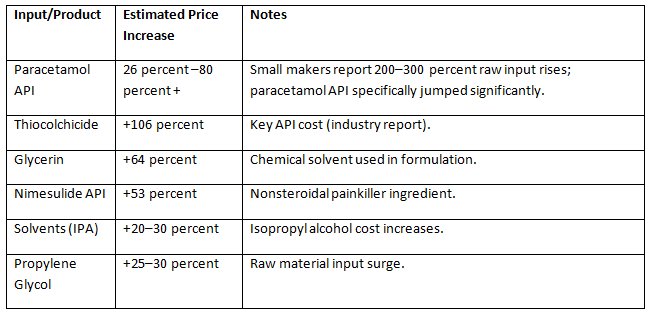
A previous report shows that paracetamol API prices in India stood near USD 2,958 per metric ton during Q2 2025 (roughly Rs 2,350/kg at an exchange rate of ~Rs 80 per USD), underscoring how rapidly costs can move with changing supply conditions.
"With supply cuts and sharp price escalation, both pharma manufacturers and packaging suppliers are under increasing stress," said Abhay Srivastava, Senior President of Operations at Mankind Pharma.
Comparison with Historical API Price Trends
To understand how dramatic the recent spike is, look at how paracetamol API prices have changed over the past few years:
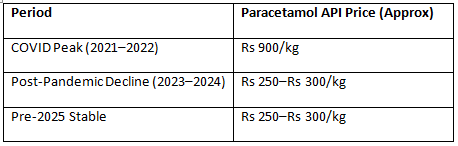
This shows how prices initially collapsed after pandemic shortages eased and Chinese suppliers added capacity, but are now rebounding sharply due to new external pressures.
The impact is clearly visible in paracetamol, one of the most widely used medicines. The price of its active pharmaceutical ingredient (API) has more than doubled in recent weeks, rising from Rs 220–240 per kg to Rs 550–600 per kg. “The new quote of paracetamol that I got yesterday (Monday) was Rs 550 per kg, up from Rs 240 earlier,” said Bhavin Mehta of Kilitch Drugs.
Impact on Production and Profitability
The surge in API and chemical costs is not just a pricing story — it’s affecting production volumes and profitability:
Reduced operating hours: Many API manufacturers in Himachal Pradesh have cut back from 24-hour to 8-hour shifts due to infeasible input costs.
Production cutbacks: Some smaller units have temporarily halted operations until prices stabilize.
Margin compression: Formulation makers face higher costs at the API purchase stage, but drug price ceilings under India’s Drug Price Control Order (DPCO) limit how much they can raise retail prices. This squeezes margins further.
Higher API prices can also affect employment and investment. If small makers shut down, the industry could become more concentrated among larger players, which may affect competition and pricing in the long term.
Broader Industry and Policy Implications
India’s API market is projected to grow significantly over the next decade, with estimates suggesting growth from a USD 13.03 billion valuation in 2023 to USD 37.11 billion by 2032 at a CAGR of ~12.3 percent . However, cost shocks like the current one challenge that trajectory if raw material supply chains remain volatile.
The industry has urged government intervention, including exploring price controls or invoking the Essential Commodities Act to prevent hoarding and stabilize raw material costs. Policy support, improved domestic production of key chemical inputs, and diversified sourcing strategies are frequently cited as part of a long-term solution.
What It Means for Consumers
For now, most priced-controlled medicines continue to be available at regulated retail rates, shielding consumers from immediate price hikes. But analysts warn that if API and chemical costs remain elevated, manufacturers may eventually seek regulatory approval to adjust drug prices — potentially leading to higher out-of-pocket costs for common medicines in late 2026 or beyond.
.jpg)