
India Pharma Outlook Team | Tuesday, 26 May 2026
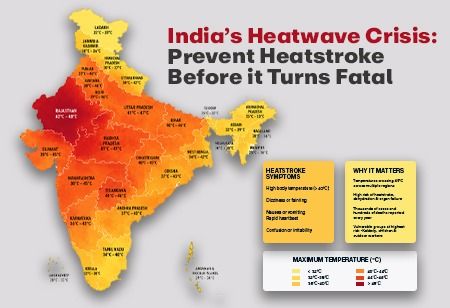
India enters into another intense summer cycle; if compared to earlier times, this can be considered the most brutal summer. Now, heatwaves are no longer seasonal disruptions; they are emerging as a public health emergency.
Let’s look at the numbers with temperatures consistently crossing 45°C across multiple regions. India is witnessing a sharp rise in heat-related illnesses and fatalities.
This heatwave crisis is particularly alarming because the official numbers only tell part of the story. While recent reports indicate thousands of heatstroke cases and hundreds of deaths annually, experts suggest that actual mortality could be 10–20 times higher due to underreporting and misclassification of causes.
At a macro level, the scale is even more concerning. A recent study estimates that a single day of extreme heat in India can trigger around 3,400 excess deaths, while a prolonged five-day heatwave could result in nearly 30,000 excess deaths nationwide.
Also Read: Safety at Stake: Lessons from the Pharma Factory Blast in Telangana
Heatwaves are often referred to as the “silent killer” because fatalities are rarely direct. Extreme heat exacerbates underlying conditions such as cardiovascular diseases, respiratory disorders, and kidney failure, making it difficult to attribute deaths solely to heatstroke.
In India, this challenge is compounded by fragmented data systems. Multiple agencies report varying figures, and a lack of standardized tracking leads to significant underestimation of the true impact. As a result, heat-related deaths often remain invisible in national health narratives.
Recent regional reports highlight the severity of the situation:
These are not isolated incidents—they reflect a pattern of intensifying and prolonged heat events across the country.
Several structural and environmental factors are converging:
Importantly, heatstroke occurs when body temperature exceeds 40°C, leading to neurological dysfunction and potential multi-organ failure if untreated.
Unlike other health crises, heatwave-related deaths are largely preventable with timely intervention:
Despite rising fatalities, heatwaves are still not uniformly treated as a national disaster in India. This limits compensation frameworks, preparedness planning, and public health prioritization.
As climate patterns continue to shift, the real risk is not just rising temperatures—but the country’s readiness to respond. Heatwaves are no longer episodic events; they are systemic risks that intersect with healthcare, infrastructure, and economic productivity.
Also Read: How India-US Cooperation Is Reshaping Biotech and Healthcare
At the state and national level, the intent is visible—but the execution often falls short of the scale required.
India has taken important first steps:
But here’s where the gap widens:
In simple terms, governments are planning for heat, but not yet designing systems to live with it.
India’s healthcare system is stepping up as the first line of defense against extreme heat—but let’s be clear, it’s still catching up with the scale of the crisis.
The reality check: The system is still more reactive than ready. Rural centers lack infrastructure, heat illnesses are underreported, and preventive care hasn’t fully caught up. In a crisis that builds silently, healthcare cannot just respond—it has to get ahead of the heat.
India’s heatwave crisis is not just about rising temperatures—it is about rising vulnerability. With mortality significantly undercounted and climate patterns intensifying, heatstroke is rapidly turning from a preventable condition into a fatal outcome.
The warning signs are already here. The question is whether response systems can evolve fast enough.
.jpg)


