Fathimanoud, Correspondent, India Pharma Outlook
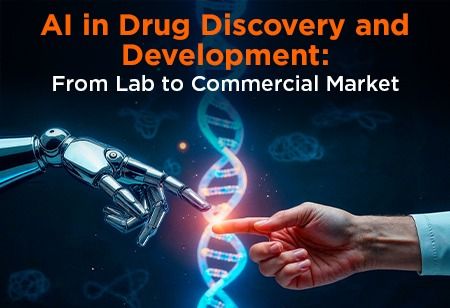
Artificial intelligence (AI) is transforming every stage of the pharmaceutical value chain, from identifying disease targets to optimizing clinical trials and commercializing innovative therapies.
Traditional drug discovery has long relied on labour-intensive trial-and-error methods, where researchers screened thousands of compounds over a decade or more to identify a single viable drug candidate. This lengthy process contributes to development costs exceeding USD 2.6 billion per approved drug, with high failure rates during preclinical and clinical testing.
Today, AI drug discovery is reshaping this model by combining machine learning, deep learning, predictive analytics, and generative AI to accelerate decision-making while improving precision.
Instead of relying solely on laboratory experiments, researchers can analyze enormous genomic, proteomic, and chemical datasets to predict promising drug candidates before physical testing begins. AI-powered simulations further forecast toxicity, efficacy, dosing requirements, and potential adverse reactions, significantly reducing costly late-stage failures.
According to McKinsey, generative AI could generate USD 60–110 billion annually in economic value for the pharmaceutical and medical products industries. Industry estimates also suggest AI could contribute more than USD 35 billion in value specifically to drug discovery pipelines by accelerating research and improving success rates.
Beyond molecule discovery, artificial intelligence in drug discovery and development plays a critical role in preclinical validation, ADMET prediction, clinical trial optimization, and regulatory decision-making.
Platforms combining AI with advanced biological models, such as stem-cell-based toxicity testing and protein structure prediction, are reducing reliance on animal studies while improving human relevance.
As pharmaceutical companies increasingly adopt AI across the development lifecycle, the technology is becoming an essential tool for delivering safer, more effective medicines to patients faster and more efficiently.
Artificial intelligence in drug discovery and development has evolved from simple computational analysis into sophisticated platforms capable of transforming pharmaceutical research.
Traditional drug development typically requires 10–15 years, whereas AI significantly accelerates target discovery, molecule screening, and candidate selection. Advanced platforms such as PandaOmics rapidly analyse biological datasets, reducing development costs while improving research efficiency.
AI is expected to add nearly USD 35 billion to drug discovery pipelines through improved productivity. Insilico Medicine's AI-developed Rentoertib demonstrates this transformation, progressing through clinical trials as one of the first fully AI-native therapeutic candidates and validating AI-driven pharmaceutical innovation.
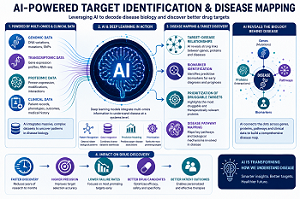 AI-powered target identification enables researchers to analyse massive genomic, transcriptomic, proteomic, and clinical datasets simultaneously to uncover disease mechanisms that traditional methods often overlook.
Deep learning algorithms integrate multi-omics information to establish target-disease relationships, identify predictive biomarkers, and prioritize druggable proteins with greater confidence.
Advanced protein prediction models developed by DeepMind, alongside sequence-based machine learning frameworks, reveal complex protein structures, cryptic binding pockets, and allosteric sites suitable for therapeutic intervention.
DeepMind’s advanced AI models aim to streamline the identification of promising drug candidates, enhance precision, optimize molecular design, and reduce the high failure rates that have historically plagued pharmaceutical development.
“AI could dramatically reduce drug discovery timelines, potentially cutting years of labor-intensive research down to mere months” said Demis Hassabis, CEO of DeepMind
These technologies improve biological understanding, reduce false-positive targets, and enable pharmaceutical companies to focus resources on the most promising disease pathways for drug development.
Generative AI is redefining molecule design by creating entirely new chemical structures instead of merely predicting existing compounds. Through de novo drug design, advanced algorithms generate molecules atom-by-atom within target binding sites while optimizing binding affinity and synthetic feasibility.
Tools such as DynamicBind and LigGen automate candidate generation before laboratory synthesis, significantly reducing medicinal chemistry timelines. During lead optimization, AI refines molecular scaffolds by improving solubility, selectivity, metabolic stability, and toxicity profiles through automated structural modifications. Combined with virtual screening and biomolecular language models, these technologies dramatically accelerate early-stage pharmaceutical innovation and discovery.
In September 2026, Rasayan Labs partnered with the Institute of Chemical Technology (ICT), Mumbai, to launch an AI-native drug discovery platform. The platform integrates molecular design, AI-powered retro-synthesis (backed by over 13 million reactions and 126 million building blocks), ADMET prediction across more than 1,400 properties, impurity prediction, and a proprietary molecular editor.
The collaboration demonstrated a three-week design-to-candidate timeline for dual COX-2/mPGES-1 inhibitors, identifying 23 candidates of which 19 advanced to synthesis. This example highlights how AI can compress early discovery cycles while linking computational design with practical synthesizability an important step for strengthening original drug research capabilities in India’s pharma ecosystem.
Predicting absorption, distribution, metabolism, excretion, and toxicity remains essential before advancing drug candidates into laboratory studies. AI-driven ADMET prediction models virtually evaluate thousands of compounds, eliminating unsuitable candidates before synthesis.
Platforms such as ADMET Predictor apply machine learning scoring functions to estimate pharmacokinetic behaviour, toxicity endpoints, and optimal dosing strategies. Explainable AI techniques, including SHAP values, improve transparency by helping toxicologists interpret computational predictions and identify dataset biases.
Combined with organoids and three-dimensional cell culture systems, AI-supported virtual screening Faritenables smarter compound prioritization, reduces animal testing, and minimizes costly downstream clinical failures.
Artificial intelligence is transforming clinical trial optimization by improving patient recruitment, protocol development, and trial monitoring. Natural language processing (NLP) extracts valuable insights from unstructured electronic health records, enabling researchers to identify eligible participants with greater accuracy.
AI also supports site selection, predicts patient dropout risks, and uses synthetic control arms to reduce recruitment burdens. Advanced predictive models simulate disease progression, treatment responses, and dosing strategies before trials begin, allowing sponsors to refine inclusion criteria and study endpoints. These capabilities reduce operational costs, accelerate recruitment, improve patient safety, and enhance the likelihood of successful regulatory outcomes.
Artificial intelligence extends beyond molecule discovery by optimizing drug formulation and delivery systems for commercial success. Machine learning models evaluate drug-excipient compatibility, predict formulation stability, and recommend optimal combinations that improve bioavailability and shelf life.
AI also supports the development of adaptive biomaterials, including hydrogel matrices and controlled-release formulations tailored to specific therapeutic needs. Predictive modelling minimizes formulation failures while accelerating technology transfer from laboratory research to manufacturing.
Additionally, AI-assisted formulation strategies strengthen intellectual property portfolios by identifying novel formulation approaches that support patent extensions and long-term commercial competitiveness.
As artificial intelligence becomes integral to pharmaceutical research, regulatory agencies are establishing frameworks to ensure transparency, reliability, and patient safety. The FDA and EMA have introduced guiding principles for good AI practice in drug development, while the EU AI Act outlines compliance expectations for high-risk healthcare applications.
Anjana T.K. and Dr. Kinjal Bipinkumar Gandhi, Researchers, Chemists College of Pharmaceutical Sciences and Research, in their research paper notes that “The regulatory landscape governing artificial intelligence (AI) in drug development and clinical trials is rapidly evolving, with the United States Food and Drug Administration (FDA) and European Union (EU) emerging as global leaders in establishing comprehensive frameworks. Both emphasizes risk-based credibility assessments, transparency in AI model functioning, and robust lifecycle management to ensure that AI applications in pharmaceutical development meet stringent standards for safety, efficacy, and quality.”
Regulatory submissions increasingly require explainable AI models, clear data lineage, human oversight, and defined contexts of use. A structured credibility assessment framework evaluates model performance, validation methods, risk management, and governance. These measures strengthen regulatory confidence while ensuring AI-driven decisions remain scientifically justified, ethical, and reproducible.
Agentic AI represents the next evolution of pharmaceutical research by enabling autonomous coordination across the Design-Make-Test-Analyze (DMTA) cycle. Unlike conventional AI systems that perform isolated tasks, multi-agent frameworks such as DrugAgent and AgentD coordinate literature mining, molecular design, laboratory planning, synthesis scheduling, experimental analysis, and decision-making.
Large language models function as intelligent orchestrators, communicating with laboratory instruments through standardized protocols such as the Model Context Protocol (MCP). These autonomous workflows reduce manual coordination, integrate multidisciplinary data, and shorten drug discovery timelines from years to months while supporting continuous scientific learning and optimization.
Artificial intelligence is fundamentally reshaping the pharmaceutical industry by addressing the longstanding challenges of traditional drug discovery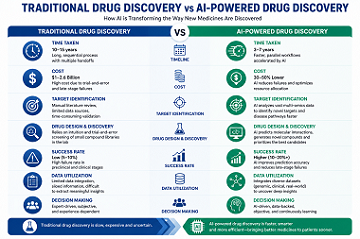 anddevelopment. Conventional research methods often require years of experimentation, extensive laboratory testing, and significant financial investment before a single drug reaches patients.
High failure rates, particularly during clinical development, have historically increased costs and delayed access to innovative therapies. AI changes this paradigm by enabling researchers to make faster, data-driven decisions throughout the drug development lifecycle.
From identifying novel therapeutic targets using multi-omics data to designing entirely new molecules through generative AI, the technology has significantly improved research efficiency. Advanced computational models predict ADMET properties, allowing scientists to eliminate unsuitable drug candidates before laboratory synthesis.
These capabilities reduce experimental burden, lower development costs, and improve the probability of clinical success. AI-powered preclinical platforms, including stem-cell-based toxicity testing and sophisticated simulation tools, are also reducing dependence on animal studies while providing more human-relevant safety assessments.
The impact of AI extends well beyond discovery. During clinical development, intelligent algorithms streamline patient recruitment, optimize protocol design, and analyze real-world evidence from electronic health records.
Predictive simulations help sponsors refine dosing strategies, improve endpoint selection, and reduce patient attrition, ultimately accelerating trial completion. AI-assisted formulation further bridges the gap between laboratory innovation and commercial manufacturing by enhancing stability, drug delivery, and intellectual property opportunities.
At the same time, responsible AI adoption requires robust governance. Regulatory agencies are emphasizing transparency, explainability, human oversight, and validated data to ensure AI-generated insights remain scientifically credible and ethically sound. As regulatory frameworks continue to evolve, collaboration between technology developers, pharmaceutical companies, and healthcare authorities will be essential for building trust in AI-driven medicines.
Looking ahead, the emergence of agentic AI and autonomous DMTA workflows signals a new era of pharmaceutical innovation. By integrating intelligent software agents with laboratory automation, researchers can coordinate complex scientific processes with unprecedented speed and precision.
Rather than replacing scientists, AI serves as a powerful decision-support system that enhances human expertise, accelerates innovation, and improves resource utilization. As pharmaceutical companies continue investing in AI drug discovery, artificial intelligence in drug discovery and development will increasingly become a strategic necessity rather than a competitive advantage.
From early-stage molecule design to clinical trial optimization and commercialization, AI is building a faster, smarter, and more efficient pathway for delivering life-changing medicines to patients worldwide.
LAST UPDATED ON: 25-09-2026
.jpg)


, CDSCO.jpg "Fostering a Quality Culture in the Pharmaceutical Industry")