
Zeenat Parween, Correspondent, India Pharma Outlook
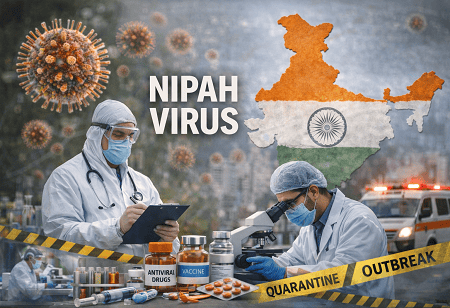
The new wave of Nipah virus in India has once again placed the pharma industry in the limelight and why their involvement is more important than ever. In West Bengal, authorities confirmed two Nipah cases since December 2025, with extensive contact tracing and testing to contain spread. The government says 196 people linked to those cases were monitored, and none tested positive so far.
This comes as a stark reminder of how quickly outbreaks can shock local health systems — and how limited treatment options make a strong pharma response critical.
Early this year, two healthcare workers in West Bengal tested positive while treating patients. They were isolated quickly, and authorities traced nearly 200 contacts. This swift public health action kept the situation from spiraling, but it also highlighted that treatment choices were largely supportive because no targeted drug exists.
In Kerala, the picture has been different but equally telling. There was an outbreak in 2025 in districts including Malappuram and Palakkad which saw several confirmed Nipah cases, including at least one fatality. Health teams traced hundreds of contacts and put surveillance measures in place. These waves of infection, occurring in both states over time, show that Nipah is not one-off but a recurring public health challenge in India.
Both outbreaks show strong surveillance systems and quick containment work. But they also expose a gap: health workers have little more than supportive care to offer patients once infected.
“Nipah has a very high fatality rate if untreated… monoclonal antibodies have the potential to neutralize the infection and improve outcomes.” — Dr. Soumya Swaminathan, former DG of ICMR and ex-WHO Chief Scientist.
Professor Dr. Narendra Kumar Arora, President of AIIMS Bilaspur: “Nipah virus is highly infectious and fatal… these sporadic outbreaks have occurred in both Kerala and West Bengal.”
Also Read: India's Rare Disease Shift Driven by PRIP and PLI Policies
There are certain ways in which Indian pharma has stepped up. Companies have been stocking broad-spectrum antivirals that may be useful in symptoms. Most companies increase the manufacture of PPE, sterile saline, secondary infection antibiotics, and diagnostic reagents quickly during outbreaks. Others collaborate with research institutes to share compounds for early research stages.
Yet when it comes to Nipah-specific treatments or vaccines, the response is limited. The virus is irregular and occurs in small number, as a result, long development timeframes and projected minimal earnings suggest that most firms have not put significant resources in specific drugs. Very few have moved past early research or laboratory studies into advanced clinical testing for Nipah. This leaves doctors dependent on supportive care rather than targeted solutions.
Dr. Sanjay Singh, CEO of Gennova Biopharmaceuticals: “By harnessing the cutting-edge capabilities of our saRNA platform, we are committed to developing a revolutionary next-generation vaccine. This partnership… ensures equitable access and strengthens global health security.”
There are several ways India’s pharma sector could change the game:
1. Shared Risk Funding: Governments could offer co-funding or advance procurement commitments. If companies know there is financial backing, they are more likely to invest in drug development for rare threats like Nipah.
2. Fast-Track Approval Channels: Regulators could set up trustable, well-defined emergency pathways for outbreak drugs. If a company has a promising candidate, knowing how quickly it can reach patients encourages earlier action.
3. Platform Technologies: Investing in broad antiviral platforms — tools that can adapt to multiple viruses — could shorten timelines dramatically. Instead of creating a Nipah drug from scratch, pharma could tweak existing frameworks when a case appears.
4. Local Trial Networks: Building clinical trial infrastructures ready to start as soon as an outbreak is identified would eliminate months of delay. India has strong medical research institutions; linking them with industry would boost readiness.
Also Read: Quality Gaps in India's Pharma Industry: Cough Syrup Case Study
There are early signs of progress beyond big pharma labs. Indian research teams have worked on rapid test kits that can detect Nipah outside main labs. These tests are being deployed in high-risk areas, shortening detection time and helping clinical decisions.
Smaller biotech firms are also interested in virus research platforms that could be repurposed fast. But without big company involvement or predictable funding, such efforts struggle to scale.
Policy makers hold powerful levers. If outbreak preparedness becomes part of national health planning — with funding, tax benefits, and clear safety standards — pharma companies will see long-term value in preparedness. Incentives should not only reward profits but also public benefit.
When rules are predictable, companies can plan ahead. Vague or reactive regulation makes them wait until an outbreak peaks before acting. That waiting costs lives.
India already has strong public health teams and surveillance systems that often contain outbreaks quickly. The next step is to give doctors more to work with — drugs that reduce severity, vaccines that prevent spread, and diagnostics that guide early treatment.
The future isn’t about stopping Nipah forever. It’s about shrinking the gap between first case and first effective treatment. With better pharma engagement, outbreaks could be shorter, less deadly, and less disruptive.
Techniques used for other viruses — like adaptive trial designs, platform antivirals, and joint public-private ventures — can soon become routine. If pharma steps up, supported by smart policy, India could turn recurring outbreaks into manageable events. That’s a future worth working for.
1. Is there any approved medicine or vaccine for Nipah in India? No. There is still no approved drug or vaccine for Nipah in India. Doctors mainly treat symptoms and try to support the patient’s body while it fights the virus.
2. Why haven’t pharma companies made a Nipah-specific treatment yet? Nipah cases are few and spread out over time. For many companies, this makes long-term research risky, since there is no steady demand for such medicines.
3. What could help India handle Nipah better in the future? More government support, faster approvals during outbreaks, and early research funding could help. If companies prepare in advance, responses can be quicker and safer.
.jpg)




, CDSCO.jpg "Fostering a Quality Culture in the Pharmaceutical Industry")