
Zeenat Parween, Correspondent, India Pharma Outlook
How Funding is Changing in 2026
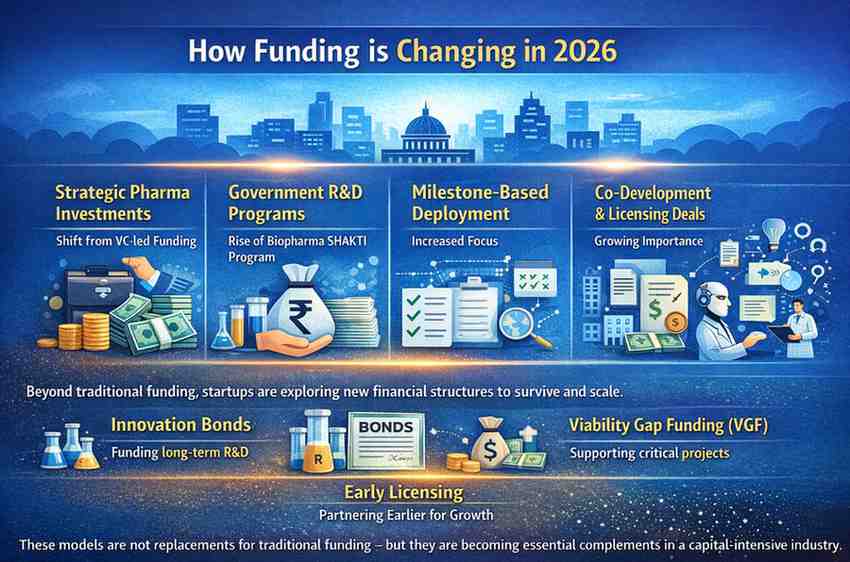
Beyond traditional funding, startups are exploring new financial structures to survive and scale. Instruments like Innovation Bonds are gaining attention as a way to fund long-term R&D while distributing risk. Similarly, Viability Gap Funding (VGF) is helping support projects that are critical for public health but not immediately profitable.
Early licensing is also becoming a strategic move. Instead of waiting for full commercialization, startups are partnering with larger companies earlier in the process. This provides capital, reduces risk, and accelerates market access.
These models are not replacements for traditional funding—but they are becoming essential complements in a capital-intensive industry.
While funding sets the direction, market realities determine survival.
One of the biggest operational challenges for Indian pharma startups is supply chain dependence. Despite being a global leader, India still relies heavily on imports for APIs and KSMs. The disruption in Penicillin-G production exposed how vulnerable this dependence can be.
Startups are now being forced to rethink their supply strategies. Backward integration, domestic sourcing, and supplier diversification are no longer optional—they are critical for resilience.
Pricing pressure is another major constraint. The National List of Essential Medicines (NLEM) caps prices on key drugs, directly impacting margins. For startups with high R&D costs, this creates a difficult balance between affordability and sustainability.
This has led to a shift toward niche therapeutic areas and export markets, where pricing flexibility is higher.
Another critical challenge is talent. India produces a large number of pharmacy graduates, but the industry is evolving faster than the education system. The rise of Pharma 4.0—which combines biology, data science, and automation—has created a significant skill gap.
Startups need professionals who understand AI-driven drug discovery, regulatory science, and advanced manufacturing systems. Finding this talent is difficult and training it takes time and resources.
Market entry is equally challenging. Established companies dominate distribution networks and enjoy deep brand trust. For a startup, breaking into this system requires not just a strong product, but also strategic partnerships and credible clinical data.
In many ways, execution in pharma is less about speed and more about precision.
Practical Strategies for Market Survival
Regulation in India is evolving rapidly, and for startups, it is both a challenge and an opportunity.
The Schedule M reset is one of the most important developments in 2026. By aligning Indian GMP standards with global benchmarks, it is raising the bar for quality and compliance. While this increases operational costs, it also opens doors to international markets.
At the same time, efforts toward a single-window clearance system, often described as “One Nation, One Regulator,” aim to simplify the approval process. Though still in progress, this initiative has the potential to significantly reduce compliance fatigue and accelerate time-to-market.
Intellectual property is another critical area. Startups working on New Chemical Entities (NCEs) must build strong IP strategies from the beginning. Without proper protection, even the most promising innovation can lose its competitive edge.
.jpg)
.jpg)
.jpg)


, CDSCO.jpg "Fostering a Quality Culture in the Pharmaceutical Industry")