
Zeenat Parween, Correspondent, India Pharma Outlook
For decades, India’s pharmaceutical strength was built on cost leadership. Affordable manufacturing, strong process chemistry, and scale allowed Indian companies to dominate the global generics market. But in 2026, cost advantage alone is no longer enough.
Global markets—especially the US and EU—are demanding more. Regulators expect higher compliance standards, faster data transparency, and stronger pharmacovigilance systems. Buyers are also shifting preferences toward companies that can demonstrate innovation, sustainability, and supply chain reliability.
For startups, this creates a dual challenge. They must compete not only with domestic generic giants but also with global biotech firms that operate at the cutting edge of science. Entering these markets requires a level of readiness that goes far beyond product development.
Startups must think globally from day one. This means aligning clinical strategies with international regulatory expectations, building export-ready manufacturing systems, and ensuring that intellectual property is protected across jurisdictions.
At the same time, geopolitical shifts and supply chain disruptions are creating new opportunities. Global companies are actively looking to diversify their sourcing beyond traditional hubs. India, with its scale and improving compliance standards, is well-positioned to benefit from this shift—provided startups can meet the required benchmarks.
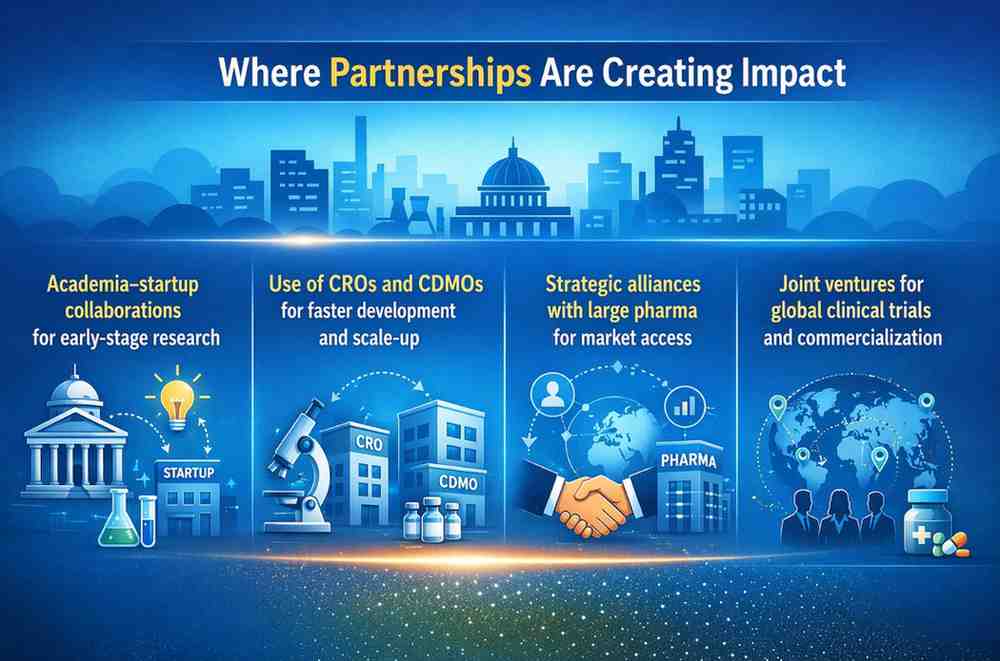
Another defining trend in 2026 is the shift from isolated innovation to collaborative ecosystems.
Pharma startups are no longer operating alone. They are increasingly partnering with:
This collaborative model helps startups overcome resource limitations. Instead of building everything in-house, they can leverage existing infrastructure, expertise, and networks.
For example, early-stage research can be accelerated through academic partnerships, while manufacturing scale-up can be handled by specialized CDMOs. Similarly, regulatory navigation becomes easier when working with experienced industry players.
These collaborations also play a critical role in de-risking innovation. By sharing costs and expertise, startups can focus on their core strength—scientific discovery—while relying on partners for execution support.
However, collaboration requires clarity. Startups must carefully structure agreements to protect their intellectual property and ensure long-term value creation.
The next ten years will be decisive for India’s pharma startup ecosystem.
The building blocks are already in place—policy support, scientific talent, manufacturing strength, and growing investor interest. But turning these advantages into global leadership will require consistency and coordination.
Startups will need to move with discipline. Investors will need to adapt to longer timelines. Policymakers will need to ensure that regulatory reforms translate into real ease of doing business.
Most importantly, the ecosystem must stay focused on innovation—not just as a buzzword, but as a sustained commitment.
As Satish Reddy, Chairman of Dr Reddy's Laboratories highlights, “The future of Indian pharma will be defined by our ability to innovate, collaborate, and compete globally.”
That future is within reach. But it will not be built overnight. It will be shaped by decisions made today—by startups willing to take risks, by capital willing to stay patient, and by a system willing to evolve.
India’s pharma startup ecosystem is no longer in its early phase. It is entering a stage where outcomes matter more than intent.
The transition from “Pharmacy of the World” to “Innovator for the World” will depend on how well startups navigate funding constraints, regulatory complexity, and market pressures—all while continuing to push the boundaries of science.
The opportunity is real, but so are the challenges.
As Kiran Mazumdar-Shaw emphasizes, “India has the science and the talent. What we need is sustained commitment to innovation.”
That commitment—across founders, investors, and policymakers—will determine whether India can truly lead the next wave of global pharmaceutical innovation.
1. What are the biggest challenges facing pharma startups in India in 2026?
Pharma startups in India face long R&D timelines, limited access to patient capital, regulatory complexity, pricing pressure from NLEM, and dependence on imported APIs. Talent gaps in Pharma 4.0 and strong competition from established players add to the challenge.
2. How is funding changing for Indian pharma startups?
Funding is shifting from venture capital to strategic pharma investments and government-backed programs like Biopharma SHAKTI. Startups are also exploring Innovation Bonds, Viability Gap Funding (VGF), and early licensing deals to support long-term growth.
3. What role does innovation play in the future of India’s pharma industry?
Innovation is central to growth, with startups focusing on NCEs, biologics, AI-driven drug discovery, and digital trials. Technologies like Digital Twins and Real-World Evidence (RWE) are helping reduce development time and improve global competitiveness.
.jpg)
.jpg)
.jpg)


, CDSCO.jpg "Fostering a Quality Culture in the Pharmaceutical Industry")