Indian Telemedicine Apps in 2026: Enhancing Rural Health Accessibity

Anna Elzabeth Tom, Correspondent, India Pharma Outlook

 Indian Telemedicine Apps in 2026, India Pharma Outlook

Telemedicine refers to the delivery of healthcare through digital technologies, bridging the gap between patients and healthcare providers. Indian Telemedicine sector first saw its boom during the pandemic era. Furthermore, in 2026, Indian Telemedicine has transformed from a pandemic-era temporary stopgap into the backbone of India’s rural health revolution.

India’s Telemedicine Revolution

At the core of Indian telemedicine revolution is eSanjeevani, India’s National Telemedicine Service, launched in November 2019. It mainly provides two types of services, eSanjeevani AB-HWC and eSanjeevaniOPD. The former operates on a hub and spoke model where Ayushman Bharat Health and Wellness Centres set up at the state level (hub) can connect with community health care officers and nurses at the zonal level (spoke), while the latter focuses on direct-to-patient consultation.

As per PIB reports, E-sanjeevani has crossed 43 crore consultations as of November 2025, as confirmed by the parliament. This makes it one of the largest public digital health initiatives in the world. About 57 percent of its beneficiaries are women, and 12 percent are senior citizens, the two demographically underserved categories of traditional healthcare services. E-sanjeevani has on boarded more than 230,000 medical care providers, a significant achievement for the government-led telehealth initiative.

The commercial Indian telemedicine sector has also seen significant growth in recent years.  According to the Modor Intelligence report, Indian telemedicine market is valued at approximately USD 3.64 billion in 2025. It expects to reach USD 12.36 billion by 2031, growing at a Compound Annual Growth Rate (CAGR) of around 23%. The mobile health sector holds the largest share at nearly 47 percent. 

This data shows us that the Indian telehealth apps of 2026 are no longer competing on novelty; they are competing for rural reach, reliability, and dedicated care. 

Prasad Kompalli, Co-founder and CEO of mFine stated that telemedicine is not just a market place connecting a doctor and a patient. He says, “This is an expert driven, quality driven and most importantly, on the consumer side trust driven network, you need to really make sure that particularly the consumer is able to trust the provider.”

How Indian Telemedicine Platforms Connect Rural Patients to Top Specialists

India has a major healthcare paradox. According to National Family Health Survey data for 2019-21, nearly 65 percent of the Indian population lives in rural areas, and the majority of healthcare specialists remain concentrated in the cities. This means that for a patient in remote areas, needing a specialist has to travel very long to the cities for care. This usually meant delayed care or no care at all.

As of late 2025, India's overall doctor-population ratio is 1:811. Indian Telemedicine is dismantling these divides, not through a single solution, but through a system of interconnected mechanisms.

The Hub-and-Spoke Model

At the heart of India’s telemedicine architecture, we have the hub and spoke model. Zonal-level Rural Health and Wellness Centers serve as spokes while district-level hospitals and medical colleges function as hubs. Under the eSanjeevani AB-HWC model, the health workers in the rural areas don’t refer the patient to the nearest city hospital. Instead, they connect to the platform from the local health center and connect with a specialist in a district hospital through a video consultation. This is the hub-and-spoke model in practice.

This system works on two levels simultaneously. The first level connects the rural doctor to seek specialist guidance if he is uncertain about a complex diagnosis, before deciding on treatments or referrals. In the second level, it brings the patient directly into a video consultation with the specialist. This makes it flexible to handle everything from routine chronic care to complex referral decisions.

AI Diagnostics: The Silent Game-Changer

AI diagnostics refers to the use of Artificial Intelligence algorithms, particularly machine learning and deep learning, for diagnosing complex data. It analyses complex medical data, including imaging, lab results, and electronic health records, to detect diseases and health risks, allowing doctors to make more accurate diagnoses.

The most transformative part of AI diagnostics is that some platforms, like Bangalore-based telehealth app mFine, are using AI diagnostics tools. These tools analyses symptoms, medical images, and medical history, building an electronic health record of the patient. So, by the time the rural patient reaches the doctor, the doctor would have the AI-analysed data. This helps them to decide on potential treatments by giving them a comprehensive view of the risk factors and symptoms.

Survankar Datta, Faculty fellow, Asohka University, comments on AI diagnostics as, “The biggest benefit of AI currently is in the drafting of preliminary reports… Instead of starting from scratch, we begin with a preliminary report, review the scan, and make changes. That’s been the biggest timesaver so far.”

Remote Patient Monitoring

Remote Patient Monitoring (RPM) uses digital technology such as wearables and apps to collect and record vital physiological data like blood pressure, heart rate, etc. This technology can also help in sharing these critical details with medical practitioners, thus lowering costs by reducing hospital visits.

Grand View Research reports that the global RPM market was estimated at USD 22.03 billion in 2024. It has an expected projection of USD 110.71 billion by 2033, growing with a CAGR of 19.8 percent. In 2024, North America was the largest RPM market, with Asia Pacific the fastest-growing market. Meanwhile, Market Research Future analysis estimated the Indian RPM market size at USD 1083.5 million in 2024.

In this digital era, every consultation, prescription, and diagnostic report is linked to patients' ABHA Digital Health ID. Lab results, radiology images, pathology reports, and other diagnostics are digitally indexed against the patient’s ABHA ID. This enables a specialist reviewing a case to have access to the complete medical history. Patients and doctors can share these records, eliminating the need to repeat the tests. This reduces both patient costs and burden on the diagnostic infrastructure; meanwhile, while ensuring that decisions are made on complete and accurate data.

Scaling Indian Telemedicine: The Barriers No One Is Talking About

In spite of these advantages, the Indian telemedicine sector faces many barriers. This includes unreliable internet connectivity, low digital literacy, and a shortage of telemedicine specialists.

As per World Meter reports, India has an overall population of 1.47 billion as of May 2026. Reports show that as of January 2025, there are a total of 806 million internet users in India, making the internet penetration rate 55.3 percent. This is shocking as it shows that about half of the population lacks internet connectivity and hence telemedicine services.

India’s doctor population ratio is 1:811, and this sounds impressive on paper as it surpasses WHO norms of 1:1000. But the reality is different; states like Goa, Karnataka, and Kerala have a doctor population ratio of 1:335, 1:483, and 1:492. On the other hand, states like Jharkhand, Mizoram, and Nagpur suffer with 1:4673, 1:8000, and 1:13,514. This shows an abundance of healthcare professionals in urban areas, while the rural PHCs suffer.

Though India has 13, 86,145 allopathic doctors registered with State Medical Councils and NMC (as of Nov 2025), not all of them are actively practicing. According to the Rural Health Statistics (RHS) 2021–22 analyses, India faces almost an 80 percent shortfall of specialist doctors at rural CHCs, with surgeons, physicians, gynecologists, and pediatricians. But with AI diagnostics evolving rapidly and video infrastructure becoming more accessible, India’s rural healthcare gap is narrowing.


IoT and Wearables: The Shift to Chronic Disease Management at Home

Medical Internet of Things, or Medical IoT, refers to a series of interconnected healthcare devices and sensors that collect and communicate patient health details. These devices don’t depend on clinic visits to capture data. They capture physiological metrics continuously and send them to medical teams to monitor, even without the patient leaving their homes.

Medical IoT includes a plethora of devices ranging from smart watches tracking cardiac health and cardiac rhythms to implantable sensors. Medical IoT covers a wide range of devices and software sharing the single purpose of eliminating delayed treatment.

India has seen a significant leap in the adoption of Medical IoT. As per Grandview Research reports, India’s medical IoT market has generated USD 5.6 billion in 2023 and is expected to reach USD 30.6 billion by 2030, growing at a CAGR of 27.4% between 2024 and 2030. Hardware, including wearables, home monitors, implantable sensors, and connected diagnostic tools, emerges as the largest revenue-generating segment.

 Ayanabh DebGupta, Co-Founder, Group President & Director at Medica Superspecialty Hospital, Kolkata, comments on Medical IoT as, “We have understood that we can use technology to transcend geographical barriers. We are now able to provide critical care from Kolkata to smaller towns and monitor the patients 24×7, delivering lifesaving treatments.”

Inside the Connected Care Ecosystem

There are four categories of Medical IoT, which include wearables, home monitors, connected medication tools, and implantable sensors.

  • Wearables – They monitor the user’s heart rate, activity levels, blood oxygen levels, and sleep patterns continuously.
  • Home monitors- It includes devices like portable ECG, continuous glucose monitors (CGM), which measure blood pressure, weight, glucose level, and blood function at regular intervals. This enables health care professionals to monitor chronic patients from afar.
  • Connected medication tools – It refers to systems that are designed to optimize medicine management. It includes devices like smart pill dispensers, which provide alerts, smart injectors and pens which track dose amount, and mobile health monitoring apps.
  • Implantable Sensors – These devices capture internal metrics like cardiac rhythm, temperature, pulmonary artery pressure, etc., from within the body.

EHR Integration and the Power of Context

When it comes to telehealth, just data isn’t enough. The real transformation occurs when that data can be integrated with the patient’s electronic health record or EHR. EHR allows wearable readings, implantable sensor outputs, and home monitor logs to be directly updated in the patient’s health record.

This provides the doctors with complete medical history, previous diagnoses, lab results, and specialists' notes, helping them to make better decisions. Moreover, EHR also powers AI diagnostics tools that help to identify subtle patterns across data points. This helps to catch early warning signs that humans could have missed. For patients dealing with diabetes, hypertension, or chronic heart disease, this shift to proactive care is transformative.
                               

Top Indian Telemedicine Apps to Watch in 2026: Features and Usability

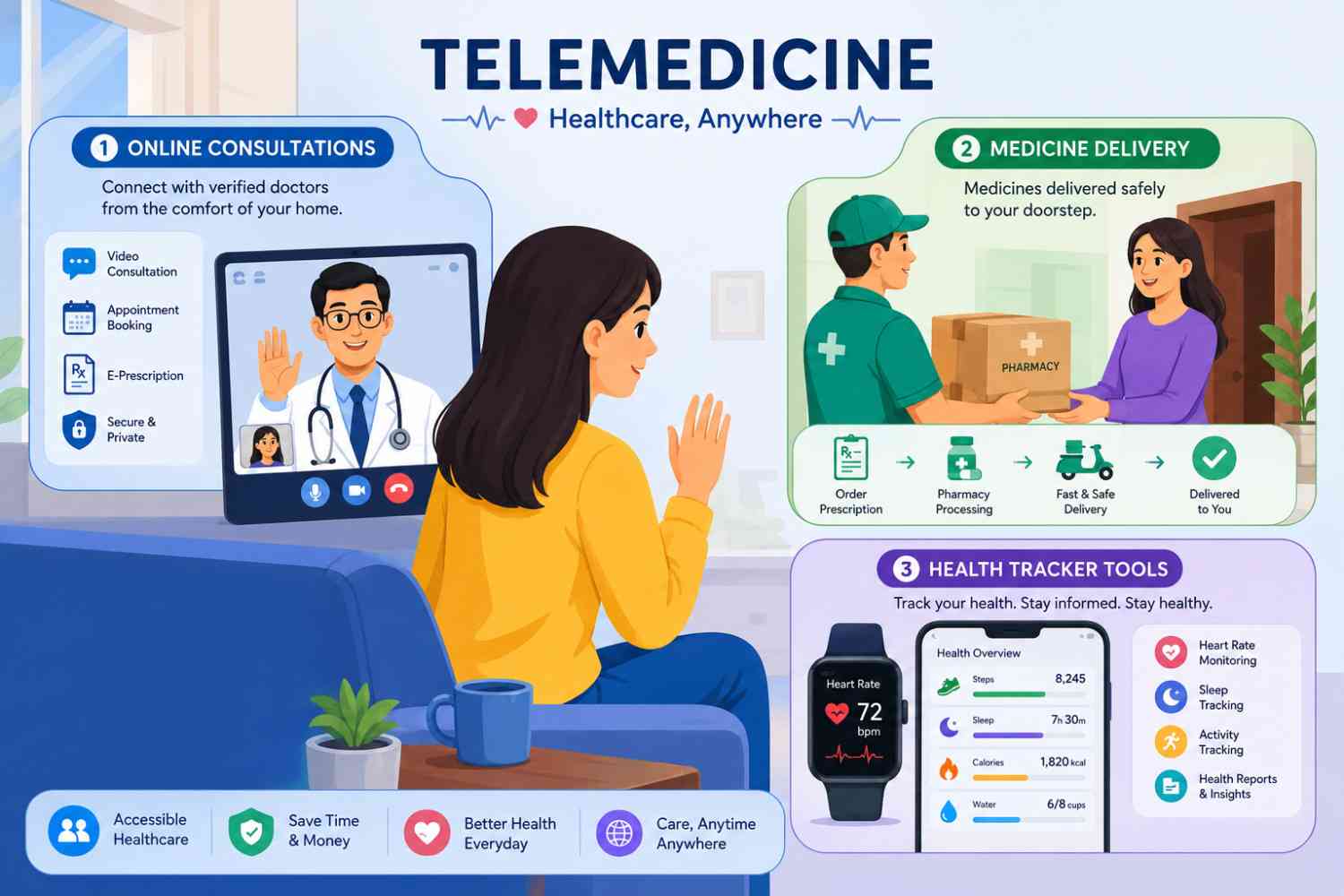
The Indian telemedicine revolution has come a long way in 2026. It has pivoted from a simple video consultation tool to a comprehensive digital ecosystem. Now, the Indian telemedicine market has evolved to integrate artificial intelligence, chronic disease management, pharmacy services, and real-time patient monitoring in a single app.

The major telemedicine apps in India are:

Practo

Practo is the most recognizable name in the telemedicine industry. Their key services include online consultations, appointment booking, medicine delivery, and diagnostic test bookings.  It operates in over 100 Indian cities and is popular for its doctor-on-demand consultation services. Practo has a rating of 4.7 on the App Store and 4.5 ratings on the Google Play Store.

Features:

  • It provides multilingual support across Hindi, Tamil, Telugu, and Kannada, and 15 plus Indian languages.
  • Personalized doctor searchers allow users to search doctors based on specialization, location, and reviews.
  • Provides articles, disease information, and health trackers to help users manage their health effectively.

Apollo 24/7

Apollo 24/7 is India’s largest omni-channel healthcare platform with 20 million users and 4.4+ star ratings. It brings the credibility of Apollo Hospitals to the telemedicine market. IT is an integrated ecosystem, catering to serve the patient in their every stage.

Features:

  • Provides direct access to 4,400+ Apollo-verified doctors across 55+ specialties.
  • 19-minute medicine delivery in metro cities like Delhi NCR, Hyderabad, Bengaluru, and Kolkata.
  • “Ask Apollo” AI symptom checker and a “Digital Vault” syncs your prescriptions, lab reports, and other data for seamless care.

Tata1mg

Tata1mg is the go-to app for people who need both consultation and medicine in one go. It is a joint venture between Tata Digital and 1mg Technologies Pvt. Ltd. Tata 1mg has a rating of 4.7 on the App Store and 4.6 ratings on the Google Play Store.

Features:

  • 2 lakh+ allopathic medicines are available at the best prices.
  • Medicine delivery to over 1000+ cities within the same day or the next day.  
  • 2,000 types of lab tests and health check-ups in partnership with 120+ top verified labs like Dr Lal Path Labs, SRL Diagnostics, Thyrocare, etc.  

MediBuddy

MediBuddy is a healthcare platform with a strong focus on the corporate wellness space. Additionally, it also provides corporate health solutions, helping companies to manage the health and well-being of their employees.

Features:

  • Free home test sample pick up in 2 hours
  • 60 minutes
  • medicine delivery
  • Online doctor consultations, medicine delivery, diagnostic tests, and cashless hospital admissions

Netmeds

Netmeds is a leading online pharmacy and healthcare platform in India. The platform was acquired by Reliance Retail, a subsidiary of Reliance Industries Limited (RIL), from its parent company Vitalic Health Pvt. Ltd., for approximately Rs 620 Cr in August 2020. Netmeds has a rating of 4.7 on the App Store and 4.3 ratings on the Google Play Store. 

Features:

  • Provides users with over-the-counter and prescribed medications.
  • Allows users to purchase medical devices, electronic, and wellness products all from the same platform.
  • Loyalty programs and referral benefits to incentivize repeat purchases and user engagement.  

 Mfine  

Mfine is a leading telemedicine platform connecting users with qualified health professionals for online consultations, diagnosis, and treatments. Users can prefer video, audio, and chat-based consultations based on their preferences. Mfine has 4.2 ratings on the App Store and 4.6 ratings on Google Play. 

Features:

  • Care programs, which provide a holistic care approach to manage long-term health issues like PCOD, diabetes, etc. Care programs provide personalized meal planning, wellness sessions, and regular consultations.
  • Online pharmacy with 24-48 hours delivery
  • Tools and trackers, like a BP monitor, where users can regularly check their vitals without needing another device.

eSanjeevani

eSanjeevani is the world’s largest government-led telemedicine platform. It was launched in November 2019 by the Ministry of Health and Family Welfare. eSanjeevani is integrated with Ayushman Bharat Digital Mission (ABDM), allowing citizens to create a 14-digit Ayushman Bharat Health Record (ABHA) ID. This ID links health records and allows access to free doctor consultations throughout India.

Union Health Secretary Smt. Punya Salila Srivastava, in the India AI Impact Summit 2026, stated that Ayushman Bharat Digital Mission (ABDM) has evolved to become a holistic telemedicine ecosystem with over 859 million ABHA accounts linked to more than 878 million health records, enabling over 449 million teleconsultations.

Features:

  • Allows users to create their Ayushman Bharat Health Account (ABHA) to link and manage their existing health records.
  • eSanjeevani OPD enables patients to consult with doctors from home via web/app.
  • eSanjeevani AB-HWC is a doctor-to-doctor system enabling doctors in rural areas to seek guidance from a specialist.
  • The service is free of cost.

India’s telemedicine landscape is growing rapidly in 2026. Together, the integration of AI diagnostics, IoT-enabled monitoring, and government-led platforms like eSanjeevani is bridging the barriers that once kept timely, quality healthcare out of reach for India's rural population.

 

on the deck

Most Viewed

Addressing Antimicrobial Resistance (AMR) Through Collaborative Efforts Fostering a Quality Culture in the Pharmaceutical Industry Advancements in Computer-Aided Drug Design for Pharmaceutical Research Why India is Gaining Popularity for Clinical Trials The Future of Kidney Transplants in India Usage of Conversational AI in the Health Insurance Sector Strategies for India to Reduce Its API Dependence on China Business Impact of USFDA Approvals on Indian Pharma Companies Innovative Strategies for Expanding Access to Life Saving Healthcare Solutions Badhal Village Crisis: How Rapid Diagnostics Could Have Saved Lives Why India is a Hotspot for Biotech Startups? Why Adapting Flexibility in IP Rights will Drive Generics Market Meeting the Challenges of High-Potency API (HPAPI) Production Impact of Human Factors Engineering on Medical Device Safety The Future of Pharma: Embracing Continuous Manufacturing The Role of Orphan Drugs in Treating Rare Diseases Emerging Technologies Shaping the Future of Drug Formulation Strategies for Optimizing Pharmaceutical Supply Chain Efficiency The Future of Medicine: Harnessing the Power of RNA-based Therapeutics AI in Medicine: Unmasking the Myths and Embracing the Transformative Reality Cycle Pharma Acquires Banner Life Sciences WHO's First-ever Global Summit on Traditional Medicine Starts in Gujarat The Importance of Data Integrity in Pharmaceutical Quality Control DCGI in Talks with Stakeholders to Develop a Standardised Web Platform to Assure Drug Quality and Patient Safety Glenmark Pharmaceuticals secures ANDA Nod for 0.03 per cent Tacrolimus Ointment Streamlining Laboratory Operations with a Modern LIMS Healthtech Start-up Suraksha QR Ropes In Actor Murali Sharma as its Brand Ambassador Unlocking the Potential of Pharmacogenomics: Enhancing Drug Safety and Efficacy The Impact of Pharmaceutical Testing on Drug Development India has Identified Three Health Priorities to Strengthen Global Health Infrastructure, says WHO National Health Authority launches 100 Microsites Project to Speed Up Digital Health Adoption India Should Partner with Australia to avail PBS for the Selection, Listing, and Pricing processes of exported drugs, says Sudarshan Jain Zydus Lifesciences India More than Doubles Profit Due to Increased Sales in the US India Triples Organ Donations over Past Decade says Union health minister Mansukh Mandaviya Advent Therapeutics Awarded $3 Million NIH Grant For Novel Neonatal Lung Therapy Three Pharma Marketing Strategies That Drive Sales Novartis Targets India's Rare Disease Market with 17 Clinical Programs UK Health Regulator approves GSK's Vaccine for the common respiratory virus RSV WHO Urges Increased Use Of Recommended Malaria-Fighting Tools Karnataka Budget Offered a Significant Boost to Health & Lifesciences Start-ups with Focus on Infrastructure & Innovation Three High Potential Moonshot Project Areas in Pharma CCI approves Bharat Biotech International-Eastman Exports deal How Biotech is Revolutionizing the Fight Against Cancer LifeCell and HaystackAnalytics ink strategic pact to scale-up TB whole genome sequencing pan-India Mankind Pharma IPO To Open On April 25 With A Price Fixed At Rs 1,026-1,080 Per Share US CDC Approves Second Omicron-Updated COVID Booster For Adults Three Trends that will Impact Pharmaceutical Industry in 2023 ModeX Therapeutics Commences Phase I EBV Vaccine Trial with Merck Designing Impactful Leadership and Talent Management Programs with Strategies for Success Novo Nordisk and Valo Health Partner to develop novel Treatments FOPE Calls for Extended Deadline for Schedule M Compliance Telix Pharma To Acquire ImaginAb to Boost Therapeutics and Innovation Roche Secures US FDA Approval for its Ultra-Sensitive ISH test Rappta Therapeutics and SpringWorks Partner on Molecular Glue Targeting PP2A Taro Pharma To Acquire entire stake in Antibe Therapeutics Innovent Biologics Secures Breakthrough Therapy Designation for IBI343 Emcure Pharma Launches Largest R&D Centre in Ahmedabad Zydus Bags USFDA Nod for Phase II(b) Trial to Optimize Usnoflast Dosage US FDA Approves Amgen's Lumakras-Vectibix Combo for KRAS G12C-Mutated mCRC Glenmark Pharma Unveils generic anticoagulant injectable emulsion Strides Pharma Bags USFDA Nod for OTC Acetaminophen-Ibuprofen Combo Tablets US FDA Lifts Hold on Sanofi's Trial to Make Cialis Available Over-the-Counter Hoth Therapeutics Expands Intellectual Property with New Patents Jaguar Health Starts POC Trial of Crofelemer for Rare Pediatric Disease MVID Pharma and Healthcare Sector Eyes Union Budget 2025 for Innovation Boost How Innovative Drug Formulations are Enhancing Treatment Outcomes Apollo and Mayapada Healthcare Unite to Boost Indonesia's Healthcare Novo Nordisk Reports Positive Phase 1b/2a Results for Amycretin Govt to Extend Schedule M Compliance Deadline for Drug Manufacturers to Dec Lupin Secures US FDA Nod for Ipratropium Bromide Nasal Solution ANDA Granules Pharmaceuticals Secures USFDA Nod for Key Generic Drug Bajaj Healthcare Bags DCGI Nod to Manufacture Pimavanserin API & Formulation Union Budget 2025: Healthcare Gets 9.78% Boost, Allocation Nears 1 Lakh Crore Metropolis & Roche Launch Self-Sampling HPV Test for Cervical Cancer Sigachi Industries Invests $1M in Hyderabad R&D Hub for API Innovation Pharma Testing Market Surges with Rising Demand for Biologics ISTH Releases Clinical Practice Guideline For Haemophilia Treatment Sanofi and Biovac Lead Polio Vaccine Manufacturing Capabilities Sun Pharma and Takeda Ink Pact To Market Gastrointestinal Drug Takeda and Ascentage Pharma Ink Option Agreement For Olverembatinib Enhancing Compliance through Effective Pharmaceutical Regulatory Affairs Strategies India poised to become a Global Hub for Clinical Trials: Exec SCHOTT Pharma Unveils Next-Gen Polymer Syringes for Enhanced Safety GSK's Jemperli Gains EU Nod for First-Line Treatment of Endometrial Cancer Union Health Secretary Urges Stronger Drug Regulations for Quality Control Telangana Govt Inks Landmark Deals to Propel Life Sciences and Job Growth R&D in Indian Pharma: Breakthroughs and Innovations in 2024 Dr. Reddy's Partners with Shanghai Henlius to Develop Cancer Drug Uniphar Expands Global Footprint with Three New Facilities 74th Indian Pharmaceutical Congress 2025 Opens Registrations AGC Pharma Expands HPAPI Capabilities in Barcelona to Meet Growing Demand The Future of Genomic Sequencing: Trends That Will Define the Next Decade Lexaria Bioscience Ethics Review Board Nod to Commence New GLP-1 Study Amitabh Kant Urges India to Focus on Innovation at BioAsia 2025 Government Enhances Research & Integration Initiatives in Unani Medicine Blind & Deaf individuals face Major Barriers to access Medicines: Report C-CAMP and PariSante Campus launched Indo-French Life Sciences Hub Jaguar Health Begins Pediatric Trial for Crofelemer in Short Bowel Syndrome Algiax Pharma Reports Promising Phase 2a Results for AP-325 Govt Bans 34 Antimicrobials for Use in Animals Pharmaceutical Procurement Strategies: How to Optimize Costs Personalized Medicine: Get Tailored Treatment Plans for You Now How to Bridge the Healthcare Gap in Emerging Markets with MedTech The Evolution of In-Vitro Diagnostics: Trends and Future Prospects Needle-Free Injection System: A Game Changer in Less Pain Vaccination How Global Capability Centers are Shaping the Future of Biometrics Building a Successful Pharma Brand in India: The Role of Scientific Communication Unlocking India's Innovation Potential in Pharma The Future of Green Chemistry in API Production Top 10 Pharmaceutical Recruitment Consultants - 2024 | Pharma Outlook Blockchain for Secure Pharmaceutical Supply Chains - 2025 & Beyond Mass Spectrometry in Biomarker Discovery for Early Disease Detection Iconovo and Lonza Team up to Advance Intranasal Biologic with ICOone Nasal Fetal Imaging to Cardiac Diagnosis: The Expanding Role of Ultrasound Balancing Innovation and Affordability in Medical Solutions for India Changing Landscape for LTBI and Syndromic Testing Methodologies How Advanced Training Methods can Enhance Patient Care Balancing Cost Efficiency and Compliance in Pharmaceutical Manufacturing LUB Urges Govt to Scrap Mandatory Lab Testing for Cough Syrup Exports Role of Optical Imaging in Early Cancer Detection and Treatment Hoth Therapeutics Unveils Promising Data for KIT-Targeting Therapy Pharmexcil Engages ASEAN Nations to Boost Pharma Trade Ties Fortis Partners with Teleflex for South Asia UroLift Training Anti-Infectives: How New Research is Shaping Infection Control Building Bridges for Sustainable Growth through Strategic Alliances in Ethical Pharmaceuticals Quality as the Cornerstone of Lab Solutions FDA Approves Roch's NSCLC Diagnostic Linked to Emrelis How Early Detection is Transforming Cancer Treatment in India Ensuring Data Privacy in Pharma World Enhancing Clinical Trial Supply Chain Resilience to Address Global Disruptions in India Cost-Effectiveness of Minimally Invasive Surgery in Outpatient Settings How Organic Synthesis is Accelerating Drug Discovery in Pharma Strategic finance for pharmaceutical innovation and stability Top 10 Teleradiology Service Providers - 2024 | Pharma Outlook Importance of Investing in R&D and Quality for Competitive Advantage in Eye Care Top 10 In Vitro Diagnostics Companies - 2024 | Pharma Outlook Phytopharmaceuticals: Driving Global Herbal Medicine Innovation Gender Gap in Healthcare: Why Women's Health Needs More Research Impact of Modern Technology on the Indian Life Sciences Sector Why Global Pharma Expects CDMOs to Be Ready for Joint Inspections The Role of Customizable Stent Grafts for Treating Complex Anatomies Nutraceuticals vs Pharmaceuticals: Complementary or Alternative in Chronic Disease Management? Top 10 Pharma CDMO Companies In India – 2023 | Pharma Outlook Leaping Towards Global Compliance with Revised Schedule M Meril Concludes TechVentory, Boosts AI-Driven Healthcare Supply Chains 10 Pharma Sector Revolutions in India Standardizing Medicine Labeling and Embracing Digital Transformation Creating a patient-centric healthcare ecosystem for all Biomanufacturing of Enzymes: A Sustainable Approach to Industrial Biotechnology Integrating CSR into HR Practices to Enhance Brand Reputation in Pharma Merck Launches Phase 3 Trial for Promising Dengue Vaccine V181 Breakthrough: Eye-Opening Healthcare Strategies Doctors Swear By on Doctor's Day 2025 Bristol Myers Squibb Reports Strong Phase 3 Results for Deucravacitinib trail Alcon Launches Innovative Daily Lenses Designed for Long-lasting Comfort Apisolex Excipient by Lubrizol Backs Phase I Drug Success FDA Approves Enflonsia to Prevent RSV in Infants with One Dose Biosimilars in India 2025 Market Trends, Growth Forecast & Opportunities How Regulations Are Shaping India's Medical Device Landscape Bharat Biotech Partners with GSK for Shigella Vaccine Development Eli Lilly Obesity Drug Shows 11.5% Weight Loss in 12 Weeks Laborate Pharmaceuticals: Illuminating Pathways Of Quality, Affordability Innovation In Healthcare Sun Pharma Bags CDSCO Approval to Produce Fexuprazan Hydrochloride Tablets The Fusion of Biology, Medicine, Health, and AI Glenmark Gets DCGI Nod to Launch Oncology Drug BRUKINSA in India Kyndryl Partners with Dr Reddys to Automate Global IT Operations How Robotic Assisted Surgery Is Redefining Precision in Kidney Transplants Top 10 Women Disruptors in Asia Pharmaceutical Industry

Editor's Guest

Related Articles


© 2026 India Pharma Outlook. All Rights Reserved.