
Availability is the single largest challenge in radiopharmaceuticals, and ensuring consistent delivery has been central to our mission
Pillai Ambikalmajan M R, Group Director

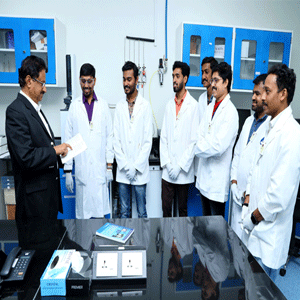
The radiopharmaceutical and cyclotron business in India and at the global front is facing a major challenge that hovers around the supply and delivery of crucial isotopes in a timely manner. Since a large number of diagnostic isotopes, including F-18 FDG in PET scans, have very short half-lives, the constant supply of these products to hospitals and diagnostic facilities is a significant logistical challenge. Then there are the regulatory burdens, high cost and the fact that trained staff are required to operate such advanced technologies are really cumbersome. The inevitable consequence is that there is a possibility that patients may not have access to advanced diagnostics. This is especially true for targeted therapies in non-metro areas.
Molecular Cyclotrons, under the leadership of Dr Ajith Joy, focuses on mitigating these challenges in a multi-pronged fashion. The company has EU-GMP standard facilities, which can manufacture several diagnostic and therapeutic radiopharmaceuticals, and delivery to the doorstep of the hospital. With a combination of the latest cyclotron technology, centralized radiopharmacy and innovative logistics, the company has improved access, affordability, and clinical use of radiopharmaceuticals in India.
Pioneering Radiopharmaceutical Services in India
Molecular Group have become one of the prominent players in the radiopharmaceutical sector in India where it fills the glaring gaps in the field of diagnostic as well as therapeutic nuclear medicine. Furthermore, the company provides an end-to-end package of services to enhance accessibility, efficiency and affordability to hospitals and oncology centers. It caters the production and supply of F-18 fluorodeoxyglucose (FDG) and more than 10 other F-18 radiopharmaceutical to conduct positron emission tomography (PET) scans, which is vital in detecting cancers at an early and accurate stage. The company is also involved in N-13 ammonia isotopes production to carry out cardiac assessments, indicating that it is not limited to cancer treatment.
Furthermore, acknowledging the difficulties in the short half-life of PET isotopes, such as F-18 FDG, which decays every 110 minutes, Molecular Cyclotrons has created a strong infrastructure of timely delivery of the isotopes at the hospital doors. “Availability is the single largest challenge in radiopharmaceuticals, and ensuring consistent delivery has been central to our mission,” explains Dr Ajith Joy, Managing Director. The company’s strategic use of road-based logistics within Kerala has enhanced reliability and minimized delays that previously affected patient care.
Availability is the single largest challenge in radiopharmaceuticals, and ensuring consistent delivery has been central to our mission Pillai Ambikalmajan M R, Group Director
If we look at the treatment sphere, the company offers ready to use Iodine-131 and Lutetium-177 which previously had to be imported in small quantities from abroad. The centralized production and supply allow the company to save money, ease the transportation logistics, and assist hospitals in unbroken therapy schedules. In addition to these services, it has its own production of freeze dried kits that provide the necessary compounds in SPECT imaging and other nuclear medicine procedures.
One of the pillars of the company is its R&D prowess. The company engages in active collaboration with hospitals and research institutes in the development of new tracers, peptide-based therapies including PSMA for prostate cancer, new radiopharmaceuticals to image neurological, cardiac, and infectious diseases. Such a combination of R&D guarantees that the latest radiopharmaceutical technologies can be transformed into clinical applications in India much faster than the usual international adoption.
By integrating its diagnostics, therapeutics, centralized radiopharmacy, and research, Molecular Cyclotrons has established itself as a reliable collaborator to medical establishments. Its quality and EU GMP standards combined with patient-centric delivery make it possible to have advanced solutions of nuclear medicine that are both accessible and sustainable in India.
Expanding Horizons in Patient Care
Molecular Cyclotrons is a key player in the Indian market, solving the age-old problem of diagnostics and therapy-related isotopes. with the group being headed by specialists, such as Dr M.R.A. Pillai with BARC, BRIT and IAEA experience, Molecular Cyclotrons created EU-GMP-certified facilities to guarantee quality supply and standards. The engineering support for the projects are given by K.N.S. Nair, a former Outstanding Scientist of BARC. The company has grown fast since its establishment in 2018, with a footprint to supply various radiopharmaceuticals to more than 20 oncology centers in Kerala. The second cyclotron project is planned to be commissioned in Palakkad by 2027 to meet the growing needs of the southern Indian region.
The company looks forward to a future of multi-tracer molecular imaging, AI-assisted reporting and developing to neurological, cardiac, and infectious disease diagnostics. Through integrating the latest cyclotron technology, research partnerships, education, and efficient supply chains, the company will close the divide between the global novelties and the Indian clinical practice. Their roadmap focuses on precision diagnostics, targeted therapeutics and sustainable access, making Molecular Cyclotrons a game changing initiative in the nuclear medicine industry in India.


, CDSCO.jpg "Fostering a Quality Culture in the Pharmaceutical Industry")