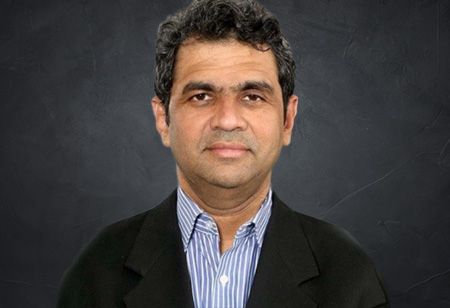
Akshansh Chaudhary
Director & Chief Technology Officer
The injectable pharmaceutical industry is navigating one of its most demanding phases in decades. Regulatory expectations have intensified with evolving frameworks such as Schedule M, EU GMP, and global compliance standards requiring continuous infrastructure upgrades and real-time adherence.
Somewhere in a sterile filling suite in Baddi, Himachal Pradesh, a robotic arm moves with the kind of precision that human hands simply cannot match. No margin for error. No room for compromise. Just the quiet, mechanical certainty of a system engineered to keep contamination at zero. Inside the vial: a critical care injectable bound for hospitals across four continents.
In a pharmaceutical landscape crowded with volume players and fast followers, Venus has chosen a fundamentally different path - one grounded in research, built on compliance, and guided by a vision that looks well beyond the next quarter. The company’s presence across 100 countries and a portfolio of over 1,000 international marketing approvals did not happen by accident.
They are the product of more than three decades of deliberate choices, hard-won science, and an institutional belief that the world deserves better medicines.
Science First Always
Venus Remedies operates across the full spectrum of sterile injectable manufacturing - antibiotics, oncology therapies, critical care formulations, pre-filled syringes, and both small and large volume parenterals.
Its manufacturing facilities deploy isolator-based and robotic filling systems that minimise human intervention, delivering the highest levels of sterility assurance and particle control. Compliance is not a milestone here; it is a rhythm. All production runs in real time against Schedule M, EU GMP, UK MHRA, PIC/S, and WHO requirements.
What distinguishes Venus from conventional manufacturers, however, is what happens before a single vial is filled. At the heart of the company is the Venus Medicine Research Centre (VMRC) - a GLP-accredited, DSIR-recognised R&D engine that drives both generic and differentiated product development.
Equipped with Organ-on-a-Chip laboratories, LC-MS/MS analytical systems, and Hollow Fibre infection models, VMRC does not merely replicate existing science - it advances it. The centre’s work spans formulation innovation, stability research across global climatic zones, and a long-standing focus on antimicrobial resistance that began in 2002, well before AMR became a recognised global health crisis.
Supply chain reliability completes the picture. The Venus Global Fulfillment Center (VGFC) functions as a centralized command for temperature-controlled, track-and-trace logistics. Every consignment - whether moving by sea, air, or land - is monitored for location, environmental conditions, and product integrity from dispatch to delivery. In regulated markets, this kind of supply chain intelligence is not a differentiator. It is a requirement.
Venus has made it a strength. “We believe that consistency is the only thing that earns trust in global healthcare - consistent quality, consistent supply, consistent science. Everything we build is designed around that principle,” says Akshansh Chaudhary, Director & Chief Technology Officer, Venus Remedies Limited.
We believe that consistency is the only thing that earns trust in global healthcare: consistent quality, consistent supply, consistent science. Everything we build is designed around that principle
Akshansh Chaudhary, Director & Chief Technology Officer
Where It All Began
Venus Remedies was founded in 1989 and began production in 1991 from Panchkula, Haryana - as a glucose manufacturer. The product was simple. The ambition was not.
What followed was a carefully considered evolution. The company moved into injectable formulations, then into critical care, and eventually into research-driven pharmaceutical development with a sharp focus on infectious diseases. Each step was driven not by market trends but by a clear sense of where Venus could create the most meaningful impact.
By 1999, it had launched advanced injectable formulations. By 2001, it had entered oncology. And by 2002, it had begun researching antimicrobial resistance -a field that the wider world would not recognise as a crisis for another decade. That early conviction has defined the company’s scientific identity ever since.
The milestones that followed speak to both innovation and credibility. Venus developed Elores (CSE-1034), an Antibiotic Resistance Breaker - a formulation that went well beyond generics into genuinely differentiated science.
WHO prequalification of that molecule, UNICEF authorisation, and the US FDA’s QIDP designation for its pipeline drug VRP-034 confirmed what Venus had long known: its science holds up anywhere in the world.
The commissioning of the Baddi manufacturing site in 2005-06 gave the company the production backbone to match its scientific ambition. And through it all, Venus maintained a financial discipline that is rare in capital-intensive pharmaceutical manufacturing.
By 2021, the company had achieved a position most in the industry can only aspire to - completely debt-free. That financial freedom removed short-term pressure entirely, creating the conditions for its most ambitious chapter yet.
Mission 2030 is not a Tagline, It is a Blueprint
At its core is the Venus Industrial Park - a large-scale manufacturing campus designed to expand injectable capacity to a scale that can serve entire populations, not just markets. Alongside it, the Venus Innovation Centre will deepen research into AMR, cell culture technologies, and the next generation of therapeutic platforms.
A new corporate campus and an evolving leadership structure signal something equally important: Venus is building for permanence, not just growth.
The goal is to be the most trusted global partner for high-quality, research-backed injectable medicines. Not the largest. Not the fastest. The most trusted.
In a sector where trust is earned one compliant batch, one approved dossier, and one reliably delivered consignment at a time - Venus Remedies has spent thirty-five years building exactly that.



.jpg)


, CDSCO.jpg "Fostering a Quality Culture in the Pharmaceutical Industry")