India Pharma Outlook Team | Monday, 23 November 2026

Millions of patients now take GLP-1 drugs, and a growing share wears a glucose sensor alongside them. Yet no company sells the two as one offer. Novo Nordisk and Eli Lilly sell the medicine, while Dexcom and Abbott sell the devices.
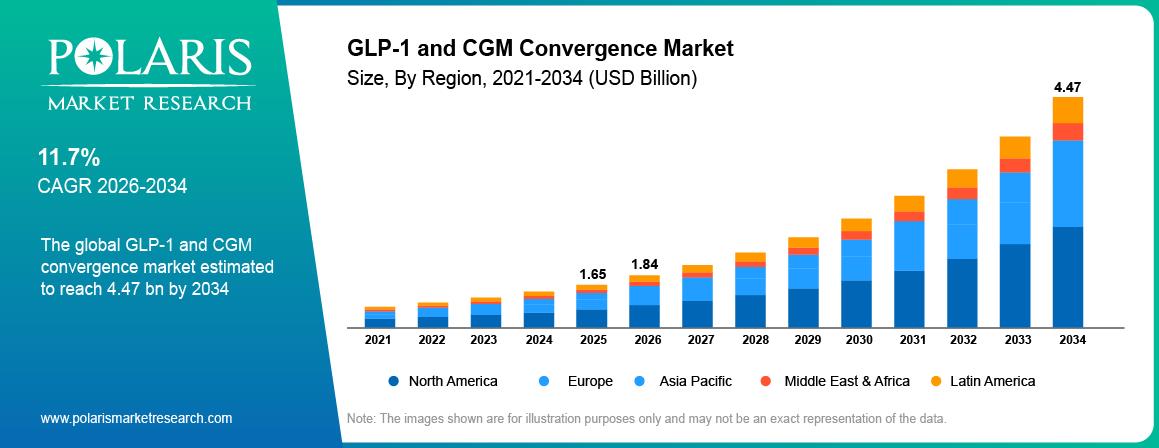
According to Polaris Market Research, the revenue that sits at their intersection (sensor sales to people on GLP-1s) was USD 1.65 billion in 2025 and should reach USD 4.47 billion by 2034, an 11.7% CAGR. For leaders in this space, the question is who will own the integrated experience, and which policy decisions will determine when it arrives.
Demand Is Already Here, but the Product Isn't
Behavior is ahead of the business model. A 2026 Dexcom survey found that 58% of people with type 2 diabetes who use GLP-1s also use CGM, compared with 27% of non-insulin type 2 users. Patients are assembling the combination themselves.
Falling drug prices widen the funnel. Lilly's oral Foundayo launched in April 2026 at USD 149 a month for the lowest self-pay dose, and the Medicare GLP-1 Bridge offers selected drugs at a USD 50 copay through December 2027. Every new GLP-1 user is a potential sensor customer, yet no one has built the bridge between prescription and glucose insight.
We have previously explored the expanding GLP-1 drug landscape in its report, 10 GLP-1 Drugs Revolutionizing Diabetes & Obesity Treatment. The report examines key therapies, including semaglutide, liraglutide, tirzepatide and emerging oral candidates, highlighting their role in improving blood glucose control and supporting weight management. It also discusses how advances in dual-agonist therapies and oral formulations are broadening treatment options, creating new opportunities for complementary technologies such as continuous glucose monitoring (CGM).
The Real Gatekeeper: Reimbursement, Not Clinical Interest
The strongest evidence so far is the CONNECT trial, published in October 2026. Among adults with type 2 diabetes not on insulin, Dexcom G7 users cut A1C by 0.9 points more than routine care over 26 weeks. Dexcom funded the study, so payers will scrutinize it, but it gives coverage advocates their best argument.
Coverage is the swing factor. Medicare generally covers CGM for non-insulin type 2 patients only with documented problematic hypoglycemia, and a CMS decision on broader coverage is expected before the end of 2026, effective mid-2027. In the Dexcom survey, 90% of U.S. clinicians cited coverage and reimbursement challenges, against 53% elsewhere. Prior authorization adds friction. The constraint is policy timing, not patient appetite.
In another earlier report, GLP-1 Side Effects: Tips for Gastrointestinal Comfort 2026 Update, India Pharma Outlook examined the patient-management challenges associated with GLP-1 therapies. The report highlights common gastrointestinal complications, including nausea, vomiting, bloating, diarrhea and constipation, often linked to delayed gastric emptying and dosage adjustments. It also emphasizes the importance of medical supervision, dietary changes and treatment monitoring to improve patient comfort and adherence. As GLP-1 adoption expands, combining medication with digital health tools such as CGM could further support treatment management and provide patients and clinicians with better insights into metabolic health.
Business Insights: Where Value Will Concentrate
Prescription devices anchor revenue; over-the-counter devices drive growth. Prescription wearables held 78.42% of 2025 revenue, but OTC biowearables are projected to grow at 18.94% annually. Stelo and Lingo are sold without a prescription, and Biolinq's needle-free Shine received OTC clearance in September 2026.
Payment mix is shifting. Commercial insurance led with 47.86% and Medicare/Medicaid held 30.42%, but self-pay is the fastest-growing pathway at 14.76%. Companies that serve cash-paying consumers well will not have to wait for payers.
Obesity without diabetes is the expansion frontier. Type 2 diabetes on GLP-1 held 63.54% of 2025 revenue, but obesity or overweight without diabetes is projected to grow fastest, at 15.24% a year. Signos, which pairs Stelo sensors with a weight-loss app at USD 139 a month, shows what that model looks like.
Software is the differentiator. Abbott's partnership with Google Health and Dexcom's AI-enhanced Stelo app relaunch signal that coaching, adherence tracking and subscriptions are where the integrated product will be built. Sensors are becoming the entry point to a data relationship.
Also Read: How Digital R&D Is Transforming API Development and cGMP Scale-Up in India
Regional Insights: One Dominant Market, One Rising Challenger
North America held 68.42% of 2025 revenue, and Dexcom's U.S. revenue grew 14% year on year in the third quarter of 2026. It is the most developed market and also the most coverage-constrained, so the CMS ruling matters here more than anywhere.
Europe held 17.64% and depends on country-by-country reimbursement. Integration is advancing through partnerships: Glooko plans to connect Roche's Accu-Chek SmartGuide CGM in select countries, and Senseonics began launching its one-year implantable Eversense 365 after CE Mark approval.
Asia Pacific is the fastest-growing region, at a 15.42% CAGR, driven by rising diabetes prevalence and growing interest in obesity management. International Diabetes Federation projections for India alone point to sharp growth in adult diabetes through 2050.
Latin America (2.36%) and the Middle East and Africa (1.70%) remain early and cost-sensitive. Brazil and Mexico offer scale opportunities, but affordability and uneven access limit near-term adoption.
Competitive Landscape: Two Camps, One Open Gap
Drugmakers (Lilly, Novo Nordisk, Boehringer Ingelheim, Amgen) and device makers (Abbott, Dexcom, Roche, MiniMed, Senseonics) each hold half of the equation. Abbott and Dexcom lead devices, while Lilly and Novo lead drugs. Boehringer and Amgen remain pipeline stories. Emerging players such as Signos and Biolinq are testing consumer-facing models.
The strategic opening is integration. Whoever links medication data, glucose data and coaching into one trusted experience will capture value that neither a drug nor a sensor can on its own. Competitive advantage depends on clinical credibility, device compatibility, data security and ease of use, so partnerships are more likely than acquisitions in the near term.
Future Outlook: What Will Shape 2027 and Beyond
Three developments matter most. First, the CMS decision on non-insulin type 2 coverage could expand the addressable population of U.S. users overnight. Second, next-generation multi-agonist drugs, the fastest-growing therapy class at a 21.48% CAGR, will widen the GLP-1 user base. Lilly plans to file retatrutide in the first quarter of 2027. The first candidate to win a type 2 diabetes label is the one most likely to pull CGM coverage with it. Third, drug prices are falling faster than evidence for integrated monitoring is maturing, so proving cost-effectiveness will be essential for payers.
Conclusion
The GLP-1 and CGM convergence market is small today but strategically significant. Patients have already begun pairing the two, clinical evidence is building, and technology is ready. What remains is the commercial architecture: reimbursement clarity, consumer-friendly access and a data layer that turns readings into decisions. Companies that treat convergence as a partnership and platform challenge, rather than a product feature, will be best placed to capture the next USD 3 billion of growth.