
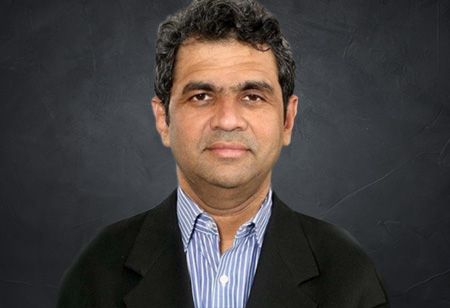
Vijaya kumar Naganaboina, Head R&D, Wanbury Limited

During an interaction with Thiruamuthan, Assistant Editor at India Pharma Outlook, Vijaya kumar Naganaboina, Head R&D, Wanbury Limited, discusses how digital R&D is transforming API development and cGMP scale-up in India through AI-enabled process development, predictive modeling and data-driven manufacturing. He highlights the role of process optimization, technology transfer and scientific validation in improving manufacturing consistency and accelerating the development of complex APIs.
Vijaya Kumar Naganaboina, an experienced pharmaceutical R&D leader with over a decade of expertise in API process development, scale-up, and manufacturing. His work spans predictive analytics, cGMP manufacturing, technology transfer and regulatory submissions, with a focus on digitalization and improving process efficiency.
In API process development, how can AI-enabled Design of Experiments (DoE) using machine learning identify complex relationships between reaction variables and critical process parameters?
In many Indian API companies, Design of Experiments (DoE) is still largely approached through the traditional one-factor-at-a-time methodology. However, parameters such as temperature, base equivalents, addition rate and moisture content are interdependent, and their interactions cannot be adequately captured by a simple quadratic model. In simple words:
Decision Tree: A sequence of yes-or-no decisions, similar to a structured batch troubleshooting process. For example, is the temperature above 60°C? Is the moisture content above 0.5%? Based on these conditions, the model predicts whether impurity levels are likely to be high. Each decision tree generates an individual prediction.
Random forest: one prediction can go wrong, like the opinion of one chemist. So it makes hundreds of trees on slightly different portions of data and takes the average of hundreds of predictions.
XGBoost: first tree predicts, second tree corrects its error, third corrects remaining error, hundreds of times. Like a student correcting mistakes after every test.
Gaussian Process Regression (GPR): gives a prediction and also "how sure I am", so the next experiment is planned where the model is least sure.
These models capture non-linear relationships and interaction effects, while even failed experiments help identify conditions to avoid. In one polymorph-related challenge, GPR-guided experiments helped us understand the combined effects of seeding temperature and cooling rate. Feature importance also shows which parameter is driving the result, a good start for criticality assessment.
However, with only 20–30 experiments, models can easily overfit, memorizing data rather than identifying meaningful patterns. Both modeling and mechanistic understanding are essential for gaining QA and regulatory acceptance.
AI models can capture non-linear relationships between process parameters, but mechanistic understanding remains essential to prevent overfitting and secure quality assurance and regulatory acceptance
When scaling an API process from laboratory to commercial production, how can predictive models account for differences in mixing, heat transfer and reaction kinetics?
Scale-up is like cooking biryani for four people at home and then preparing it for 400 at a wedding. The recipe remains the same, but the vessel, heat and stirring conditions change. In a 6 KL reactor, mixing times can differ significantly from those in the lab, while dosing can take hours instead of minutes.
For the first scale-up, there is no plant history available. Therefore, the model is built using lab data, reaction kinetics, heat of reaction from calorimetry and plant equipment characterization, including jacket heat transfer and kLa for hydrogenation.
Even before the first batch, the model helps determine whether the reaction is kinetics- or heat-removal-controlled and establish a safe dosing time. Work-up is also considered, as a significant part of the yield gap can arise from filtration, washing and mother liquor losses. Model accuracy is assessed using RMSE (Root Mean Square Error), which measures the average prediction error. An RMSE of 2 indicates that the model's prediction is off by approximately 2% in yield.
However, prediction alone cannot solve scale-up challenges. It tells us what is likely to happen, such as the plant achieving 78% yield when the lab achieves 88%, but not what action to take. Dosing time, cooling rate and equipment selection can all involve competing requirements. This is where the predict-then-optimize approach becomes important.
The optimizer searches inside the model for best settings within constraints like jacket delta T, safe dosing time and impurity specification, with Mixed Integer Linear Programming (MILP) handling yes/no equipment choices. It also shows which constraint impacts most if heat removal stops faster dosing, the answer is colder brine, not one more lab trial.
Prediction without optimization is like having a weather forecast without deciding whether to carry an umbrella or wear a raincoat. Both predictive modeling and prescriptive optimization are essential.
During API technology transfer, how can digital process data and development knowledge help manufacturing teams reproduce critical process parameters and impurity profiles at commercial scale?
The biggest challenge in tech transfer is not parameters; it is knowledge behind them. The development report tells "what" but rarely "why," and the why walks out of the company with the chemist.
First, a knowledge package linking each parameter to CQA, with impurity fate and purge map, so when the plant sees a new impurity, you trace in hours which step should remove it. Second, plant temperature, dosing and pH profile overlaid on pilot "golden batch", so deviation is visible before out of specification (OOS). Third, capture small things nobody writes in the tech pack - hold times, water quality, and order of addition. More than once, I saw ROI failure traced to lab versus plant water.
How can Process Analytical Technology (PAT) data support continued process verification by identifying process drift before it affects critical quality attributes in API manufacturing?
Traditional Continued Process Verification (CPV) is trending release results once a year, like checking sugar once a year. By then, many batches are made.
Process Analytical Technology (PAT) provides real-time process visibility through tools such as FTIR or Raman for endpoint, FBRM for crystallization and NIR for Loss on Drying (LOD). Combined with Principal Component Analysis (PCA), which squeezes 30 related trends into two or three charts, it helps identify process drift before any individual parameter crosses its limit.
For example, reaction time may gradually increase from batch to batch, with each batch remaining within the acceptable range. However, the trend may indicate changes in raw material quality or jacket fouling. This allows corrective action before Critical Quality Attributes (CQAs) are affected.
No need for full PAT to start. DCS/SCADA data is already stored, and nobody is looking at it.
What scientific and validation evidence should API manufacturers establish before using AI-based predictive models to guide process development and GMP manufacturing decisions?
Start with intended use and risk. A model suggesting the next laboratory experiment is different from one determining a batch endpoint. The FDA draft guidance refers to the "context of use", while the EU draft Annex 22 permits only static locked models for critical GMP applications.
Data must comply with ALCOA+ principles and cover real process variability. Garbage in, gospel out: an incorrect answer can come with a very confident appearance.
Validation should be performed using independent batches, with acceptance criteria defined in advance (for example, RMSE for yield NMT 2%). Models should never be used outside their trained range, and their predictions must make chemical sense.
Retraining must go through change control, with model drift monitored and a human involved in every GMP decision. Run the model in "shadow mode" for a few campaigns before relying on its predictions.
Looking ahead to 2030, where do you expect AI-enabled process development and predictive modeling to make the greatest difference in India's ability to develop and manufacture complex APIs?
For complex APIs, India's key gaps are speed and right-first-time execution. This is where AI can make the biggest difference. Retrosynthesis combined with patent landscape analysis can reduce route scouting from months to weeks. Other promising applications include polymorph prediction, where many programs face challenges during validation, flow chemistry for hazardous reactions under ICH Q13, and predict-then-optimize approaches to bridge the lab-to-plant gap.
The main challenges remain data foundation and skilled talent. AI will not replace process chemists, but chemists who use AI will certainly have an advantage over those who do not.

, CDSCO.jpg "Fostering a Quality Culture in the Pharmaceutical Industry")