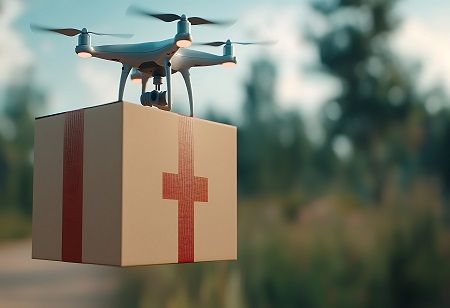
The fight against tuberculosis is no longer just about better medicines or advanced diagnostics, rather it is increasingly about speed.
TB diagnosis often suffers from delays, not because of a lack of testing technology. But due to the time it takes for samples to travel from remote areas to laboratories.
In many cases, this process can take hours or even days, delaying treatment and increasing the risk of transmission.
Now, drone-based logistics are emerging as a game-changing solution. By cutting transport time to mere minutes, drones are redefining how quickly patients can be diagnosed, treated, and protected from further complications.
Traditionally, transporting TB samples involves road networks that are often slow, inconsistent, and dependent on geography. In rural or hard-to-reach regions, samples may take an entire day or longer to reach diagnostic labs.
Drone-based systems, however, compress this timeline dramatically. What once took hours can now be completed in minutes. This shift is not just about convenience it directly impacts how quickly a patient receives a confirmed diagnosis and begins treatment.
The Indian Council of Medical Research (ICMR) said its flagship i-Drone initiative has demonstrated significant potential in improving healthcare delivery. By leveraging drone technology, the initiative enables faster and more reliable transport of TB samples to testing facilities.
This initiative emerged from a programme based study at Yadadri- Bhuvanagiri district of Telangana in collaboration with AIIMS Bibinagar.
"Affordable and timely access to diagnosis remains central to India's TB elimination efforts. This study demonstrates how technology can help bridge geographical barriers and reduce the burden on patients, particularly those living in remote areas,” said Dr. Rajiv Bahl, Secretary, Department of Health Research and Director General, ICMR.
This innovation ensures that even geographically isolated populations are no longer excluded from timely diagnostic services, bridging a critical gap in India’s healthcare system.
Also Read: Scaling Perfusion Technology from Lab Success to Manufacturing Reality
Speed in diagnosis plays a crucial role in controlling TB. Faster sample transport means earlier detection, which leads to quicker initiation of treatment. This reduces the window during which an infected person can unknowingly spread the disease.
In a country with a high TB burden, even small reductions in diagnostic delays can significantly lower transmission rates and improve overall public health outcomes.
The initiative also substantially reduces the financial burden faced by patients. Delays in traditional systems often lead to repeated visits, additional travel costs, and lost wages. Drone-enabled delivery minimizes these indirect costs, making TB diagnosis more accessible and affordable, particularly for economically vulnerable populations.
When diagnosis happens faster, treatment outcomes improve. Patients are less likely to experience severe disease progression, and healthcare systems can respond more efficiently. By addressing logistical drawbacks, drone technology is not just improving speed. It is also enhancing the entire continuum of care, from detection to recovery.
India’s TB challenge is as much about logistics as it is about medicine. By transforming hours into minutes, drone technology offers a scalable solution to one of the biggest gaps in TB diagnosis.
As initiatives like ICMR’s i-Drone gain momentum, they could redefine how healthcare reaches the last mile. Along with ensuring that timely diagnosis is no longer a privilege, but a standard.
.jpg)