Industry Outlook Team | Friday, 20 November 2026
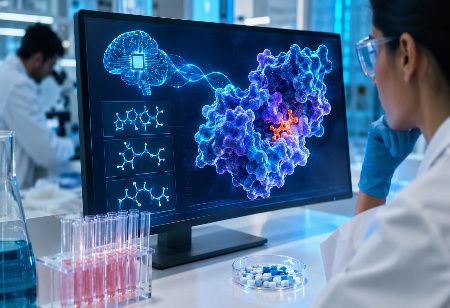
AI drug discovery is gaining momentum as Merck and Isomorphic Labs enter a strategic research collaboration to identify small-molecule candidates against an undisclosed oncology target.
Announced on November 19, 2026, the partnership combines Isomorphic Labs' proprietary Drug Design Engine (IsoDDE) with Merck's research expertise and proprietary datasets.
Isomorphic Labs will conduct computational predictions and deliver molecular designs, while Merck will manage subsequent preclinical and clinical development, manufacturing and commercialization.
The collaboration highlights how pharmaceutical companies are combining artificial intelligence and established research capabilities to explore new approaches to drug discovery.
Also Read: AI in Drug Discovery and Development: From Lab to Commercial Market
AI drug discovery uses computational models to analyze biological information and predict how potential drug molecules may interact with disease-related targets.
These predictions can help researchers prioritize molecular designs for further investigation.
Isomorphic Labs' IsoDDE combines foundational AI models to support computational drug design. In this collaboration, the platform will incorporate selected datasets supplied by Merck to generate molecular designs against the undisclosed oncology target.
However, computational predictions are only one part of drug development. Potential candidates must undergo experimental evaluation and preclinical testing before they can advance to human clinical trials.
AI-generated designs require experimental assessment to establish whether they demonstrate the desired biological activity. Preclinical studies and clinical trials are also necessary to evaluate safety and effectiveness.
The partnership divides responsibilities between the two companies. Isomorphic Labs will lead computational design, while Merck will oversee preclinical and clinical development, manufacturing and commercialization.
Merck's research datasets and discovery expertise are expected to complement Isomorphic's modeling capabilities. This combination reflects the growing role of AI drug discovery in pharmaceutical R&D.
The collaboration has not yet announced any resulting drug candidates or clinical programs. Its progress will depend on whether computationally designed molecules can translate into viable therapeutic candidates.