Fathimanoud, Correspondent, India Pharma Outlook

Pharma marketing KPIs can help you understand whether your marketing efforts are actually delivering results or simply generating activity.
In 2026, Indian pharma companies need to look beyond sales numbers and examine how effectively they reach healthcare professionals, influence prescribing behavior, engage doctors across channels, and convert marketing investments into commercial outcomes.
If you are tracking field-force activity, digital campaigns, or HCP interactions, the right KPIs can help you identify what is working and where performance needs improvement. They can also help you compare marketing efficiency, strengthen resource allocation and connect engagement with measurable business results.
But not every metric tells the full story. Tracking reach, clicks, or calls alone may show activity without explaining its impact. This is why you need to look at KPIs as a connected framework rather than isolated numbers.
This article will explore pharma marketing KPIs that Indian companies should track, how marketing KPIs differ from sales KPIs, which metrics managers should monitor monthly, and how to measure pharma marketing ROI in India. We will also look at vanity metrics, the role of AI in KPI tracking, and a four-level KPI maturity model for pharma marketing.
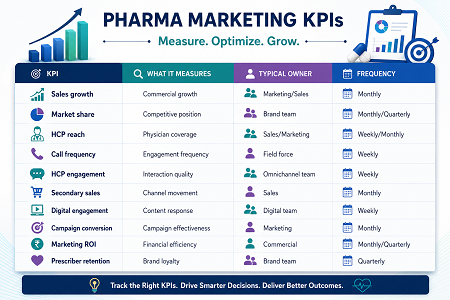
Pharma marketing KPIs are measurable indicators that show how effectively pharmaceutical companies achieve their marketing and commercial goals. In a highly regulated industry, these metrics help companies move beyond assumptions and understand what is actually working.
KPIs can track areas such as sales performance, prescription behavior, HCP engagement, field-force activity and marketing efficiency. They also support data-driven decision-making by helping companies identify performance gaps and improve resource allocation.
Pharmaceutical companies use performance measures across R&D, manufacturing and quality. However, management standards require organizations to decide what they should monitor and measure.
John Flemming, VP Commercial Insights & Analytics at OptimizeRx, said, "We're so focused a lot of times on frequency and reach that we're missing the opportunity of timing. And that's really what we need to start looking at from a KPI perspective: timing, not so much reach and frequency."
Key Performance Indicators in Pharma marketing help Indian companies move beyond measuring basic field activity. They show whether marketing efforts are influencing prescription behavior and engaging doctors.
Indian pharma companies manage large field forces and increasingly use digital channels to engage HCPs. Pharma marketing performance metrics help connect these activities with actual outcomes.
India's diverse healthcare market requires companies to allocate resources carefully. Pharma marketing ROI metrics help identify which campaigns, channels, and HCP segments deliver stronger results. Companies can then redirect spending toward activities that demonstrate greater impact.
Similarly, Pharma sales and marketing KPIs can help companies monitor promotional activities, approved messaging, and HCP interactions. This creates greater visibility into potential compliance gaps and supports more consistent execution.
A 2023 MM+M and Publicis Health survey found that nearly 90 per cent of pharma marketers had adopted digital tools, while only around 40 per cent used consistent KPIs to measure success. This gap highlights why digital adoption alone does not guarantee effective performance measurement.
For Indian pharma companies, KPIs therefore provide a link between marketing activity, HCP behavior and commercial outcomes. They help teams identify what works improve resource allocation, and build more data-driven marketing strategies.
Also Read: Building Resilient QMS in Global Pharma Manufacturing
.jpg)



, CDSCO.jpg "Fostering a Quality Culture in the Pharmaceutical Industry")