
Fathimanoud, Correspondent, India Pharma Outlook
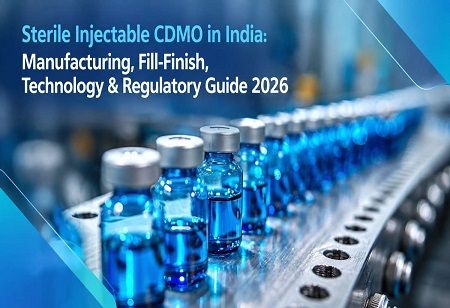
Sterile Injectable CDMOs in India play an increasingly significant role in global pharmaceutical supply chains.
Grand View Research estimates India’s sterile injectable contract manufacturing market at USD 1.84 billion in 2026, with projections indicating growth to USD 4.38 billion by 2033 at a compound annual growth rate of 13.2 percent.
A sterile injectable CDMO is a specialized partner that supports pharmaceutical companies in the development and manufacturing of sterile injectable medicines.
CDMOs provide services across the manufacturing process, including formulation development, raw material sourcing, sterile fill/finish, production, quality control, packaging, and delivery.
Their operations rely on specialized facilities, skilled personnel, rigorous process controls, and compliance with regulatory standards such as WHO-GMP and ISO requirements.
This helps companies reduce costs, improve production flexibility and scalability, accelerate product availability, and maintain consistent quality while focusing on product development, marketing, and distribution.
Therefore, a comprehensive assessment of Sterile Injectable CDMOs in India must address manufacturing scale, fill-finish precision, technology adoption, and regulatory adherence.
Choosing an injectable CDMO is not simply a question of manufacturing capacity; companies must assess sterility assurance, fill-finish technology, containment, analytical capabilities, regulatory history, technology transfer, and commercial scalability. The following guide provides that evaluation for 2026.
A sterile injectable CDMO (Contract Development and Manufacturing Organization) is a specialized partner that supports pharmaceutical companies in the development, manufacturing, and supply of sterile injectable medicines.
These products include vaccines, biologics, monoclonal antibodies, high-potency drugs, and other therapies that demand precise dosing and contamination-free production. Unlike a pure CMO (Contract Manufacturing Organization), which primarily focuses on large-scale production, a CDMO offers both development and manufacturing capabilities.
This dual role allows pharmaceutical companies to move from early formulation work through clinical batches to full commercial supply under one partner. Sterile injectable manufacturing requires aseptic processing or terminal sterilization to maintain product sterility.
Aseptic manufacturing keeps the entire process free from microbial contamination under tightly controlled cleanroom conditions. Terminal sterilization applies a final sterilization step after the product is filled and sealed, where the formulation permits it. Both approaches demand specialized facilities, rigorous process controls, and highly trained personnel.
Also Read: Choosing the Right CDMO in India: A 2026 Compliance Guide
.jpg)




, CDSCO.jpg "Fostering a Quality Culture in the Pharmaceutical Industry")