India Pharma Outlook Team | Saturday, 26 September 2026
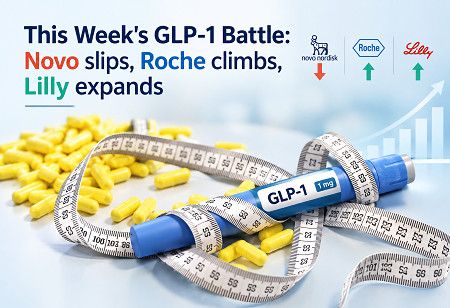
This week’s GLP-1 battle shows Novo slipping while Roche climbs and Lilly expands.
The obesity-drug arms race enters a sharper phase as Novo Nordisk loses its market lead to Eli Lilly, then answers with a strong CagriSema trial win and a triple strategy of oral pills, prevention, and new markets.
Roche advances its dual agonist with impressive stay-on rates in diabetes patients. Lilly adds a once-weekly insulin approval that further strengthens its diabetes-and-obesity footprint.
Together, these moves capture a single week in which leadership, pipelines, and patient options all shifted at once.
Novo Nordisk once dominated the obesity market. Shares have plunged more than 70 percent from their peak while Lilly’s stock has surged. Lilly’s Zepbound is on track to outsell Wegovy by more than USD 7 billion this year.
CEO Mike Doustdar faces pressure to rebuild growth beyond semaglutide before patent expiry in the early 2030s. The company earlier halted trials of heart drug ziltivekimab and faced a prior CagriSema setback.
In the 68-week REIMAGINE 5 trial, CagriSema (semaglutide plus cagrilintide) delivered 12.4 percent average weight loss versus 9.1 percent for tirzepatide 5 mg in adults with type 2 diabetes. The dual GLP-1 and amylin approach signals the industry’s move toward multi-mechanism therapies.
Also Read: 10 GLP-1 Drugs Revolutionizing Diabetes & Obesity Treatment
Doustdar is preparing for a market that could split evenly between pills and injectables. Oral Wegovy already claims more than 80 percent of new oral prescriptions in the United States and generated nearly 5.5 billion Danish crowns (USD 843 million) in first-half sales.
He told Reuters: “What happens if by 2030 the market is 50/50 (pills-to-injectables)? We are preparing ourselves for all scenarios, including that one.”
Similarly, Novo expanded its UNICEF partnership with an additional USD 18 million from 2026 through 2030 to reach more than 80 million children with prevention programs. Senior Vice President Elin Jäger linked the move to the company’s updated sustainability strategy.
Chief Scientific Officer Martin Lange also pointed to hair-loss research: “We could leverage our scientific knowledge potentially moving into that space. It’s not necessarily what we’ll pursue first, but that would be a clear possibility.”
Roche’s once-weekly dual agonist enicepatide produced 15.5 percent average weight loss at 48 weeks in overweight or obese patients with type 2 diabetes. Only about 2 percent of participants stopped treatment because of side effects, and weight loss had not plateaued.
Pharmaceuticals chief Teresa Graham said the company explores both standalone use and combinations, especially for patients who need greater weight reduction or tighter blood-sugar control. Roche already runs Phase 3 obesity studies and plans further late-stage trials.
Lilly continued its commercial momentum with Zepbound while the FDA approved its once-weekly basal insulin Onswik for adults with type 2 diabetes. Onswik can reduce injection frequency by more than 300 doses per year compared with daily basal insulin and will launch in the United States in the coming months as a pre-filled KwikPen.
Novo fights on every front, like oral share, multi-hormone innovation, prevention and adjacency. Roche climbs with a dual agonist that patients stay on. Lilly expands both its obesity franchise and its insulin portfolio. The GLP-1 battle this week shows leadership no longer belongs to a single molecule or a single company.
For the large patient population living with obesity and type 2 diabetes, these developments expand practical choices. Oral options and once-weekly injections can reduce the burden of frequent dosing.
Stronger weight-loss results from multi-hormone combinations and high stay-on rates improve the chance that more people remain on therapy long enough to see lasting metabolic benefit.
Prevention programs that reach tens of millions of children add an earlier layer of support. Collectively, the week’s advances point toward more convenient, more effective, and more sustained care for the millions who depend on these treatments.
.jpg)