Zeenat Parween, Correspondent, India Pharma Outlook
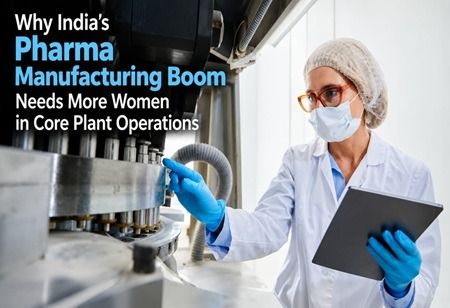
India’s pharma manufacturing sector needs more women in core plant operation roles as the industry expands production, automation, APIs, formulations and regulated-market exports.
The reason is practical. India is building a larger and more advanced pharmaceutical manufacturing base, and that growth needs a bigger pool of skilled workers across production, engineering, packaging, quality, maintenance and plant management.
Keeping qualified women concentrated in laboratories, research or corporate functions leaves part of that talent pool underused. For India’s pharma manufacturing sector to keep expanding, pharmaceutical companies need a larger and more diverse pool of skilled workers across the factory floor.
This includes people working in API synthesis, formulation facilities, sterile manufacturing, cleanrooms, packaging, quality operations and CDMO scale-up. These are not support functions; they directly influence how efficiently a plant can produce medicines while meeting strict quality and regulatory requirements.
As stated in a release by PIB, India's pharmaceutical market is expected to reach about USD 130 billion by 2030. India is already the world's third-largest pharmaceutical producer by volume and has more than 10,500 manufacturing units.
More factories and larger production capacities will require more people who understand equipment, processes, documentation, safety and quality systems. As a result, the factory floor is an important part of the conversation about women in pharma.
India has made considerable progress in bringing women into science and technology education. Government data shows that women account for 43 percent of STEM enrolment in higher education in India. Yet their participation in the STEM workforce remains much lower.
The pharmaceutical sector faces a similar challenge. Women are visible across research, biotechnology, quality control, pharmacy and scientific roles. However, manufacturing jobs can involve shift work, hazardous materials, heavy material handling and physically demanding processes. These factors can make plant careers less accessible unless companies deliberately redesign the workplace.
This is where seeing women in core plant operations becomes a manufacturing issue. A woman trained in chemistry can work in API production. Likewise, women engineers can work with automated production equipment. A woman quality professional can move into manufacturing quality management. And a woman with production experience can become a shift supervisor or plant head.
The question should be whether she has the required training and capability. It should not be whether the factory has traditionally been a male workplace.
For India’s pharma manufacturing sector, expanding this talent pool could become increasingly important as companies move toward more complex products and automated production systems.

.jpg)


, CDSCO.jpg "Fostering a Quality Culture in the Pharmaceutical Industry")