India Pharma Outlook Team | Monday, 28 September 2026
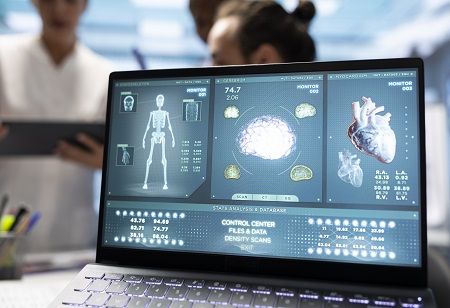
Autonomous AI labs are emerging as the next step in pharmaceutical research.
Roche is developing laboratories where artificial intelligence, experimental science and automation operate as a connected system.
At its Pharma Day on September 28, Roche outlined plans to develop autonomous AI-driven laboratories to accelerate research and drug discovery.
The company said 40 percent of pipeline decisions between the fourth quarter of 2025 and the second quarter of 2026 had a tracked AI or computational contribution.
Its Target Nexus platform is expected to support 80 percent of research portfolio decisions by the end of 2026.
The larger development, however, is how Roche is connecting AI with the physical laboratory.
Roche’s approach is centered on its “lab-in-the-loop” model, in which AI models use experimental and clinical data to generate predictions, those predictions are tested through laboratory experiments, and the resulting data is fed back into the models.
Roche has described this as an iterative connection between computational and experimental work rather than a standalone AI application.
This changes the role of AI in pharmaceutical R&D. Instead of simply helping researchers analyse existing information, the system can continuously use experimental results to refine subsequent research decisions.
Roche has now placed “Revolutionizing drug R&D with Lab in a Loop” directly on its Pharma Day agenda, indicating that the approach is becoming part of its broader R&D strategy.
Also Read: 15 Pharma Marketing KPIs Indian Companies Should Track in 2026
An autonomous laboratory requires more than sophisticated algorithms. It also needs the physical infrastructure capable of carrying out experiments and moving materials with limited manual intervention.
Roche’s collaboration with ABB Robotics provides this physical layer. The companies are developing robotic solutions for laboratories, including autonomous mobile manipulators for moving samples and materials between instruments and robotic systems for pathology slide handling.
ABB said the collaboration is intended to create digitally connected laboratories using physical AI and more autonomous robotics.
Computing infrastructure forms another part of the system. Roche is deploying more than 3,500 NVIDIA Blackwell GPUs across its operations, with the infrastructure supporting biological foundation models, drug discovery, laboratory automation and manufacturing applications.
The distinction is important because conventional AI adoption can improve individual stages of pharmaceutical research without changing how the laboratory itself operates. Roche’s lab-in-the-loop model attempts to connect those stages into a continuous cycle.
AI can identify potential targets or molecules, automated systems can conduct experiments, and the resulting experimental data can then improve the next computational prediction.
Roche has also been developing autonomous and self-improving loops for AI and laboratory workflows, showing that the company is building capabilities around longer-running automated research processes.
The objective is therefore not simply to introduce AI into an existing laboratory, but to make the laboratory increasingly responsive to the information generated within it.
As laboratories become more automated, pharmaceutical companies will increasingly need integrated AI infrastructure, robotics, laboratory automation and data systems rather than treating these as separate technology investments.
Roche’s AI infrastructure is being used alongside digital twins for manufacturing facilities, while AI applications are being developed for areas including production scheduling and quality assurance.
This point’s to a broader shift in pharmaceutical manufacturing: the laboratory itself is becoming a technology-intensive industrial system.
The competitive advantage may increasingly depend not only on better AI models, but on how effectively companies connect those models with automated experiments, physical equipment and manufacturing infrastructure.
.jpg)