India Pharma Outlook Team | Friday, 09 October 2026
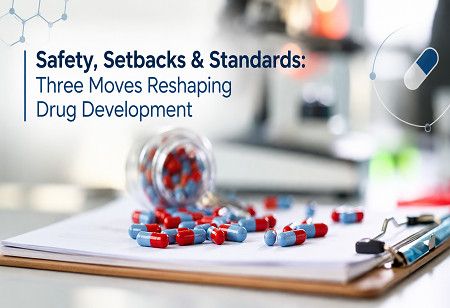
Safety alerts, clinical setbacks, and rising standards now reshape drug development across the industry.
Pharma companies confront a dual reality as individual programs stall under regulatory caution and trial failures, yet leaders collaborate on digital tools that accelerate the broader pipeline.
Recent moves highlight this tension. One firm faces a clinical hold after safety signals emerge in a schizophrenia program.
Another loses a major expansion chance when a late-stage study fails.
At the same time, industry players launch a consortium to modernize chemistry, manufacturing, and controls processes. These events capture the current dynamics of caution, attrition, and modernization that define today’s development landscape.
Newron Pharmaceuticals confronts sharp regulatory scrutiny over its experimental schizophrenia drug evenamide. The U.S. Food and Drug Administration identifies four deaths among patients who received the treatment across studies, compared with one death in the placebo group.
The agency flags a potential safety signal because it cannot definitively exclude a fatal arrhythmic mechanism. Shares of the Switzerland-listed company fall 5.7 percent after the feedback.
Key details include:
This regulatory caution slows a program aimed at treatment-resistant schizophrenia, a serious condition that affects thinking, emotions, and perception of reality.
Also Read: 10 AI-Powered Manufacturing Technologies Improving Pharma Production
Argenx shuts down a late-stage study of Vyvgart Hytrulo in Sjogren’s disease after an independent data committee finds the trial will not meet its primary endpoint of improving systemic disease activity.
The biopharma ends the Phase 3 UNITY trial, removing what analysts call the next potential blockbuster expansion opportunity for the drug. Shares tumble nearly 14 percent, or about USD 130 per share.
The announcement surprises the market because full results were not expected until the second half of 2027. The futility analysis draws on data from more than 500 patients of the 630 enrolled.
Sjogren’s disease, an autoimmune disorder that primarily affects moisture glands and causes dry eyes and dry mouth, has long challenged developers due to high placebo response rates.
Vyvgart Hytrulo already holds approvals for generalized myasthenia gravis and chronic inflammatory demyelinating polyneuropathy and recently delivered a late-stage win in autoimmune myositis.
In a separate positive note, Argenx reports a mid-stage win for FB102, an investigational CD122 inhibitor acquired through its USD 2.2 billion Forte Biosciences deal.
Patients receiving the asset show a statistically significant change from baseline in a small-intestine health measure, prompting plans to advance it into late-stage development.
While individual programs face delays, industry leaders advance infrastructure modernization. Rockwell Automation joins as a founding member of the Digital CMC Consortium, a not-for-profit, pre-competitive collaboration that advances digital standards and infrastructure to speed drug development.
The group unites pharmaceutical organizations, biotechnology firms, contract development and manufacturing organizations, technology providers, and consulting experts.
Founding members include Rockwell Automation, Novartis, Thermo Fisher Scientific, Takeda, Flagship’s Pioneering Medicines, Stellix, ZS Associates, and QbDVision. Chemistry, Manufacturing, and Controls activities have long created bottlenecks through manual, document-based workflows and limited standardization.
As therapies grow more complex and personalized, the consortium targets structured digital systems that accelerate technology transfer and enable knowledge sharing and data-driven decisions.
Immediate priorities center on digital technology transfer and structured knowledge exchange between sponsors and CDMOs. Longer-term goals connect capabilities across the full CMC lifecycle, including knowledge management, automated content authoring, digital twins, and artificial intelligence.
These three developments illustrate pharma’s current balance. Safety holds, and clinical attrition slows specific assets, yet collaborative standards work aims to remove systemic friction and deliver therapies faster to patients.

.jpg)