
India Pharma Outlook Team | Friday, 10 July 2026
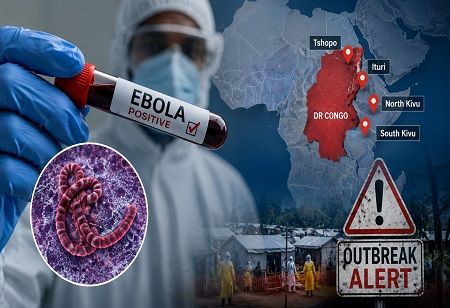
The Ebola concern in the Democratic Republic of the Congo has entered a new phase.
Health officials are now focusing less on the official case count. Instead, they are trying to find infections that remain undetected.
The Ebola concern has grown after the World Health Organization (WHO) said many new infections cannot be linked to known patients. This suggests the outbreak is spreading beyond the reach of current surveillance.
WHO officials believe the real outbreak could be two to four times larger than official figures. Disease modeling and testing trends support this estimate. The finding comes as health workers struggle to trace infections across affected communities.
According to WHO, nearly 80 percent of newly confirmed patients in the hardest-hit areas have no known link to earlier cases. This means contact tracing is becoming less effective.
Officials say many infected people may never be tested. Others may seek treatment only after severe symptoms appear. Some may die before reaching a treatment center.
The outbreak has officially recorded 1,792 confirmed cases and 625 deaths. However, WHO believes these numbers do not reflect the full scale of transmission.
The situation is especially serious in Ituri province. Bunia remains the center of the outbreak. Around half of the people tested there are found to have Ebola. Such a high positivity rate points to wider community transmission.
Also Read: Why the Latest Ebola Outbreak Has Global Health Experts on Alert
WHO believes the outbreak involves the Bundibugyo strain of Ebola. This strain may cause milder illness than some other Ebola viruses.
Milder symptoms can delay diagnosis. People may not seek medical care immediately. This gives the virus more time to spread within families and communities.
Health officials also found another worrying trend. About 70 percent of the first 400 deaths happened outside treatment centers. This shows many patients were never diagnosed or treated in time.
The combination of hidden infections and delayed care has made the outbreak much harder to contain.
Health authorities have expanded efforts to find missing infections. More than 21,000 community health workers are being trained for door-to-door visits.
Their role includes identifying people with symptoms, encouraging testing, and helping patients reach treatment centers quickly.
WHO says finding infections early remains the most important step. Early detection can improve survival and reduce further spread.
The latest update marks a shift in the response. Officials are no longer relying only on confirmed numbers. They are now focusing on infections that remain outside the health system. Until those hidden cases are identified, WHO believes the outbreak will remain difficult to control.
.jpg)