
Zeenat Parween, Correspondent, India Pharma Outlook
The pharmaceutical outsourcing landscape is undergoing its most consequential structural transformation in decades—and Indian CDMO players are leading the charge.
As global drug innovators race to compress timelines and de-risk capital-intensive pipelines, the Indian CDMO 2.0 framework has emerged as the industry's answer: a new generation of contractual architectures built on aligned incentives, shared financial exposure, and the hybrid model that blends traditional manufacturing muscle with agile, innovation-grade capabilities.
This is no longer a market defined by cost arbitrage alone. Indian CDMO represents a fundamental re-engineering of how risk, reward, and responsibility are distributed between pharma innovators and their manufacturing partners.
According to Expert Market Research, the Indian contract development and manufacturing organization (CDMO) market was valued at USD 25.51 billion in 2025 and is projected to reach USD 71.14 billion by 2035, growing at a CAGR of 10.80 percent. A 2025 Boston Consulting Group report further underscored the momentum: some India CDMO players witnessed a 50 percent year-on-year surge in requests for proposals in 2024 alone, driven by global pharma companies aggressively diversifying away from single-source dependencies. The era of passive service has ended. Indian CDMO and the hybrid model are now the architecture of choice for sophisticated pharma-CDMO partnerships.
Traditional pharmaceutical manufacturing relied on rigid cost-plus or time-and-materials pricing—structures that insulated the service provider from clinical and commercial risk entirely. If a batch failed, if a regulatory submission stalled, or if yields fell below expectation, the client bore the financial fallout. The CDMO operated as a fee-collecting vendor, not a strategic partner.
The CDMO 2.0 era dismantles this asymmetry. The introduction of pay-for-performance (P4P) metrics forces service providers to have genuine skin in the game. Under this model, Indian contract development and manufacturing organizations share the financial rewards of successful drug development while absorbing a portion of the losses during clinical or manufacturing failures. This structural realignment makes CDMO incentives coextensive with client outcomes.
The shift is quantifiable. Industry analysis from Persistence Market Research projects the Indian CDMO market growing from USD 23.3 billion in 2026 to USD 55.5 billion by 2033 at a 13.2 percent CAGR. Much of this premium valuation is attributed to new contract structures that embed performance accountability directly into pricing architecture and not just low-cost manufacturing.
Rajendra Kumar Sahu (CEO) & Jordi Robinson (CCO), Navin Molecular said, "India remains economically advantageous in comparison with its competitors ... The bigger and more established Indian CDMOs have made huge advances and investments over the past decades, and their facilities would rival the infrastructure and quality seen in the west. As well as excellent facilities, India boasts a large, educated workforce."
To ease the capital burden on emerging biotech and pharma innovators, modern contract development and manufacturing organizations accept lower upfront development fees. In exchange, contracts embed back-ended, high-yield payouts tied directly to specific milestones:
"The old transactional model commoditized Indian manufacturing talent. What we are building now is an ecosystem where our scientific depth is priced into the outcome, not just the invoice." — Dr. Satyanarayana Chava, CEO, Laurus Labs.
Also Read: Unlocking India's Innovation Potential in Pharma
Pay-for-performance structures do more than redistribute risk—they fundamentally reframe how return on invested capital (ROIC) is calculated for CDMO operators. Under traditional models, ROIC is a straightforward function of asset utilization and margin on services rendered. Under P4P, the CDMO's ROIC incorporates a deferred revenue component: the probability-weighted value of milestone payments tied to drug development outcomes.
This has meaningful implications for total shareholder return (TSR) among publicly listed Indian CDMOs. Laurus Labs, for instance, reported a 33 percent year-on-year revenue increase to INR 3,223 crore in H1 FY26, driven in part by multiple late-phase and commercial-scale deliveries—milestone events that triggered back-ended payment realizations. The stock rallied 82 percent in calendar year 2025, illustrating how the market prices milestone-rich revenue pipelines at significant premiums over pure-service revenue.
Carried interest mechanics (borrowed conceptually from private equity) are beginning to appear in certain long-duration CDMO partnerships. In these structures, the CDMO receives a profit participation in the commercial revenues of drugs it helped develop, in exchange for accepting below-market development fees during the pre-commercial phase. While still nascent in the Indian context, early adopters in the biologics space are deploying this model selectively for oncology and rare disease programs.
Building dedicated biological or small-molecule infrastructure requires immense upfront capital expenditure. A single GMP-compliant bioreactor suite can cost upwards of INR 150–250 crore to establish. Under legacy CDMO models, this burden fell entirely on the service provider, who then sought to recoup it through pricing premiums—a mechanism that created structural tension between cost competitiveness and infrastructure adequacy.
The Indian CDMO 2.0 framework resolves this bottleneck through Co-Investment Models that replace CapEx concentration with shared ownership of strategic infrastructure assets.
Under co-investment arrangements, pharma clients directly fund specialized infrastructure—advanced bioreactors, fill-finish lines, continuous flow chemistry setups, or high-potency API (HPAPI) containment suites—within the CDMO's facility. This capital injection delivers three discrete advantages:
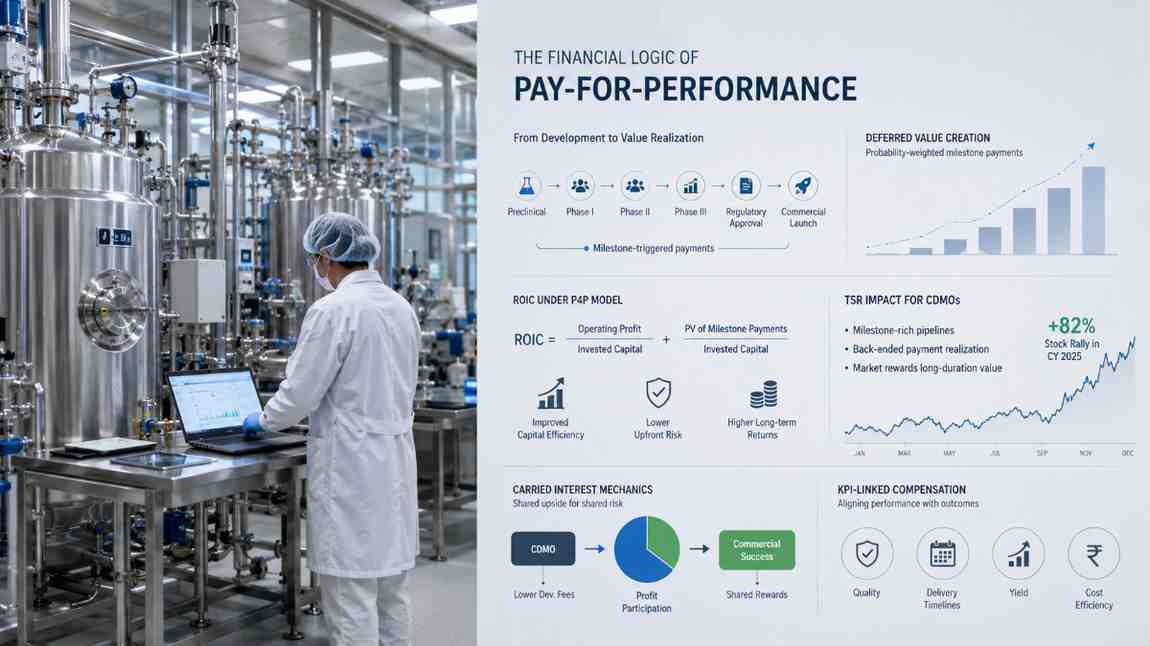
Compensation models under Indian CDMO 2.0 tie directly into precise operational key performance indicators. Failure to hit specific targets results in financial penalties for the CDMO; exceeding them triggers performance premiums. Common KPI structures include:
KPI Category | Typical Threshold | Penalty/Premium Structure |
Batch Success Rate | ≥97% first-pass yield | Penalty at <95%; premium at >99% |
API Purity Compliance | USP/EP specification adherence | Penalty per out-of-specification batch |
On-Time Delivery | ≥95% schedule adherence | Milestone delay fees apply below threshold |
Regulatory Submission Readiness | Zero critical USFDA/EMA findings | Penalty for audit-triggered remediation costs |
Cold Chain Logistics Integrity | <0.5% temperature excursion rate | Full batch replacement liability below threshold |
"India has moved from being the world's pharmacy to becoming the world's pharmaceutical development partner. That transition requires us to absorb risk, not just capacity." — Kiran Mazumdar-Shaw, Executive Chairperson, Biocon & Syngene International.
Modern Indian CDMOs operate as fully integrated extension units of their pharma clients—not external factories executing batch records. By absorbing operational responsibilities that extend beyond core chemistry and manufacturing, contract development and manufacturing organizations structurally isolate innovators from the full spectrum of regulatory and logistical vulnerabilities that define pharmaceutical commercialization risk.
The scope of risk-sharing under Indian CDMO 2.0 explicitly encompasses adjacent supply chain vulnerabilities that legacy contracts systematically excluded:
Regulatory Compliance Accountability CDMOs now assume full accountability for audit readiness under both USFDA and EMA inspection frameworks. This means absorbing the financial penalties if compliance gaps halt production—including remediation costs, batch quarantine losses, and client-side supply disruption damages. Gland Pharma, for example, has built its entire B2B model around this accountability commitment: its injectable manufacturing units carry active USFDA and EMA approvals, and the company's P&L absorbs the cost of maintaining continuous inspection-readiness as a core operating expense rather than a client-billable item.
The USFDA remains the gold standard for Indian CDMO regulatory positioning. Facilities with active USFDA Drug Master Files and clean inspection histories command 15–25 percent price premiums in contract negotiations, per industry benchmarks. The same dynamic applies in the EMA context: Akums Drugs and Pharmaceuticals' landmark Euro 200 million CDMO supply agreement for the European market (announced December 2024, commencing 2027) was anchored explicitly on its EMA-aligned manufacturing compliance posture.
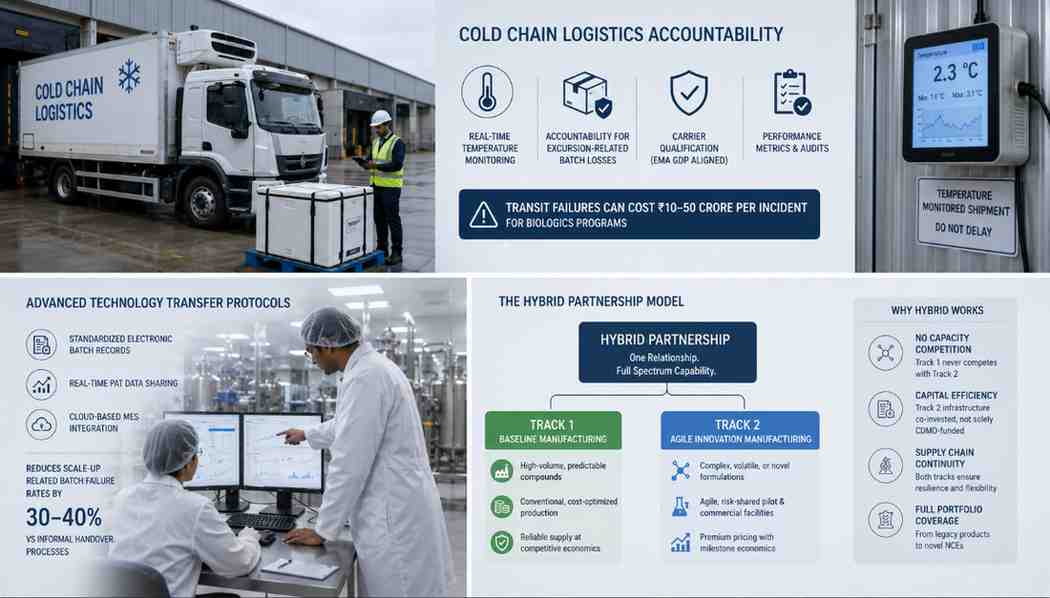
Risk-sharing frameworks under Indian CDMO 2.0 extend accountability into cold chain logistics management—a critical evolution given the increasing proportion of temperature-sensitive biologics in global drug pipelines. Cold chain logistics failures represent a significant and historically under-insured risk category: transit-related batch degradation can result in losses of INR 10–50 crore per incident for biologics programs.
Modern CDMO contracts now embed cold chain logistics performance obligations explicitly: real-time temperature monitoring during transit, accountability for excursion-related batch losses up to a contractually defined threshold, and carrier qualification standards that align with EMA GDP (Good Distribution Practice) guidelines. Indian CDMOs with WHO-prequalified cold chain logistics infrastructure are finding this capability translates directly into competitive differentiation in tender processes for global health programs.
Seamless digital data exchange during scale-up—through standardized electronic batch records, real-time process analytical technology (PAT) data sharing, and cloud-based manufacturing execution systems—minimizes execution risk during the critical development-to-commercial transition. CDMOs that invest in technology transfer infrastructure reduce scale-up failure rates materially, with industry data suggesting that structured tech transfer protocols can reduce scale-up-related batch failure rates by 30–40 percent versus informal handover processes.
The hybrid model combines traditional manufacturing efficiency with flexible, specialized capabilities within a single contractual relationship. This dual-track architecture enables pharma clients to optimize across two distinct operational requirements simultaneously:
Baseline Manufacturing: High-volume, predictable compounds (established generics, mature small molecule APIs) routed through conventional, cost-optimized production lines. Here, the economic proposition is classical: India's cost advantage, regulatory track record, and manufacturing scale deliver reliable supply at competitive economics.
Agile Innovation Manufacturing: Complex, volatile, or novel formulations—biologics, ADCs, gene therapy intermediates, HPAPIs—routed through highly agile, risk-shared pilot and commercial facilities. Here, the economic proposition is fundamentally different: the CDMO's scientific expertise, proprietary process knowledge, and willingness to share development risk justify premium pricing and back-ended milestone economics.
The hybrid model safeguards supply chain continuity (Track 1 never competes with Track 2 for capacity) while maximizing capital efficiency (Track 2 infrastructure is co-invested, not solely CDMO-funded). For pharma innovators managing complex portfolios—a mix of legacy branded products, biosimilars, and novel NCEs—the hybrid partnership structure provides a single relationship that spans the full economic spectrum.
Syngene International's partnership with Bristol Myers Squibb—extended through 2035 and expanded during FY26 to incorporate antibody-drug conjugate capabilities—represents a mature hybrid partnership in practice. Syngene provides BMS with dedicated discovery research capacity, process development services, and commercial-scale manufacturing for select programs, all within a long-duration contract that embeds both dedicated capacity guarantees and performance-linked fee structures. The partnership's longevity (over two decades) reflects the structural value generated when a hybrid model is executed with consistent scientific quality and regulatory discipline.
"The future of Indian pharma is not in being a low-cost alternative to Western manufacturing—it is in being a high-value co-developer. That requires Indian CDMOs to put capital and reputation on the line alongside their clients." — Dr. Glenn Saldanha, Managing Director & CEO, Glenmark Pharmaceuticals.
Metric | Value | Source |
India CDMO Market Size (2025) | USD 25.51 Billion | Expert Market Research |
Projected Market Size (2035) | USD 71.14 Billion | Expert Market Research |
CAGR (2026–2035) | 10.80% | Expert Market Research |
RFP Surge (2024, select CDMOs) | +50% YoY | BCG Report 2025 |
Small Molecule Segment Share | 67.2% (2025) | IMARC Group |
API Segment Revenue Share | 81.7% (2024) | Grand View Research |
India's Share of Global CDMO Market | 8.7% (2024) | Grand View Research |
Laurus Labs H1 FY26 Revenue Growth | +33% YoY | Business Standard |
India CDMO 2.0 moves beyond the legacy fee-for-service model by embedding risk-sharing, co-investment, and pay-for-performance mechanisms into the core contractual architecture. Traditional CDMOs charged for effort and capacity; under CDMO 2.0, compensation is increasingly tied to drug development outcomes—regulatory approvals, commercial launch readiness, and specific yield or quality KPIs. The CDMO becomes a co-investor in the drug's success, not merely a service vendor.
The hybrid model allows a single CDMO relationship to serve two fundamentally different manufacturing needs simultaneously: cost-optimized, high-volume production for mature compounds, and agile, risk-shared manufacturing for complex or novel modalities. This eliminates the operational and management overhead of maintaining multiple CDMO relationships for different product categories, while ensuring that complex programs receive dedicated, specialized resources rather than competing for capacity on standard commercial lines.
Co-investment models allow pharma clients to fund specialized CDMO infrastructure (bioreactors, fill-finish lines, HPAPI suites) in exchange for dedicated capacity guarantees and preferential pricing on future production. The ROIC improvement comes through: (a) lower per-unit manufacturing costs over the contract duration, (b) production credits that amortize the initial capital outlay as billing discounts, and (c) supply chain risk reduction—which has a material, if harder to quantify, value in portfolio ROIC calculations.
This article is a detailed component of the broader series "Pharma CDMOs in India & CDMO 2.0 Model: Detailed Review 2026." The risk-sharing and hybrid model structures described herein reflect industry trends and publicly reported transactions as of Q2 2026; specific contractual terms vary materially by program, therapeutic area, and counterparty. Market statistics are sourced from publicly available third-party research reports. Readers seeking regulatory guidance on USFDA or EMA compliance obligations should consult qualified regulatory affairs counsel. This content is intended for informational purposes for pharma and biotech industry professionals and does not constitute financial, legal, or investment advice.
.jpg)



, CDSCO.jpg "Fostering a Quality Culture in the Pharmaceutical Industry")