
India Pharma Outlook Team | Tuesday, 30 June 2026
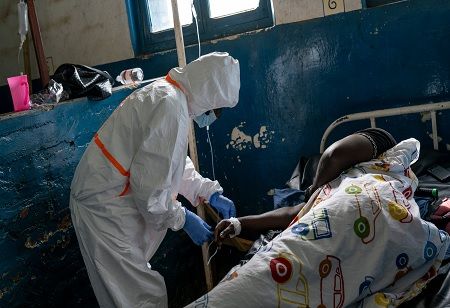
The Ebola crisis in DR Congo has entered a more dangerous phase, with the Ebola outbreak now spreading to a fourth province.
The latest development marks a major setback for health authorities, who are already struggling to contain the deadly virus caused by the rare Bundibugyo strain. As the Ebola crisis expands, experts warn that controlling the outbreak will become even more difficult due to the wider area affected and the growing number of people at risk.
In our previous report, we highlighted why the outbreak had put global health experts on alert, mainly because it involves the Bundibugyo strain, which has no approved vaccine or strain-specific treatment. The confirmation of a case in a fourth province now signals that the outbreak is moving beyond its initial hotspots, increasing pressure on surveillance and emergency response teams.
According to health authorities, at least one confirmed Ebola case has been detected in a fourth province, extending the outbreak across much of northeastern DR Congo. The wider geographic spread raises concerns that more communities could be exposed if the virus is not contained quickly.
As of June 29, authorities have reported 1,274 confirmed Ebola cases, including 360 deaths, making it one of the country's most serious outbreaks in recent years. Around 15 million people now live in the affected areas, increasing the challenge of preventing further virus spread.
Also Read: Travel Alert: India Mandates Airport Checks with Air Suvidha 2.0
Unlike outbreaks caused by the Zaire strain of Ebola, the current epidemic is driven by the Bundibugyo strain, for which there is no licensed vaccine or approved strain-specific treatment. This leaves health officials dependent on traditional outbreak control measures such as contact tracing, rapid testing, patient isolation, safe burials, and community awareness campaigns.
The response has also become more difficult because parts of eastern DR Congo continue to face armed conflict, population displacement, and limited healthcare access. These conditions make it harder for response teams to identify infected individuals, trace their contacts, and stop further transmission. Reports have also highlighted that many infected people remain outside the reach of health authorities, increasing the risk of continued community spread.
The WHO and Congolese health authorities are expanding surveillance, strengthening laboratory testing, and deploying additional response teams to affected areas. Health workers are also continuing contact tracing and public awareness campaigns to detect infections early and prevent the virus from spreading further.
Although the outbreak remains concentrated in Central Africa, international health agencies continue to monitor the situation closely because cross-border transmission remains a possibility. The latest spread into a fourth province shows that the Ebola outbreak is still evolving, making rapid detection and coordinated public health action critical in the weeks ahead.


.jpg)
