India Pharma Outlook Team | Monday, 06 July 2026
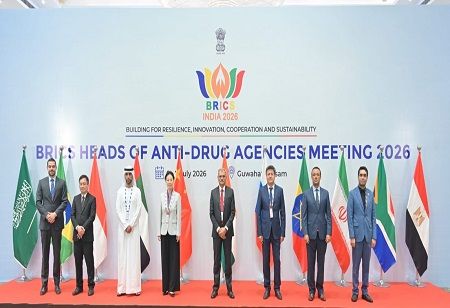
India is leading the BRICS Heads, who will address the global efforts against drugs, in Guwahati. This marks an important step in strengthening global cooperation against drug trafficking and substance abuse.
The meeting will be organized by the Narcotics Control Bureau (NCB), under the Ministry of Home Affairs. The meeting will be attended by senior officials and heads of anti-drug agencies from BRICS nations with an agenda to address emerging challenges in narcotics control.
BRICS is a group of major emerging economies, which includes Brazil, Russia, India, China, and South Africa. It will now be expanding to include additional member nations. These groups play a key role in global economic and strategic cooperation among developing countries.
The 2026 anti-drug agencies meeting is held in Guwahati, Assam. The meeting in Guwahati highlights India’s focus on regional inclusion and the importance of the Northeast in international cooperation initiatives.
Also Read: Driving Vaccine Adoption Beyond Pediatric Immunization in India
The significance of this meeting lies in the growing concern of global drug trafficking. Modern drug networks operate across borders using advanced methods. Such as drug production of synthetics, dark net platforms, and digital payment systems.
Therefore, no country can stop these problems alone. So the meeting brings together BRICS nations to share information, work together, strengthen operational coordination, and build institutional partnerships.
This collaborative approach is crucial as the sophistication of drug trafficking continues to rise globally. Additionally, India’s role as a host under its BRICS leadership reflects its increasing influence in global security and discussions on governance.
It also reinforces India’s goal of a zero-tolerance approach towards narcotics and thereby addressing the transnational crime associated with it.
The meeting focuses on creating a framework to tackle drug-related challenges. The key areas of discussion include strengthening intelligence sharing mechanisms, improving real-time data exchange, and enhancing cooperation among enforcement agencies.
Similarly, another focus is on addressing the rise of synthetic drugs and new psychoactive substances, which are harder to detect and regulate. Through finding resources and expertise, BRICS nations aim to develop more effective monitoring and enforcement strategies.
However, building capacity is also a priority, with discussions around training, technology adoption, and sharing best practices across countries. This ensures that member nations are equipped to respond to evolving drug threats.
The BRICS anti-drug aims to build a more effective international response to one of the world’s most pressing security and public health challenges.
.jpg)