India Pharma Outlook Team | Thursday, 17 September 2026
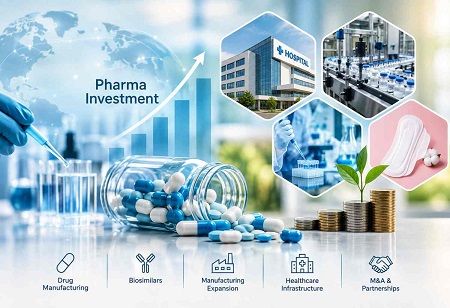
The pharma industry is going through one of its busiest stretches of investment trends in recent memory, with healthcare investment, pharma manufacturing expansion and industry consolidation all playing out simultaneously across India and global markets.
These developments also reveal a wider shift: capital is increasingly moving beyond conventional drug manufacturing toward specialized capabilities, integrated healthcare assets and portfolio diversification.
For the Indian pharma Industry, the developments could support domestic supply-chain resilience, attract further R&D Investment and create opportunities for smaller suppliers, technology providers and specialized pharmaceutical companies. However, the success of these investments will depend on execution, regulatory approvals, capacity utilization and the ability to convert capital expenditure into sustainable pharma Growth.
The 5 key takeaways from this article are:
Global private equity firm Advent International is set to invest roughly USD 328.5 million (about Rs 3,150 crore) for a 24.9 percent stake in Yatharth Hospital and Trauma Care Services, one of North India's fastest-growing hospital chains.
Advent has historically stayed close to pharma investment and pharmaceutical companies rather than hospital operators - its only prior hospital bet was Care Hospitals back in 2012 - so this deal marks a broader pivot by PE funds from pure-play drug development and manufacturing assets toward integrated healthcare infrastructure.
The transaction also carries the mandatory open-offer mechanics under Indian takeover rules: because promoters hold 55.8 percent, any large stake purchase could trigger a further 26 percent open offer.
The broader context matters too: Indian hospitals drew roughly USD 5 billion in PE investment in a single recent year, part of a wider healthcare mergers and healthcare sector consolidation wave that parallels pharma growth trends globally.
Also Read: How Deviation Trends Can Reveal Hidden Pharma Quality Risks
Amneal Pharmaceuticals is deepening its India footprint with plans to invest up to USD 200 million (around Rs 1,680 crore) over the next four to five years to build two new greenfield facilities in Ahmedabad - one dedicated to peptide synthesis and the other to advanced sterile fill-finish drug manufacturing.
The peptide-synthesis facility positions Amneal for complex generics and GLP-1-class therapies - a fast-growing, high-margin segment where manufacturing capacity is currently a global bottleneck.
It also ties directly into Amneal's parallel push into biosimilar manufacturing, including oncology biosimilars referencing Neupogen, Neulasta and Avastin, since sterile fill-finish capacity is essential infrastructure for biosimilars, not just small-molecule generics. Amneal’s recent acquisition of Kashiv BioSciences has also strengthened its biosimilar capabilities.
Novartis shares slumped roughly 11 percent in a single trading session — wiping out nearly USD 30 billion in market value - after its muscle-wasting disorder drug del-desiran failed a late-stage study. The drug came from Novartis's USD 12 billion acquisition of Avidity Biosciences.
The failure marked the company's second major clinical setback within days, following disappointing results for cardiovascular candidate pelacarsen and a pause of eight trials for cell therapy rap-cel after three patient deaths.
Novartis's earlier USD 2.9 billion MorphoSys acquisition has also run into trouble, with lead asset pelabresib carrying a safety signal since acquisition, pointing to a pattern across multiple healthcare mergers rather than an isolated failure.
The real strategic pressure point is that Novartis faces a steep patent cliff on legacy drugs Entresto, Promacta and Tasigna, expected to create a roughly USD 4 billion revenue gap - meaning the appetite for more pharma mergers and licensing deals isn't going away, even as investors demand tighter due diligence.
Also Read: 10 GLP-1 Drugs Revolutionizing Diabetes & Obesity Treatment
Chennai-based Amrutanjan Health Care has commissioned a new greenfield sanitary napkin manufacturing facility in Seetharampur, Telangana, at a final investment cost of Rs 150 crore - up from the Rs 123 crore originally approved by its board in 2024. The plant is Amrutanjan's fifth manufacturing facility.
The bigger strategic shift is that Amrutanjan is moving its "Comfy" sanitary napkin brand from third-party outsourced production to full in-house pharma manufacturing, a move expected to materially improve margins that were previously squeezed by outsourcing fees and raw material costs.
The plant's two fully automated, high-speed production lines imported from Japan give it an annual capacity of 700 million napkins, positioning Amrutanjan to compete not just domestically but in export markets.
The expansion also benefits from the central government's PLI (Production Linked Incentive) scheme for textiles.
Taken together, these four developments trace a consistent thread across the pharma industry: capital is flowing aggressively into pharma manufacturing, biosimilar manufacturing and healthcare infrastructure