India Pharma Outlook Team | Tuesday, 18 August 2026
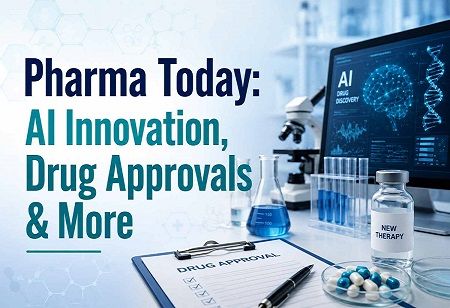
AI innovation is accelerating across India’s drug development, approvals, medical devices and specialized healthcare ecosystem.
TCS has launched an agentic AI platform for drug development, while Mankind Pharma has restructured security for its non-convertible debentures and released its pledge on Bharat Serums shares.
Biocon has secured US FDA approval for two Yesintek prefilled autoinjector formats. IIT Mandi researchers have developed a sea-urchin-inspired coating for 3D-printed bone implants, and AIIMS New Delhi has launched a national retina training center.
Together, these developments highlight measurable progress across pharma innovation and healthcare capacity building.
Tata Consultancy Services (TCS) has launched TCS ADDAgentHub, a role-based, enterprise-ready platform that enables pharmaceutical companies to deploy agentic AI across drug development workflows. The platform allows companies to build customized AI agent hubs and deploy them across clinical workflows while retaining human oversight for governance and decision-making.
“The platform enables a shift from reactive to proactive, scalable, and audit-ready operations amidst an ever-changing regulatory environment. TCS’ strategy is to move towards autonomous enterprise functions where an AI agentic workforce operates alongside humans driving innovation in drug development and improving patient safety,” said Debashis Ghosh, President, Lifesciences and Healthcare, TCS.
TCS reports up to 40 per cent efficiency gains in clinical data management, up to 30 per cent reduction in clinical study build effort through metadata-driven automation and up to 30 per cent cost savings in end-to-end safety case processing. AI-powered safety agents can also reduce quality control effort across R&D operations.
Also Read: Why Vaccine Innovation Must Go Beyond Traditional Platforms
Mankind Pharma has released the pledge on 28,280 equity shares of Bharat Serums and Vaccines Ltd (BSVL), representing 38.68 per cent of BSVL’s paid-up equity share capital. The company completed the release on August 17, 2026, after creating revised security cover for its outstanding non-convertible debentures (NCDs).
Mankind had announced the proposed realignment of its NCD security cover on May 19. The company subsequently created revised security in favor of Catalyst Trusteeship Limited, the debenture trustee, over tangible and intangible assets of the company and its subsidiaries. NCD holders approved the arrangement on July 13, followed by BSE approval on July 21.
The revised security cover now stands at 1.26 times the outstanding NCD amount, complying with applicable SEBI regulations and the Debenture Trust Deeds. Mankind now has no Bharat Serums shares pledged as security for its NCDs.
Biocon’s US subsidiary has received supplemental USFDA approval for two single-dose prefilled autoinjector presentations of Yesintek. The approved formats include Yesintek 45 mg/0.5 ml and Yesintek 90 mg/ml single-dose prefilled autoinjectors.
Yesintek treats moderate to severe plaque psoriasis and active psoriatic arthritis in adults and children aged six years and older. It also treats moderately to severely active Crohn’s disease and ulcerative colitis in adults. The new delivery formats expand treatment options across different care settings and strengthen Biocon’s US immunology portfolio.
Researchers at IIT Mandi have developed a dual-layer hydroxyapatite coating for 3D-printed bone implants, using microscopic needle-like structures inspired by sea urchins. The research, published in the Chemical Engineering Journal, addresses two key implant challenges, which are bacterial infections and poor integration with surrounding bone.
The team, led by Dr. Sumit Murab, chemically activates a 3D-printed polylactic acid (PLA) scaffold through alkaline treatment before applying hydrothermal treatment at 90°C. This process creates clusters of hydroxyapatite needles across the surface. Hydroxyapatite supports bone growth, while the microscale structures mechanically disrupt bacterial cells.
Unlike antibiotic-based approaches, the coating uses physical surface characteristics to inhibit bacterial colonization. The researchers also highlight the process’s relatively low temperature and simplicity, with potential applications in orthopedic and dental implants and other biomedical devices.
The Dr Rajendra Prasad Centre for Ophthalmic Sciences at AIIMS New Delhi has launched the Modulated Retina Training Program at its newly inaugurated National Retina Skill Development Center in partnership with the Roche India Healthcare Institute (RIHI).
The center includes the Retina Skill Lab CORE (Comprehensive Retinal Education), equipped with high-resolution optical coherence tomography systems, fundus cameras and specialized microscopes. The program will train more than 100 ophthalmologists from public health systems over three years through eight structured modules covering key aspects of retinal care.
Rajji Mehdwan, Director, Roche India Healthcare Institute (RIHI), and MD and CEO, Roche Pharma India, said, “Retinal diseases represent an invisible crisis for the country. Yet, India continues to face a significant gap in the availability of trained retina specialists and skilled professionals who can enable early detection and timely management. This is precisely where partnerships such as this with AIIMS can make a meaningful difference."
The initiative addresses a major capacity gap as retinal disorders, including diabetic retinopathy and age-related macular degeneration, contribute significantly to irreversible vision loss in India. According to the Vitreo-Retina Society of India, India has around 1,700 retinologists, a number that remains inadequate for the country’s disease burden.
The latest developments show pharma innovation progressing across distinct but connected fronts, which are AI-enabled drug development, financial restructuring, US drug approvals, advanced medical device research, and specialist healthcare training.
TCS has quantified operational gains from agentic AI, Biocon has expanded its US immunology delivery options, IIT Mandi has advanced infection-resistant implant technology, and AIIMS has created a structured pathway to expand retinal expertise. Together, these data points indicate that India’s healthcare ecosystem continues to build capabilities across both commercial pharma and specialized clinical infrastructure.
.jpg)