Advanced Safety Practices for Pharmaceutical Manufacturing Workers

Ajay Sunny, Correspondent at India Pharma Outlook

 Advanced Safety Practices for Pharmaceutical Manufacturing Workers

Pharmaceutical manufacturing workers form the backbone of resilient domestic and global drug supply chains. They operate in highly regulated, sterile environments to produce, package, and ensure the quality of essential medicines, from everyday generics to complex biologics and potent therapies. In an era of geopolitical tensions, pandemics, and raw material vulnerabilities, these frontline professionals maintain production continuity, prevent shortages, and safeguard patient access to life-saving drugs. Their expertise in adhering to Good Manufacturing Practices (GMP), quality controls, and safety protocol Guide directly supports supply chain integrity, enabling timely delivery across borders while minimizing disruptions from quality issues or contamination events. Without a skilled, healthy workforce, even advanced facilities risk downtime, recalls, or failures that ripple through healthcare systems worldwide.

MSDs and Chemical Exposure Risks in Pharma Plants

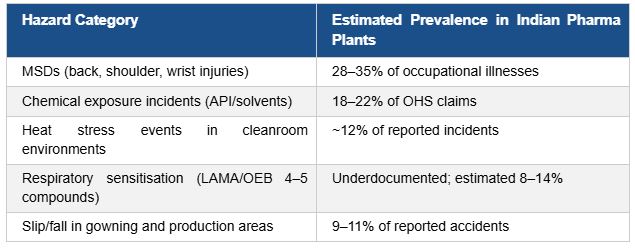
Despite the critical nature of their role, pharmaceutical workers face significant occupational hazards. Repetitive tasks such as capping, labeling, pipetting, manual material handling, and packaging—often performed in cleanrooms under time pressure—contribute to high rates of musculoskeletal disorders (MSDs). Studies on pharmaceutical workers report MSD prevalence ranging from approximately 63% to over 83%, with common complaints in the lower back, neck, shoulders, wrists/hands, and lower extremities. Symptoms include aches, pain, cramps, and moderate severity that still allows work but leads to discomfort, reduced productivity, and potential long-term disability.

Broader manufacturing data underscores the scale: In the U.S. private sector, MSDs accounted for about 30% of days-away-from-work (DAFW) cases in recent years, with manufacturing among the top contributors alongside retail and healthcare. Median DAFW for MSD cases hovers around 12 days, imposing substantial costs through lost productivity, medical expenses, and workers’ compensation. Factors exacerbating risks include prolonged standing, awkward postures, high repetition, and extended shifts (e.g., over 8 hours), which elevate ergonomic strain in pharma’s high-volume lines.

Chemical exposure presents another major threat. Workers handle Active Pharmaceutical Ingredients (APIs), many of which are potent compounds capable of causing adverse effects at very low concentrations via inhalation, skin contact, or accidental ingestion. Risks include respiratory irritation, dermatitis, systemic toxicity, and long-term effects from potent or highly potent substances. While full-shift exposures often stay below limits with proper controls, short-term peaks during tasks like powder scooping or equipment cleaning can spike dust or vapor levels. Industry-wide, chemical-related injuries, though declining as a percentage of total cases, still result in thousands of incidents annually, with potential for acute poisonings or chronic conditions. Dermatitis from repeated PPE use or cleaning agents is also common.

These issues threaten not only worker health but also supply chain stability: injured or ill workers lead to absenteeism, training burdens, reduced output, and higher error rates that could compromise product quality.
                          

Also Read: India Pharma Startups: Navigating Growth Funding and Market Reality

Ergonomics and Repetitive Motion: Protecting the Hands That Manufacture Health 

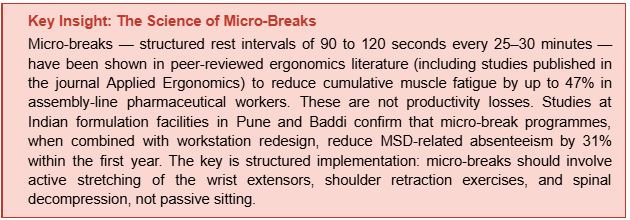
Pharmaceutical manufacturing is, at its core, a hands-on industry. Despite increasing automation in upstream synthesis, the downstream operations — blister packing, manual capping, label application, tablet counting, ampoule inspection, and secondary packaging — remain heavily reliant on human dexterity performed at pace, under pressure, and at scale. A packaging operator on a 12-hour shift may perform the same wrist flexion-extension movement upwards of 8,000–12,000 times. This is the epidemiological breeding ground for Repetitive Strain Injuries (RSI), carpal tunnel syndrome, rotator cuff tendinopathy, and lower back dysfunction — collectively categorised as Musculoskeletal Disorders (MSDs).

Workstation adjustment is equally non-negotiable. The principle of neutral posture — maintaining the spine in its natural lordotic and kyphotic curves, keeping elbows at approximately 90 degrees during manual tasks, and ensuring that the work surface height is positioned to eliminate shoulder elevation — is the foundation of MSD prevention. In cleanroom environments, this is complicated by the need for gowning, restricted footwear, and the absence of conventional ergonomic furniture. The following checklist addresses this challenge directly.
                          

Chemical Exposure & Potent Compound Safety: Engineering Out the Invisible Risk 

Active Pharmaceutical Ingredients (APIs) are, by molecular design, biologically active at microgram quantities. This pharmacological potency — the very property that makes them therapeutic — also makes occupational exposure a critical risk. Workers in API synthesis, granulation, blending, and sterile filling operations may be exposed to potent compounds that carry Occupational Exposure Limits (OELs) measured in nanograms per cubic metre of air. A single shift's inadequate containment can result in acute toxicity, hormonal disruption, reproductive harm, or long-term carcinogenesis.

The industry standard framework for managing this risk is the Hierarchy of Controls — a structured, prioritised approach to hazard management that moves from the most effective permanent solutions to the least effective temporary measures. Dr. Venkataraman emphasises that in high-potency API environments, the hierarchy is not a philosophical guide but a legal and engineering mandate.
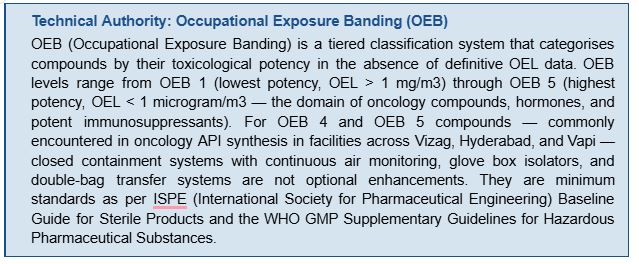
                          

HEPA filtration — High-Efficiency Particulate Air filtration — is the cornerstone of engineering control for potent compounds. Facility design must ensure that OEB 4/5 handling areas operate under negative pressure relative to adjacent spaces, with HEPA-filtered exhaust. HVAC systems must be validated for HEPA filter integrity (using DOP/PAO challenge testing) on a minimum bi-annual basis, or following any facility modification. Potent compound containment failures must trigger immediate area evacuation, biological monitoring of exposed workers, and root cause investigation under a documented CAPA (Corrective and Preventive Action) framework.

Cleanroom Safety & PPE Integration: When Protection Becomes a Hazard 

Cleanrooms impose unique burdens: full-body gowns, hoods, booties, gloves, and often respirators or powered air systems restrict movement, vision, and heat dissipation. Workers perform precise tasks under these constraints, increasing risks of heat stress, fatigue, restricted visibility (fogging, limited peripheral view), and dermatitis from prolonged occlusion or cleaning residues.

                          

Actionable Steps:

  • Hydration Protocols: Provide approved electrolyte solutions or water stations with scheduled intake. Monitor urine color and symptoms (dizziness, cramps). Acclimatize new workers gradually.
  • Gowning-Room Safety Checks: Pre-shift inspections of gown integrity, sizing, and fit. Train on proper sequencing to minimize contamination and skin irritation. Post-use doffing areas with waste segregation and skin care routines (moisturizers for dermatitis prevention).
  • Respiratory Protection Programs: OSHA-compliant fit-testing, training, and maintenance. Select low-burden options like powered systems where possible. Rotate personnel to limit continuous wear time.
  • Additional Measures: Cooling vests or undergarments if feasible; task rotation; buddy systems for monitoring; climate-controlled gowning areas. Address dermatitis through hypoallergenic materials and barrier creams.

Regular health surveillance and feedback loops help tailor PPE to tasks.

Also Read: World Health Day: How Global Healthcare is Evolving in 2026

Future Outlook: Technology & Automation — The Zero-Harm Horizon

The convergence of Industry 4.0 and pharmaceutical GMP is rapidly reshaping the occupational safety landscape of drug manufacturing. The most transformative development is the deployment of Collaborative Robots — universally known as Cobots — in high-risk manual operations. Unlike conventional industrial robots that require physical separation from human workers, cobots are designed with force-limiting sensors, soft-stop functions, and spatial awareness that allow them to operate safely within shared human workspaces without guarding barriers.

In the pharmaceutical context, cobots are being deployed to absorb the highest-risk categories of manual work: heavy tray loading and unloading in autoclave operations (eliminating MSDs from repetitive heavy lifting), continuous blister-pack feeding and carton erecting (eliminating RSI from repetitive motion tasks), and vial inspection operations requiring sustained visual concentration under bright lighting (reducing eye strain and associated error rates). The risk reduction case for cobots is not aspirational — it is increasingly evidenced.

Beyond cobots, AI-powered environmental monitoring systems are beginning to replace periodic manual air sampling in high-potency areas, providing continuous real-time OEL breach alerts and predictive maintenance signals for containment equipment. Digital wearables — including smart bands that monitor heart rate variability, skin temperature, and movement patterns — are being piloted by forward-looking EHS teams at Indian pharma majors to provide early-warning signals for heat stress and ergonomic over-exertion, enabling supervisory intervention before injury occurs.

The ethical dimension of automation in pharma safety deserves direct address: cobot deployment and AI monitoring are not instruments of workforce reduction. They are, when implemented within a worker-centric safety culture, instruments of workforce protection. The workers displaced from the most hazardous repetitive tasks must be upskilled into cobot operation, maintenance, and quality oversight roles — a transition that India's National Skill Development Corporation (NSDC) and the Pharma Sector Skill Council are actively facilitating through certified training programmes.

on the deck

Most Viewed

Addressing Antimicrobial Resistance (AMR) Through Collaborative Efforts Fostering a Quality Culture in the Pharmaceutical Industry Advancements in Computer-Aided Drug Design for Pharmaceutical Research Why India is Gaining Popularity for Clinical Trials The Future of Kidney Transplants in India Usage of Conversational AI in the Health Insurance Sector Strategies for India to Reduce Its API Dependence on China Business Impact of USFDA Approvals on Indian Pharma Companies Innovative Strategies for Expanding Access to Life Saving Healthcare Solutions Badhal Village Crisis: How Rapid Diagnostics Could Have Saved Lives Why India is a Hotspot for Biotech Startups? Why Adapting Flexibility in IP Rights will Drive Generics Market Meeting the Challenges of High-Potency API (HPAPI) Production Impact of Human Factors Engineering on Medical Device Safety The Future of Pharma: Embracing Continuous Manufacturing The Role of Orphan Drugs in Treating Rare Diseases Emerging Technologies Shaping the Future of Drug Formulation Strategies for Optimizing Pharmaceutical Supply Chain Efficiency The Future of Medicine: Harnessing the Power of RNA-based Therapeutics AI in Medicine: Unmasking the Myths and Embracing the Transformative Reality Cycle Pharma Acquires Banner Life Sciences WHO's First-ever Global Summit on Traditional Medicine Starts in Gujarat The Importance of Data Integrity in Pharmaceutical Quality Control DCGI in Talks with Stakeholders to Develop a Standardised Web Platform to Assure Drug Quality and Patient Safety Glenmark Pharmaceuticals secures ANDA Nod for 0.03 per cent Tacrolimus Ointment Streamlining Laboratory Operations with a Modern LIMS Healthtech Start-up Suraksha QR Ropes In Actor Murali Sharma as its Brand Ambassador Unlocking the Potential of Pharmacogenomics: Enhancing Drug Safety and Efficacy The Impact of Pharmaceutical Testing on Drug Development India has Identified Three Health Priorities to Strengthen Global Health Infrastructure, says WHO National Health Authority launches 100 Microsites Project to Speed Up Digital Health Adoption India Should Partner with Australia to avail PBS for the Selection, Listing, and Pricing processes of exported drugs, says Sudarshan Jain Zydus Lifesciences India More than Doubles Profit Due to Increased Sales in the US India Triples Organ Donations over Past Decade says Union health minister Mansukh Mandaviya Advent Therapeutics Awarded $3 Million NIH Grant For Novel Neonatal Lung Therapy Three Pharma Marketing Strategies That Drive Sales Novartis Targets India's Rare Disease Market with 17 Clinical Programs UK Health Regulator approves GSK's Vaccine for the common respiratory virus RSV WHO Urges Increased Use Of Recommended Malaria-Fighting Tools Karnataka Budget Offered a Significant Boost to Health & Lifesciences Start-ups with Focus on Infrastructure & Innovation Three High Potential Moonshot Project Areas in Pharma CCI approves Bharat Biotech International-Eastman Exports deal How Biotech is Revolutionizing the Fight Against Cancer LifeCell and HaystackAnalytics ink strategic pact to scale-up TB whole genome sequencing pan-India Mankind Pharma IPO To Open On April 25 With A Price Fixed At Rs 1,026-1,080 Per Share US CDC Approves Second Omicron-Updated COVID Booster For Adults Three Trends that will Impact Pharmaceutical Industry in 2023 ModeX Therapeutics Commences Phase I EBV Vaccine Trial with Merck Designing Impactful Leadership and Talent Management Programs with Strategies for Success Novo Nordisk and Valo Health Partner to develop novel Treatments FOPE Calls for Extended Deadline for Schedule M Compliance Telix Pharma To Acquire ImaginAb to Boost Therapeutics and Innovation Roche Secures US FDA Approval for its Ultra-Sensitive ISH test Rappta Therapeutics and SpringWorks Partner on Molecular Glue Targeting PP2A Taro Pharma To Acquire entire stake in Antibe Therapeutics Innovent Biologics Secures Breakthrough Therapy Designation for IBI343 Emcure Pharma Launches Largest R&D Centre in Ahmedabad Zydus Bags USFDA Nod for Phase II(b) Trial to Optimize Usnoflast Dosage US FDA Approves Amgen's Lumakras-Vectibix Combo for KRAS G12C-Mutated mCRC Glenmark Pharma Unveils generic anticoagulant injectable emulsion Strides Pharma Bags USFDA Nod for OTC Acetaminophen-Ibuprofen Combo Tablets US FDA Lifts Hold on Sanofi's Trial to Make Cialis Available Over-the-Counter Hoth Therapeutics Expands Intellectual Property with New Patents Jaguar Health Starts POC Trial of Crofelemer for Rare Pediatric Disease MVID Pharma and Healthcare Sector Eyes Union Budget 2025 for Innovation Boost How Innovative Drug Formulations are Enhancing Treatment Outcomes Apollo and Mayapada Healthcare Unite to Boost Indonesia's Healthcare Novo Nordisk Reports Positive Phase 1b/2a Results for Amycretin Govt to Extend Schedule M Compliance Deadline for Drug Manufacturers to Dec Lupin Secures US FDA Nod for Ipratropium Bromide Nasal Solution ANDA Granules Pharmaceuticals Secures USFDA Nod for Key Generic Drug Bajaj Healthcare Bags DCGI Nod to Manufacture Pimavanserin API & Formulation Union Budget 2025: Healthcare Gets 9.78% Boost, Allocation Nears 1 Lakh Crore Metropolis & Roche Launch Self-Sampling HPV Test for Cervical Cancer Sigachi Industries Invests $1M in Hyderabad R&D Hub for API Innovation Pharma Testing Market Surges with Rising Demand for Biologics ISTH Releases Clinical Practice Guideline For Haemophilia Treatment Sanofi and Biovac Lead Polio Vaccine Manufacturing Capabilities Sun Pharma and Takeda Ink Pact To Market Gastrointestinal Drug Takeda and Ascentage Pharma Ink Option Agreement For Olverembatinib Enhancing Compliance through Effective Pharmaceutical Regulatory Affairs Strategies India poised to become a Global Hub for Clinical Trials: Exec SCHOTT Pharma Unveils Next-Gen Polymer Syringes for Enhanced Safety GSK's Jemperli Gains EU Nod for First-Line Treatment of Endometrial Cancer Union Health Secretary Urges Stronger Drug Regulations for Quality Control Telangana Govt Inks Landmark Deals to Propel Life Sciences and Job Growth R&D in Indian Pharma: Breakthroughs and Innovations in 2024 Dr. Reddy's Partners with Shanghai Henlius to Develop Cancer Drug Uniphar Expands Global Footprint with Three New Facilities 74th Indian Pharmaceutical Congress 2025 Opens Registrations AGC Pharma Expands HPAPI Capabilities in Barcelona to Meet Growing Demand The Future of Genomic Sequencing: Trends That Will Define the Next Decade Lexaria Bioscience Ethics Review Board Nod to Commence New GLP-1 Study Amitabh Kant Urges India to Focus on Innovation at BioAsia 2025 Government Enhances Research & Integration Initiatives in Unani Medicine Blind & Deaf individuals face Major Barriers to access Medicines: Report C-CAMP and PariSante Campus launched Indo-French Life Sciences Hub Jaguar Health Begins Pediatric Trial for Crofelemer in Short Bowel Syndrome Algiax Pharma Reports Promising Phase 2a Results for AP-325 Govt Bans 34 Antimicrobials for Use in Animals Pharmaceutical Procurement Strategies: How to Optimize Costs Personalized Medicine: Get Tailored Treatment Plans for You Now How to Bridge the Healthcare Gap in Emerging Markets with MedTech The Evolution of In-Vitro Diagnostics: Trends and Future Prospects Needle-Free Injection System: A Game Changer in Less Pain Vaccination How Global Capability Centers are Shaping the Future of Biometrics Building a Successful Pharma Brand in India: The Role of Scientific Communication Unlocking India's Innovation Potential in Pharma The Future of Green Chemistry in API Production Top 10 Pharmaceutical Recruitment Consultants - 2024 | Pharma Outlook Blockchain for Secure Pharmaceutical Supply Chains - 2025 & Beyond Mass Spectrometry in Biomarker Discovery for Early Disease Detection Iconovo and Lonza Team up to Advance Intranasal Biologic with ICOone Nasal Fetal Imaging to Cardiac Diagnosis: The Expanding Role of Ultrasound Balancing Innovation and Affordability in Medical Solutions for India Changing Landscape for LTBI and Syndromic Testing Methodologies How Advanced Training Methods can Enhance Patient Care Balancing Cost Efficiency and Compliance in Pharmaceutical Manufacturing LUB Urges Govt to Scrap Mandatory Lab Testing for Cough Syrup Exports Role of Optical Imaging in Early Cancer Detection and Treatment Hoth Therapeutics Unveils Promising Data for KIT-Targeting Therapy Pharmexcil Engages ASEAN Nations to Boost Pharma Trade Ties Fortis Partners with Teleflex for South Asia UroLift Training Anti-Infectives: How New Research is Shaping Infection Control Building Bridges for Sustainable Growth through Strategic Alliances in Ethical Pharmaceuticals Quality as the Cornerstone of Lab Solutions FDA Approves Roch's NSCLC Diagnostic Linked to Emrelis How Early Detection is Transforming Cancer Treatment in India Ensuring Data Privacy in Pharma World Enhancing Clinical Trial Supply Chain Resilience to Address Global Disruptions in India Cost-Effectiveness of Minimally Invasive Surgery in Outpatient Settings How Organic Synthesis is Accelerating Drug Discovery in Pharma Strategic finance for pharmaceutical innovation and stability Top 10 Teleradiology Service Providers - 2024 | Pharma Outlook Importance of Investing in R&D and Quality for Competitive Advantage in Eye Care Top 10 In Vitro Diagnostics Companies - 2024 | Pharma Outlook Phytopharmaceuticals: Driving Global Herbal Medicine Innovation Gender Gap in Healthcare: Why Women's Health Needs More Research Impact of Modern Technology on the Indian Life Sciences Sector Why Global Pharma Expects CDMOs to Be Ready for Joint Inspections The Role of Customizable Stent Grafts for Treating Complex Anatomies Nutraceuticals vs Pharmaceuticals: Complementary or Alternative in Chronic Disease Management? Top 10 Pharma CDMO Companies In India – 2023 | Pharma Outlook Leaping Towards Global Compliance with Revised Schedule M Meril Concludes TechVentory, Boosts AI-Driven Healthcare Supply Chains 10 Pharma Sector Revolutions in India Standardizing Medicine Labeling and Embracing Digital Transformation Creating a patient-centric healthcare ecosystem for all Biomanufacturing of Enzymes: A Sustainable Approach to Industrial Biotechnology Integrating CSR into HR Practices to Enhance Brand Reputation in Pharma Merck Launches Phase 3 Trial for Promising Dengue Vaccine V181 Breakthrough: Eye-Opening Healthcare Strategies Doctors Swear By on Doctor's Day 2025 Bristol Myers Squibb Reports Strong Phase 3 Results for Deucravacitinib trail Alcon Launches Innovative Daily Lenses Designed for Long-lasting Comfort Apisolex Excipient by Lubrizol Backs Phase I Drug Success FDA Approves Enflonsia to Prevent RSV in Infants with One Dose Biosimilars in India 2025 Market Trends, Growth Forecast & Opportunities How Regulations Are Shaping India's Medical Device Landscape Bharat Biotech Partners with GSK for Shigella Vaccine Development Eli Lilly Obesity Drug Shows 11.5% Weight Loss in 12 Weeks Laborate Pharmaceuticals: Illuminating Pathways Of Quality, Affordability Innovation In Healthcare Sun Pharma Bags CDSCO Approval to Produce Fexuprazan Hydrochloride Tablets The Fusion of Biology, Medicine, Health, and AI Glenmark Gets DCGI Nod to Launch Oncology Drug BRUKINSA in India Kyndryl Partners with Dr Reddys to Automate Global IT Operations How Robotic Assisted Surgery Is Redefining Precision in Kidney Transplants Top 10 Women Disruptors in Asia Pharmaceutical Industry

Editor's Guest

Related Articles


© 2026 India Pharma Outlook. All Rights Reserved.