Fathimanoud, Correspondent, India Pharma Outlook
Drug development fundamentally depends on identifying the right biological target. A target, typically a gene, protein, or pathway, acts as the intervention point for therapy.
AI-driven target identification and disease mapping enable precise selection of these intervention points by uncovering critical biological mechanisms underlying disease.
If this target is poorly understood or biologically irrelevant, even the most promising compounds will fail in clinical trials.
Research highlights that incorrect or weak target selection is one of the leading reasons for late-stage drug failure, making early-stage AI Target Identification critically important.
Traditional discovery cycles show that only a small fraction of targets successfully translate into approved therapies. This creates a bottleneck that drives up costs and timelines. Effective targeting improves by:
In this context, AI Disease Mapping and AI Systems Biology enable researchers to connect disease mechanisms with actionable targets. By improving biological understanding, AI enhances the probability of selecting targets that truly influence disease progression.
 Target identification is the process of discovering biological entities responsible for disease mechanisms and determining whether they can be therapeutically modulated.
Traditionally, this involves hypothesis-driven experiments, literature reviews, and laboratory validation. A major reason why drug targets fail is the limited understanding of disease biology.
Many diseases, especially complex and chronic conditions, involve multiple genes, pathways, and environmental interactions.
Traditional approaches often focus on a single target without fully understanding its role within the broader biological system. This leads to therapies that may not effectively modify disease progression or may produce unintended side effects.
Another critical factor is the reliance on poor predictive models. Conventional models, including in vitro assays and computational tools, often fail to accurately predict how a drug will behave in humans. These models may overlook key biological variables, resulting in misleading outcomes during early-stage research.
The lack of human-relevant data further compounds the problem. Many drug discovery programs depend heavily on animal models or limited datasets that do not fully capture human biology. Differences between species can lead to discrepancies in how targets behave, making it difficult to predict therapeutic success in humans.
The challenges in target identification have significant economic consequences. Drug discovery cycles can extend beyond a decade, with each stage requiring substantial investment in research, trials, and regulatory processes. High failure rates, particularly in late-stage clinical trials result in billions of dollars in losses for pharmaceutical companies.
These inefficiencies also slow down innovation and limit the number of new therapies reaching patients. Resources spent on failed targets could otherwise be directed toward more promising research avenues. As competition in the pharmaceutical industry intensifies, reducing these inefficiencies has become a strategic priority:
Also Read: Pharmaceutical 4.0: Redefines Compliance, Automation & AI
The limitations of conventional disease mapping significantly affect the efficiency and success of drug discovery. One of the most critical impacts is the delayed identification of actionable targets.
When biological data is fragmented and analyzed in isolation, it becomes difficult to pinpoint which genes, proteins, or pathways are truly driving disease progression. This delay extends into the early stages of drug discovery, pushing timelines further and increasing the likelihood of selecting suboptimal targets.
Step | Traditional Workflow | AI Target Identification |
Data collection | Manual, fragmented | Integrated datasets |
Hypothesis generation | Literature-driven | Data-driven predictions |
Validation | Sequential lab testing | Parallel computational screening |
Timeline | Years | Significantly reduced |
Another major consequence is incomplete disease understanding. Traditional approaches rely heavily on linear analysis and manual interpretation of biological data, which fail to capture the complexity of interconnected biological systems. Diseases, especially multifactorial ones such as cancer, neurological disorders, and metabolic conditions, operate through dynamic networks rather than isolated pathways.
“Traditional drug development is often prohibitively slow, expensive, and inefficient. The process can take over a decade and cost billions, with extremely high failure rates, especially in late-stage trials. Much of this is due to reliance on animal models and cell-based assays that poorly predict human response,” said Tyrone Lam, Chief Business Officer (CBO) at GATC Health.
Without a comprehensive view of these interactions, researchers may overlook critical mechanisms, leading to therapies that only partially address the disease or fail altogether. This gap in understanding directly contributes to high attrition rates in drug development. Therefore, these challenges result in inefficient resource allocation. Significant time, funding, and human effort are invested in investigating targets that may ultimately prove non-viable.
Resources spent on failed programs not only represent financial losses but also delay the development of potentially effective therapies. This inefficiency underscores the need for more advanced, data-driven approaches to disease mapping and target identification.
AI Disease Mapping addresses these challenges by fundamentally transforming how biological data is analyzed and interpreted. One of its key strengths lies in integrating multi-source biological data. AI systems can combine genomics, proteomics, clinical records, and experimental datasets into unified frameworks, overcoming the fragmentation that limits traditional approaches.
This integration enables a more comprehensive understanding of disease mechanisms, allowing researchers to identify patterns and correlations that would otherwise remain hidden. Another critical capability of AI is its ability to identify hidden relationships within complex biological systems.
Using advanced computational models such as machine learning and network-based analysis, AI can uncover connections between genes, proteins, and disease phenotypes that are not immediately apparent through conventional methods.
This aligns with findings from studies on network biology and knowledge-driven discovery, where AI reveals non-linear interactions and previously unknown pathways, significantly enhancing target discovery.
AI enables predictive modeling of disease progression, which represents a major advancement over static analysis. Instead of merely describing biological states, AI models can simulate how diseases evolve over time and how different interventions may influence outcomes.
This predictive capability allows researchers to anticipate which targets are most likely to produce therapeutic benefits, thereby improving decision-making early in the drug discovery process.
AI enhances disease understanding by combining AI Systems Biology and network-based approaches. Instead of studying isolated components, AI evaluates entire biological systems, capturing the complex interactions between genes, proteins, pathways, and environmental factors.
This holistic view enables researchers to uncover hidden relationships and identify key drivers of disease that may not be apparent through traditional methods.
Core approaches
The integration of AI into disease biology enables a far more holistic understanding of diseases, moving beyond isolated gene or protein analysis to capture the full complexity of biological systems.
Through leveraging approaches such as systems biology and network-based modeling, AI can map interactions across multiple pathways and layers of biological data, providing a comprehensive view of how diseases develop and progress. This deeper insight allows researchers to move past conventional assumptions and uncover novel intervention points that may not be visible through traditional methods.
As a result, therapies can be designed with a stronger scientific foundation, ensuring better targeting of the underlying biology. Therefore, this approach leads to an improved alignment between biology and therapy, as treatments are developed based on precise biological evidence rather than generalized hypotheses.
AI leverages multiple computational models to improve AI Target Identification accuracy. These models integrate vast biological datasets, including genomics, proteomics, and clinical data.
This is to uncover hidden patterns and relationships. By combining predictive analytics with deep learning techniques, AI enhances the speed and precision of identifying viable therapeutic targets, significantly reducing traditional research timelines.
Model | Description | Role in Drug Discovery |
Machine Learning | Uses statistical algorithms to learn patterns from data and make predictions without explicit programming. | Identifies potential drug targets, predicts outcomes, and prioritizes candidates based on historical data. |
Deep Learning | A subset of machine learning using neural networks with multiple layers to process complex data like images and sequences. | Analyzes genomics, imaging, and molecular structures to uncover hidden biological patterns. |
Graph Neural Networks (GNNs) | Models data as networks (nodes and edges) to understand relationships between entities. | Maps interactions between genes, proteins, and diseases to identify novel targets and pathways. |
Knowledge Graphs Drug Discovery | Structured networks integrating diverse biological and clinical data into interconnected relationships. | Connects drugs, diseases, and targets to enable hypothesis generation and drug repurposing. |
Large Language Models (LLMs) | AI models trained on vast text data to understand and generate human-like language. | Extract insights from scientific literature, identify trends, and support hypothesis generation in research. |
Also Read: Driving Vaccine Adoption Beyond Pediatric Immunization in India
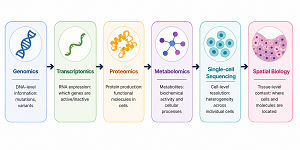 AI Multiomics integrates diverse biological datasets to provide a unified understanding of disease.
Through combining genomics, proteomics, transcriptomics, and metabolomics data, it uncovers complex biological interactions that are often missed in single-layer analysis.
This integrated approach enables more accurate identification of disease drivers and supports the development of highly targeted and personalized therapeutic strategies.
AI-driven multiomics integration allows researchers to build a comprehensive profile of diseases by combining multiple biological layers into a single analytical framework. Instead of studying genes, proteins, or metabolites in isolation, AI connects these datasets to reveal how different biological components interact in real time.
Another major advantage is the ability to identify multi-layer interactions that are often invisible through traditional research methods. AI models can detect relationships between genetic mutations, protein expressions, and metabolic changes.
That will help scientists understand how diseases evolve and progress. These insights are critical for uncovering hidden pathways and previously unknown biological connections.
This approach also significantly improves AI Drug Targets discovery by prioritizing targets that are supported by evidence across multiple biological layers. Instead of relying on a single data source, AI validates targets through integrated signals, increasing the likelihood of success in drug development.
As a result, therapies become more precise, effective, and aligned with actual disease biology. AI enables the simultaneous analysis of complex datasets, uncovering relationships that conventional approaches often miss.
Key Benefits
AI Biomarker Discovery plays a critical role in linking targets to clinical outcomes. AI can identify measurable biological indicators that signal disease presence, progression, or treatment response. That ranges from genomic and proteomic data to real-world clinical records.
These biomarkers act as a bridge between early-stage target identification and real-world patient outcomes, ensuring that therapies are not only scientifically valid but also clinically relevant.
AI enhances biomarker discovery by detecting subtle patterns and correlations that are often missed by traditional statistical methods. Machine learning models can continuously learn from new data, improving the accuracy and reliability of biomarker identification over time.
Types of biomarkers
Category | Predictive Biomarkers | Prognostic Biomarkers | Companion Diagnostics |
Purpose | Predict response to a specific treatment | Indicate disease outcome or progression | Guide safe and effective use of a specific drug |
Focus | Treatment effectiveness | Disease course (independent of treatment) | Matching patients with the right therapy |
Clinical Use | Select patients likely to benefit from a therapy | Assess risk, survival, or recurrence | Identify eligible patients, dosage, and monitoring |
Impact on Treatment | Avoids ineffective treatments | Helps plan treatment intensity | Ensures personalized and targeted therapy |
Example Use Case | Identifying responders to targeted cancer drugs | Predicting cancer recurrence risk | Diagnostic test approved alongside a drug |
Knowledge Graphs Drug Discovery integrates structured and unstructured data into interconnected networks. These graphs link entities such as genes, proteins, diseases,  and drugs, allowing researchers to visualize and analyze complex biological relationships in a more intuitive way.
Through organizing information into nodes and connections, knowledge graphs help uncover hidden associations that are difficult to detect through traditional data analysis.
AI enhances these knowledge graphs by continuously learning from new data sources, including scientific literature, clinical trials, and real-world evidence.
This dynamic updating ensures that the network remains current and increasingly accurate over time. As a result, researchers can identify novel drug targets, predict drug–disease relationships, and even discover opportunities for drug repurposing more efficiently.
Key features
Knowledge graphs allow researchers to explore complex biological relationships at scale, making them essential for modern drug discovery pipelines. This not only accelerates hypothesis generation but also strengthens the overall drug discovery pipeline by connecting fragmented data into a unified, actionable system.
Benefits
Rare diseases often lack sufficient data, making traditional research difficult. AI addresses this gap effectively. AI addresses this gap effectively by leveraging advanced algorithms that can learn from limited, fragmented, and heterogeneous datasets.
Through integrating data from multiple sources such as genomic studies, clinical records, and patient registries, AI can identify patterns that would otherwise remain undetected.
AI-powered disease mapping also enables researchers to draw insights from similar or related diseases, using transfer learning and pattern recognition to fill data gaps. This approach helps in understanding disease mechanisms, identifying potential biomarkers, and uncovering therapeutic targets even when direct data is scarce.
During the COVID-19 pandemic, BenevolentAI used its AI-driven platform to rapidly analyze vast amounts of biomedical data, including scientific literature, clinical results, and  molecular databases. The goal was to identify existing drugs that could be repurposed to fight the virus, saving critical time compared to developing a new drug from scratch.
Using advanced machine learning models, the system screened antiviral compound libraries and mapped how the virus interacts with human cells.
Instead of focusing only on the virus itself, the AI identified host-target interactions specific proteins in the human body that the virus uses to replicate and spread.
This approach opened up new possibilities for treatment by targeting the body’s response rather than the virus directly. Through this process, the AI suggested Baricitinib, a drug originally approved for rheumatoid arthritis.
The model predicted that baricitinib could both reduce viral entry into cells and control the excessive inflammatory response seen in severe COVID-19 cases.
Following this discovery, the drug quickly moved into clinical trials and later received emergency use authorization in several regions. This case clearly demonstrates how AI can accelerate drug discovery timelines, enabling faster decision-making and real-world impact during global health emergencies.
"The recent surge of critically ill patients with COVID-19 in regional hotspots illustrates the need for scientists and technologists to collaborate and explore all avenues of potential treatment until vaccines are readily available. Our team at BenevolentAI published an AI-derived hypothesis of baricitinib's dual mechanism of action against COVID-19, and along with our partners at Eli Lilly, Karolinska and clinicians on the front lines have now released data showing successful outcomes in the initial patients treated with baricitinib," said Baroness Joanna Shields, CEO of BenevolentAI.
 Using generative AI, Insilico Medicine could rapidly create and evaluate thousands of potential drug candidates based on specific disease targets. These models predict how molecules will behave in the body, including their efficacy, safety, and binding properties.
This significantly reduces the trial-and-error process that traditionally takes years in pharmaceutical research. A key breakthrough from Insilico Medicine was its AI-designed drug candidate for idiopathic pulmonary fibrosis (IPF).
The company was able to move from target identification to preclinical candidate selection in a fraction of the usual time, reportedly within months.
The impact extends into clinical development as well. By selecting higher-quality candidates early, AI reduces the likelihood of late-stage failures, thereby accelerating the transition into clinical trials. This not only lowers costs but also improves the overall success rate of drug development.
“We are pleased to announce that Insilico has achieved numerous drug discovery milestones and provided new clinical hope using generative AI. We are progressing the global clinical development of the program at top speed to allow patients with fibrotic diseases to benefit from this novel therapeutic as soon as possible,” said Alex Zhavoronkov, Founder and CEO of Insilico Medicine.
Recursion Pharmaceuticals has significantly expanded its AI capabilities by releasing a large-scale immune mapping and imaging dataset, designed to accelerate drug discovery through data-driven insights.
The company’s approach is built on its core strength high-throughput cellular imaging combined with AI models. It generates millions of images showing how human cells respond to genetic changes and drug compounds. These images are then used to create detailed biological maps that capture disease behavior at a cellular level.
A key advancement highlighted in the release is the use of AI foundation models and generative AI techniques. These models learn from massive imaging datasets to understand patterns of cellular behavior. Once trained, they can:
“We have the ambition to build a machine that will industrialize drug discovery through the application of technology at each step in the discovery process. Our ability to simultaneously advance dozens of programs, including four at the clinical stage, with a relatively small team, is a testament to the disruptive power of technology thoughtfully-applied,” said Chris Gibson, Ph.D., co-founder and CEO, Recursion
This is where generative AI becomes critical, it doesn’t just analyze data but creates new insights and predictions, helping researchers explore possibilities beyond existing experimental data.
AI-driven drug discovery is significantly improving efficiency across the pharmaceutical value chain by reducing target failure rates and increasing the likelihood of clinical success. Through leveraging advanced analytics, machine learning models can identify biologically relevant targets earlier, minimizing costly late-stage failures. This leads to more informed decision-making and better prioritization of high-potential candidates.
As a result, organizations can allocate resources more effectively, ultimately lowering overall R&D expenditure. AI accelerates pipeline progression by automating data analysis, hypothesis generation, and candidate screening. What traditionally took years can now be achieved in a much shorter timeframe, enabling a faster transition from discovery to clinical trials.
Importantly, AI does not replace laboratory experimentation but complements it, improving accuracy and reducing trial-and-error. This synergy enhances productivity while maintaining scientific rigor, ensuring that innovation is both faster and more reliable.
Also Read: Top 10 Performing Indian Pharma Stocks This Quarter (2026)
 Despite its transformative potential, AI in drug discovery faces several challenges that must be addressed for broader adoption. One major issue is explainability, as many AI models operate as black boxes, making it difficult for researchers and regulators to interpret how decisions are made.
This lack of transparency can slow trust and regulatory approval processes. Additionally, biological validation remains essential, as computational predictions must still be confirmed through experimental studies.
Data-related challenges also play a critical role. Bias in datasets can lead to skewed predictions, while poor data quality can compromise model accuracy. These limitations highlight the importance of robust, high-quality, and diverse datasets.
Furthermore, regulatory acceptance of AI-driven approaches is still evolving, requiring clear standards and validation frameworks. Addressing these challenges will be key to ensuring that AI-driven insights are reliable, reproducible, and clinically applicable.
The future of AI in drug discovery is rapidly evolving with the emergence of advanced technologies such as AI scientists, foundation models, digital cells, and agentic AI systems. AI scientists are expected to automate entire research workflows, from hypothesis generation to experimental design, significantly enhancing productivity.
Foundation models trained on large-scale biological data are enabling deeper insights across multiple domains, improving prediction accuracy and generalizability. Digital cells virtual representations of biological systems are being developed to simulate disease behavior and treatment responses. This is potentially reducing dependence on traditional experimental models.
Meanwhile, agentic AI systems can autonomously plan and execute complex research tasks, paving the way for self-driving laboratories. These advancements suggest that AI will not replace human expertise or wet labs but will augment them, leading to more precise, scalable, and efficient drug discovery processes.
AI is fundamentally reshaping drug discovery by enabling faster, more accurate identification of therapeutic targets and improving overall research efficiency. Its ability to integrate complex biological data and generate predictive insights is particularly beneficial for diseases with high unmet needs, such as cancer, rare disorders, and neurodegenerative conditions.
While challenges related to data quality, validation, and regulation remain, continuous advancements in AI technologies are addressing these limitations. AI serves as a powerful complement to traditional experimental methods rather than a replacement, enhancing both speed and reliability.
As the technology matures, its accuracy and impact will continue to improve, driving more successful clinical outcomes. Ultimately, AI holds the potential to transform healthcare by enabling more targeted, personalized, and effective therapies, marking a significant step forward in modern medicine.

.jpg)


, CDSCO.jpg "Fostering a Quality Culture in the Pharmaceutical Industry")