India Pharma Outlook Team | Thursday, 13 August 2026
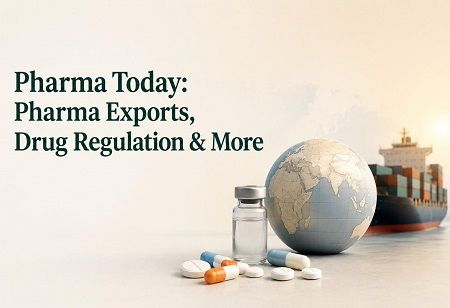
Pharma exports, drug regulation and rare disease therapies are signaling a broader shift across the pharmaceutical sector.
With the recent report on growth increasingly tied to stronger compliance, global market reach and innovation-led products.
India’s latest export figures underline the sector’s expanding international footprint, while regulatory action in the Ayurvedic segment highlights a sharper focus on manufacturing standards.
At the same time, developments in vaccines, rare disease treatments and specialized healthcare services show companies moving beyond conventional medicines.
Together, these updates reflect a pharma industry balancing scale with quality, global expansion with regulatory scrutiny, and established products with new therapeutic opportunities.
Maharashtra’s Food and Drug Administration (FDA) has intensified drug regulation across the Ayurvedic manufacturing sector after inspecting 434 licensed establishments across the state. The inspections assessed compliance with the Drugs and Cosmetics Act, 1940, Drugs and Cosmetics Rules, 1945, and Schedule T, which specifies Good Manufacturing Practices (GMP) requirements for Ayurvedic, Siddha and Unani medicines.
The FDA issued show-cause notices to 135 manufacturers for violations and non-compliance. It permanently cancelled the manufacturing licences of 10 manufacturers after identifying serious deficiencies that could affect medicine quality, safety and efficacy.
Also Read: Driving Vaccine Adoption Beyond Pediatric Immunization in India
India’s pharma exports increased 6.8 per cent year-on-year to USD 8.10 billion during April-June FY27. This was compared with USD 7.58 billion in the corresponding period of FY26, according to Pharmaceuticals Export Promotion Council of India data.
Drug formulations and biologicals remained the largest export category, generating USD 5.98 billion and accounting for 73.85 per cent of total pharmaceutical exports. The category grew 4.14 per cent year-on-year. Bulk drugs and drug intermediates recorded stronger 13.84 per cent growth, reaching USD 1.36 billion.
Vaccines emerged as the fastest-growing major segment, with exports jumping 35.68 per cent to USD 390 million. Surgical products increased 11.95 per cent to USD 210 million.
NAFTA, Europe, Africa and Latin America & the Caribbean together accounted for nearly 75 per cent of India’s pharma exports. The US remained the largest individual market at USD 2.50 billion, or 30.89 per cent of total exports, followed by Brazil, the UK, the Netherlands and France.
Pharmexcil Chairman Namit Joshi called for greater focus on complex generics, biosimilars, peptides and other innovation-led segments, alongside quality, regulatory credibility, manufacturing scale and market diversification.
In the US vaccine market, Merck & Co. and GSK hold the licenses to manufacture combined measles, mumps and rubella shots for patients. President Donald Trump’s executive order calls for the combined MMR vaccine to move toward three separate single-disease shots once such products become domestically available.
However, neither individual measles, mumps nor rubella vaccines currently holds a US licence. Merck stopped producing the individual vaccines in 2008, leaving the combined shots from Merck and GSK as the available US products. The two companies have said that published scientific evidence does not support separating the vaccines and those decades of evidence support the safety of their combined products.
The American Academy of Pediatrics and other public health experts have raised concerns that separating the shots could increase vaccine hesitancy and create additional opportunities for children to miss protection against one of the three diseases.
Zydus Lifesciences’ US-based subsidiary Sentynl Therapeutics has entered an option and license agreement with Mereo BioPharma Group for alvelestat, a neutrophil elastase inhibitor being developed for alpha-1 antitrypsin deficiency-associated lung disease.
The agreement gives Sentynl an exclusive option to acquire US commercialization rights for alvelestat. Sentynl also receives global manufacturing rights, while Mereo retains commercial rights outside the US. If Sentynl exercises the option, the agreement provides funding for the Phase 3 development programme, which could begin in early 2027.
“This partnership marks a pivotal moment for Sentynl’s rare disease strategy. Mereo’s alvelestat is a highly promising, differentiated candidate that meaningfully expands our portfolio and has the potential to address an area of significant unmet need,” said Dr Sharvil P. Patel, Managing Director, Zydus Lifesciences Limited.
AATD-LD affects an estimated 50,000 to 80,000 people in the US. If approved, alvelestat could become the first oral treatment for the rare and progressive genetic lung disorder.
Nephrocare Health Services, which operates the NephroPlus dialysis network, reported a 23.7 per cent year-on-year increase in consolidated revenue to Rs. 281.8 crore for the quarter. Adjusted EBITDA rose 30.7 per cent to Rs. 65.1 crore from Rs. 49.8 crore in Q1FY26, while the adjusted EBITDA margin expanded to 23.1 per cent from 21.9 per cent.
Vikram Vuppala, Chairman and Managing Director, NephroPlus said, "India's dialysis market is undergoing a shift from unorganised providers towards organised, pure-play dialysis networks."
NephroPlus reached 550 operating clinics across five countries during the quarter, including 50 clinics in the Philippines. Chairman and Managing Director Vikram Vuppala said organised pure-play dialysis networks now account for around 21 per cent of India’s dialysis services market, compared with virtually zero 16 years ago.
These developments highlight the pharma sector evolving across exports, regulation, innovation and specialized healthcare. Rising global shipments, tighter quality oversight, new rare disease opportunities and expanding dialysis networks show how companies are balancing growth with stronger standards and emerging patient needs.
.jpg)