
India Pharma Outlook Team | Wednesday, 23 September 2026
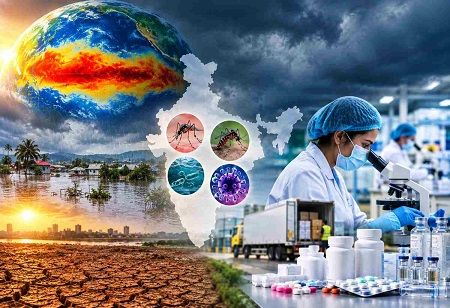
The United Nations has issued a stark warning: this year's El Nino, tied to record-warm Pacific surface temperatures, is shaping up to be the most intense on record and now poses a "significant" threat to global health.
According to WHO, heavy rain associated with the pattern could create favorable conditions for cholera and disease-carrying mosquitoes, fueling malaria, chikungunya and dengue fever.
The organization is urging countries to strengthen disease surveillance, rapid-response capacity and medical-supply preparedness.
For India, the warning raises a less-examined question: whether its health infrastructure and pharmaceutical supply chains can anticipate climate linked disease risks before they translate into higher medicine demand.
El Nino years are historically linked to erratic monsoon behavior - delayed onset, intense bursts of rainfall, extended waterlogging in some regions, and drought-like water scarcity in others.
Both extremes independently drive disease risk:
WHO's Teresa Zakaria, unit head for risk reduction and humanitarian operations, warned that "the most severe impacts will be experienced when climate shocks intersect with weak health systems, limited access to health care, food insecurity, displacement and humanitarian crisis."
India already has dedicated surveillance infrastructure. NCDC operates the Integrated Disease Surveillance Programme (IDSP), alongside divisions covering epidemiology, medical entomology, vector management and climate change and health.
NCDC also issued a specific communication to states on health preparedness for El Nino and the monsoon season in July 2026.
Also Read: Why Clinical Evidence Matters More in MedTech Commercialization
India's existing systems provide a foundation, but the emerging challenge is surge capacity.
A stronger climate signal does not automatically translate into an outbreak, meaning surveillance agencies need to identify local changes early rather than simply prepare for a nationwide disease wave.
India's frontline system is the Integrated Disease Surveillance Programme, run through NCDC with ICMR's laboratory backbone.
The numbers show a system already under sustained strain, El Nino aside: India recorded 3,020 outbreaks in 2024 and 2,285 in 2025, with dengue, chikungunya and malaria among the most frequently reported causes.
Union Health Minister JP Nadda has already directed states to tighten readiness ahead of the transmission season, instructing them to strengthen local surveillance and keep diagnostic kits and blood components stocked.
Capacity has grown, but unevenly:
Surveillance infrastructure exists on paper, but surge capacity - enough diagnostic throughput and hospital beds if several states report simultaneous spikes - has never been tested against an El Nino of this predicted intensity.
A multi-state, multi-disease surge would strain demand for antimalarial, dengue-supportive fluids, ORS, diagnostic kits and rapid test cards simultaneously.
The complicating factor is that El Nino doesn't produce one uniform national outbreak - it produces regionally divergent patterns, with some states facing flood driven cholera risk while others face drought-linked water stress and heatstroke cases.
That makes centralized demand forecasting genuinely difficult, since manufacturers and procurement agencies must plan for several distinct regional demand curves rather than one national curve.
Also Read: Why the Latest Ebola Outbreak Has Global Health Experts on Alert
Publicly available evidence currently provides clearer visibility into government preparedness than into whether Indian pharmaceutical manufacturers are changing production or inventory specifically because of the 2026 El Nino risk.
There is limited public disclosure linking individual API or formulation manufacturer’s production plans directly to El Nino forecasts.
What evidence does exist is limited in scope and reflects a longer-term trajectory rather than an immediate response: Takeda and Dr. Reddy's signed an exclusive deal to distribute the QDENGA dengue vaccine in India's private market, but availability is expected only in the first half of 2027.
Routine procurement continues through ICMR and hospital-level tenders for dengue diagnostics, but these appear tied to standard annual cycles, not climate-adjusted forecasting.
The larger manufacturing question is therefore whether climate intelligence can become part of pharmaceutical demand planning.
WHO's message is that there is still a preparation window. For India, the next test may be whether that warning travels beyond health agencies into the pharmaceutical supply chain before climate-driven disease demand peaks.
.jpg)


