
Fathimanoud, Correspondent, India Pharma Outlook
Indian pharmaceutical industry self-reliance stands as one of the defining achievements of India’s post-Independence healthcare journey.
As India marks its 80th Independence Day, the transformation of its pharmaceutical sector offers a powerful story of how domestic capability replaced dependence on foreign supplies.
In 1947, Western multinational companies controlled around 80–90 per cent of India’s pharmaceutical market and largely met demand through imports.
Today, India ranks third globally by pharmaceutical production volume, supplies about 20 per cent of global generic medicines and provides around 60 per cent of global vaccine supplies.
This journey has made India the “Pharmacy of the World” and created a foundation for the next phase of Aatmanirbhar Bharat in healthcare.
1.jpg) At Independence, India lacked the manufacturing capabilities needed to meet its growing demand for medicines.
At Independence, India lacked the manufacturing capabilities needed to meet its growing demand for medicines.
Western multinational companies controlled 80–90 per cent of the domestic pharmaceutical market, while indigenous drug production remained small.
The government responded by building public-sector manufacturing and scientific infrastructure. Hindustan Antibiotics Limited (HAL) became the first public-sector undertaking in India’s drugs and pharmaceutical sector.
The government incorporated HAL on March 13, 1954, and commissioned its Pimpri plant in 1955–56. The facility produced antibiotics such as penicillin, streptomycin, gentamicin, ampicillin and amoxicillin.
The government incorporated Indian Drugs and Pharmaceuticals Limited (IDPL) in 1961 specifically to build self-sufficiency in essential and life-saving medicines. Its facilities supported national health programs, including family planning, anti-malarial treatment and oral rehydration programs.
"India has built an enviable reputation as the pharmacy of the world. The next chapter should be about becoming the innovation partner and healthcare leader for emerging economies across the Global South," said Nikhil K Masurkar, CEO, ENTOD Pharmaceuticals.
These initiatives laid the foundation for India’s domestic pharmaceutical manufacturing capabilities and marked important milestones in the country’s journey toward self-reliance in healthcare.
Also Read: 10 AI-Powered Manufacturing Technologies Improving Pharma Production
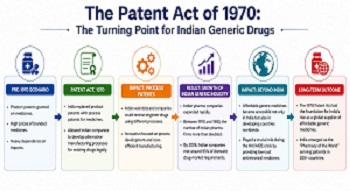 The Patents Act, 1970 fundamentally changed India’s pharmaceutical landscape.
For medicines, the law allowed process patents rather than product patents, enabling Indian companies to develop alternative manufacturing processes for existing drugs.
The framework helped domestic manufacturers build expertise in chemistry, process engineering and reverse engineering while creating competition in the medicines market.
The impact became visible through faster generic development. For example, Indian manufacturers produced a generic version of ibuprofen within years of its international launch and developed a ciprofloxacin version three years after its global introduction.
By 2006, Indian companies met about 95 per cent of the domestic drug market’s requirements. The model also expanded access beyond India. Indian manufacturers became important suppliers of affordable medicines to developing countries.
However, the process-patent era also produced low margins that limited R&D spending. India’s 1995 entry into TRIPS and its 2005 transition to pharmaceutical product patents pushed companies toward greater research, drug discovery and innovation.
 India’s global pharmacy history and growth now extends across major pharmaceutical markets.
The country ranks third globally by pharmaceutical production volume and 11thby value, with more than 3,000 companies and 10,500 manufacturing units.
The sector recorded Rs 4.72 lakh crore in annual turnover in FY25. India supplies around 20 per cent of global generic medicines, with approximately 60,000 generic brands across 60 therapeutic categories.
Its vaccine industry holds an equally important position. Indian manufacturers provide about 60 per cent of UNICEF’s vaccine supplies, meet 40–70 per cent of global DPT and BCG demand, and account for 90 per cent of WHO’s measles vaccine demand.
"By sending vital medicines to the world during the Covid-19 pandemic, India has, more than ever before, proved that it deserves to be called the ‘Pharmacy of the World’. India’s pharmaceutical sector is not only growing at a healthy rate and contributing to growth of the economy but also it contributes signi?cantly to India’s exports”, said Dr P. D. Vaghela, Secretary, Department of Pharmaceuticals, Ministry of Chemicals & Fertilizers, Government of India.
India exported pharmaceuticals to 191 countries in FY25, with half of those exports going to highly regulated markets such as the US and Europe. Pharmaceutical exports reached USD 30.5 billion in FY25, compared with USD 1.9 billion in 2000–01. This export footprint across the US, Europe, Africa and emerging markets reinforces India’s role as the Pharmacy of the World.
Also Read: How Can Indian Pharma Strengthen Quality Amid Rising FDA Scrutiny
A major test for the Indian pharmaceutical industry’s self-reliance remains the domestic production of Active Pharmaceutical Ingredients (APIs) India requires for finished medicines. Supply-chain concentration can expose manufacturers to disruptions, making domestic API, key starting material and drug-intermediate production strategically important.
The government introduced the Production Linked Incentive (PLI) Scheme for Bulk Drugs with a Rs 6,940 crore budget to encourage domestic manufacturing of critical KSMs, DIs and APIs. By September 2025, manufacturers had invested Rs 4,763.34 crore against a committed Rs 4,329.95 crore. The scheme had established 55,100 tonnes per year of manufacturing capacity across 26 critical APIs/KSMs.
"Companies are increasingly pursuing acquisitions that strengthen specialty portfolios, expand global market access and build differentiated capabilities rather than scale alone," said Bhanu Prakash Kalmath S J, Partner and Healthcare Industry Leader, Grant Thornton Bharat.
Government data also shows that pharmaceutical and bulk-drug PLI schemes have avoided Rs 3,591 crore in imports of APIs, KSMs and DIs. Three Bulk Drug Parks in Andhra Pradesh, Gujarat and Himachal Pradesh further support domestic manufacturing infrastructure. These measures give the pharma sector a stronger foundation for supply-chain resilience.
11.jpg) The next phase of the Indian pharmaceutical industry will depend on India’s ability to move beyond large-scale production.
The next phase of the Indian pharmaceutical industry will depend on India’s ability to move beyond large-scale production.
Generics remain a major strength, but biosimilars, complex generics, biologics, advanced therapies and novel drug discovery increasingly define the sector’s future.
EY identifies a transition from cost-driven manufacturing toward R&D-focused models supported by CRDMOs and Global Capability Centers.
Digital technologies can accelerate this shift. AI, advanced analytics and automation increasingly support drug discovery, clinical development, safety analytics and trial optimization.
EY’s research identifies digital integration as a major factor in future drug discovery and clinical development, while stronger industry-academia partnerships and scientific talent can support next-generation therapies.
The government’s PRIP program also supports this transition. It has established seven Centers of Excellence with a Rs 700 crore overall outlay, while 111 research projects had received approval and six patents had been filed by November 2025. EY estimates that India’s pharmaceutical sector could reach USD 450 billion by 2047, with innovation, API/KSM self-reliance and global expansion driving the opportunity.
India’s pharmaceutical transformation shows how self-reliance in pharma manufacturing can evolve into global leadership. From a market dominated by foreign companies in 1947, India built public-sector manufacturing, developed process-engineering expertise, expanded generic production and established a worldwide export network.
Today, the Aatmanirbhar Bharat pharma sector combines global-scale medicine and vaccine production with stronger domestic capabilities through PLI schemes and API manufacturing. The next milestone will require greater investment in biosimilars, complex generics, novel therapies, AI-enabled R&D and clinical research.
Strengthening Active Pharmaceutical Ingredients will also reduce supply-chain vulnerabilities. As India advances toward 2047, true healthcare independence will depend on more than expanding medicine production. It will require stronger scientific capabilities, advanced technologies and innovation to discover, develop and deliver the next generation of healthcare solutions.
.jpg)



, CDSCO.jpg "Fostering a Quality Culture in the Pharmaceutical Industry")