Most office jobs today involve sitting for eight hours or more. Screens have replaced walking, and meetings have replaced movement.
This shift has quietly created one of the biggest health risks of modern work life. Doctors now call prolonged sitting a "silent" threat, since the damage builds up slowly and often goes unnoticed.
Globally, nearly 1.8 billion adults do not meet basic physical activity guidelines, according to the World Health Organization.
That is 31 percent of the world's adult population, and the number keeps rising. For people with desk job health risks, this is not just a statistic. It shows up as back pain, fatigue, and a sedentary lifestyle that quietly reshapes long-term health.
This article looks at how sitting all day affects your heart, muscles, weight, and mind. It also shares practical, research-backed ways to reduce these risks without changing your entire routine. The goal is simple: help you sit smarter, not harder.
Sedentary behavior means any waking activity with very low energy use, like sitting, reclining, or lying down. It does not include sleep. Office workers are especially at risk because their jobs demand long, uninterrupted hours at a desk.
According to a 2026 workplace report by The People's Board, the average Indian corporate employee sits for nine to eleven hours a day. Add commuting and screen time at home, and daily sitting hours climb even higher. This pattern has earned a nickname among HR professionals: "Desk Job Syndrome."
The concern is not sitting itself. It is sitting without breaks, for hours at a stretch, day after day.
Heart health is one of the first systems affected  by prolonged sitting. When you sit for long periods, blood flow slows down. This can raise blood pressure and affect cholesterol levels over time.
A 2024 study published in the Journal of the American College of Cardiology found that sedentary time above 10.6 hours a day significantly raised the risk of heart failure and cardiovascular death. This held true even for people who exercised regularly.
Dr. Shaan Khurshid, a cardiologist at Massachusetts General Hospital and co-author of the study, explained that "too much sitting or lying down can be harmful for heart health," even for those who stay active otherwise.
The American Heart Association has echoed this warning through its own science advisory. It recommends that clinicians give patients a short reminder about their daily sitting time. The advice is simple: sit less, and move more, throughout the day.
Long hours at a desk take a toll on the body's structure. Sitting for hours weakens the core and tightens the hip flexors. Over time, this affects posture and increases strain on the spine.
A 2025 review in BMC Public Health found that sitting more than six hours a day raised the risk of neck pain by 88 percent. Prolonged phone use added even more strain, raising that risk by 82 percent. This combination of screen time and static posture is now a leading driver of back pain from sitting.
Dr. Dustin Massel, a spine surgeon at Endeavor Health, notes that most posture-related issues come from people slouching forward during long sitting stretches. He emphasizes proper desk setup and reminds patients: "you want your body and your muscles to support you, not the chair." Small ergonomic changes, he says, matter more than the type of desk used.
Common physical warning signs include:
Sitting affects more than muscles and joints. It also changes how the body processes sugar and stores fat. Research shows that occupational sitting time raises the risk of obesity and diabetes by 5–7 percent for every two additional hours of sitting.
When you sit, muscles use far less glucose than when you stand or walk. Over time, this contributes to insulin resistance, a key driver of type 2 diabetes. The CDC's 2020 data placed U.S. obesity prevalence at 41.9 percent, with sedentary work identified as a major contributing factor.
Behavior | Calories Burned (approx., per hour) | Impact on Blood Sugar |
Sitting continuously | 60–80 | Slower glucose uptake |
Standing at a desk | 88–100 | Mild improvement |
Walking (light pace) | 150–200 | Noticeably improved |
Short movement breaks every 30–60 min | Varies | Best overall metabolic response |
This table shows why standing alone is not a complete fix. Movement, even in short bursts, matters more than posture alone.
The effects of sitting too much are not only physical. Long, inactive stretches are linked to higher stress, low mood, and fatigue. Physical activity releases hormones that support mental well-being, so sitting for hours can quietly affect focus and energy.
Many office workers report a familiar afternoon slump, often around 3 PM. Reduced blood flow to the brain during long sitting periods can lower alertness and concentration. This is sometimes called the "sitting slump," and it directly affects workplace productivity.
Movement breaks help counter this dip. Even a two-minute walk or stretch can restore mental sharpness by improving circulation. Companies that have introduced short movement breaks report better focus and mood among employees during long work hours.
Nithin Kamath (CEO & Co-founder of Zerodha)said, “Sitting is the new smoking. Setting simple activity goals in terms of how much I move (calories burnt) and reminders to stand up every 45 mins has had the most impact on me.”
Bones and joints also depend on regular movement to stay strong. Prolonged sitting reduces the small mechanical stress that keeps bones dense and joints lubricated. Over years, this can contribute to stiffness and reduced mobility.
The spine's discs act like shock absorbers between vertebrae. These discs rely on movement to stay hydrated and healthy. Without regular position changes, spinal segments can become stiff, making everyday movements like bending and twisting feel harder.
Case in point: a workplace trial that introduced sit-stand desks reduced employees' sitting time by more than an hour a day. It also cut upper back and neck pain by 54 percent, while improving mood scores among participants. This shows how a fairly small change in daily habits can bring measurable joint and mood benefits.
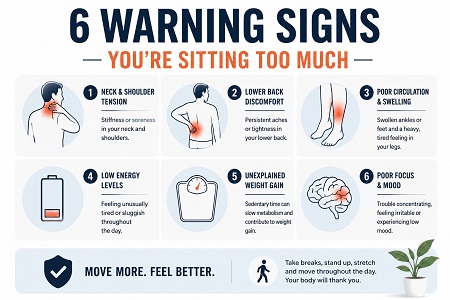 Your body often signals a sedentary lifestyle well before serious issues develop. Recognizing early signs makes prevention much easier.
If two or more of these signs feel familiar, it may be time to rethink your daily routine.
Dr. Devi Shetty, founder of Narayana Health strongly advises against sitting continuously for more than 30 minutes. To prevent silent damage to your heart and metabolism, he recommends standing up, walking around, and aiming for 8,000 to 10,000 steps every single day.
Reducing the health risks of sitting all day does not require a complete lifestyle overhaul. Small, consistent habits make the biggest difference over time.
Physiotherapist Charlotte Sayers has observed a rise in complaints tied to prolonged desk work, noting that "most of my clients complain of new low back pains since they've started working from home more." Her advice is straightforward: build short, regular movement into the workday rather than waiting for pain to appear.
Sitting all day has become the default for millions of office workers, but the health risks of sitting all day are well documented and hard to ignore. From heart strain and diabetes risk to back pain and low mood, prolonged sitting affects nearly every system in the body. The encouraging part is that small, consistent changes can meaningfully reduce these risks.
Standing every 30–60 minutes, stretching regularly, and building short walks into the day are simple, science-backed habits. Employers can support this shift through ergonomic workstations and structured movement breaks. None of these changes require major lifestyle disruption, only consistency.
As desk-based work continues to grow, treating movement as a daily priority matters more than ever. A sedentary lifestyle is not permanent; it is a pattern that can be interrupted, one break at a time. Small steps, taken consistently, can protect long-term health without sacrificing productivity.
All statistics are sourced from WHO, AHA, CDC, and peer-reviewed studies (JACC, BMC Public Health) cited inline; please re-verify links before publishing. Expert quotes from Dr. Shaan Khurshid, Dr. Dustin Massel, and Charlotte Sayers are drawn from their published statements — please re-check original sources before final publishing. The workplace wellness case study is illustrative rather than a single named company; swap in a verified, named example if one is available.
How many hours of sitting is considered too much?
Research suggests risks rise sharply above 8–10 hours of daily sitting, especially past the 10.6-hour mark linked to higher cardiovascular risk. Even active people face added risk beyond this threshold.
What are the first signs of too much sitting?
Early signs include neck and shoulder tension, tight hips, afternoon fatigue, and swelling in the legs. Slouched posture becoming your default position is another common early indicator.
How can office workers stay active during the day?
Standing every 30–60 minutes, walking during calls, using the stairs, and stretching at the desk are simple, effective habits. Ergonomic workstation setup also helps reduce strain during long sitting hours.

.jpg)



, CDSCO.jpg "Fostering a Quality Culture in the Pharmaceutical Industry")