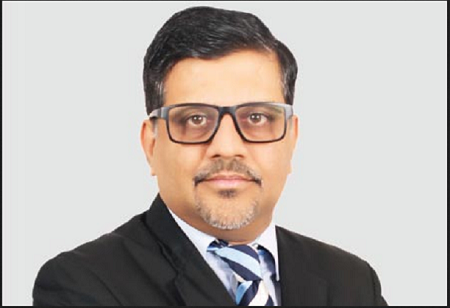
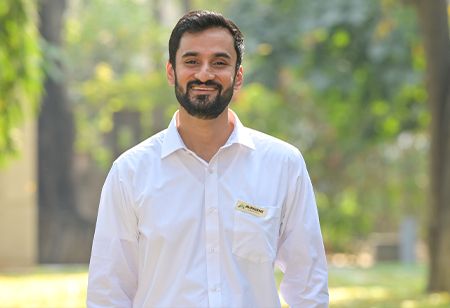
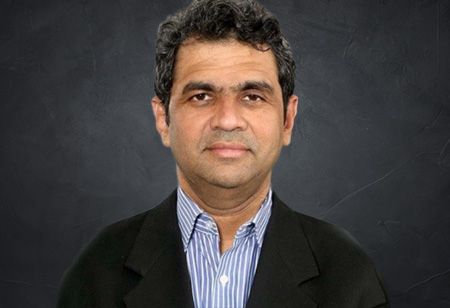
Akhil Ravi, CEO, Aurigene Pharmaceutical Services Limited
India’s CDMO sector is moving beyond its traditional strengths as demand grows for complex therapies, advanced modalities, and integrated development capabilities. At the center of this shift is a leadership challenge: building global-scale capabilities while earning customer trust across markets.
In this conversation with Thiruamuthan, Assistant Editor at India Pharma Outlook, Akhil Ravi, CEO, Aurigene Pharmaceutical, shares his perspective on building a scalable CDMO business, earning long-term customer trust, developing capabilities in complex therapies, and strengthening India’s position in the global CDMO market. He also discusses how talent and infrastructure are shaping the sector’s growth through 2030.
Akhil Ravi is a distinguished leader with more than 19 years of experience spanning entrepreneurship, strategy, manufacturing, and business development. His career across ITC, McKinsey, and Dr. Reddy’s Laboratories has shaped his approach to leadership, business building, talent development, and strategic investment.
Read the full interview to understand how Indian CDMOs can strengthen their global position.
You’ve worked across very different environments, from ITC to McKinsey and now Aurigene. How has that journey changed the way you think about leadership?
My first job at ITC, a large Indian conglomerate, was primarily about learning the fundamentals. However, I believe my learning journey truly began when I started my own venture in 2009. That experience taught me the basics of starting and building a new business and understanding what it takes to create something from the ground up.
Later, at McKinsey, a global consulting firm, I worked with very large organizations and learned how to solve complex problems at scale. The experience of working with both small and large organizations helped me develop a strong understanding of business fundamentals from different perspectives.
Over the last eight-plus years at Dr. Reddy’s, my learning journey has evolved further. I started by leading small teams of five to ten people and today lead a team of more than 1,000. This transition has taught me how to move beyond the technical aspects of a role and focus on people—their aspirations, emotions, motivations, and development.
It has been a challenging but deeply enriching journey. The organization has also supported me through various leadership development programs, which have helped me navigate this transition effectively.
More broadly, my understanding of leadership has changed significantly. There is a clear difference between what we learn about leadership in management books and what leadership looks like in practice. Over the past eight years, particularly during my journey at Dr. Reddy’s, that understanding has evolved considerably.
Since taking on the leadership role at Aurigene, what have you learned about what it takes to build a successful CDMO business in today’s pharma industry?
At first, I did not understand the CDMO business well when I started. I had to learn from our employees, customers, and industry peers to understand what it takes to build a successful CDMO business.
The first principle was curiosity. The second was building customer trust. As we grew, we realized trust was critical to long-term relationships. To support this, we created a simple operating model that dedicated manufacturing lines to CDMO clients. This strengthened customer confidence while making our operations more efficient and scalable.
The third factor was leveraging our existing strengths. We had significant capacity, a strong quality track record, and capable people. Once customers experienced this ecosystem, they saw us as the right partner.
These factors helped us scale significantly over the past four years. We initially focused on API CDMO sales, while drug product CDMO sales have also grown considerably in recent years. We followed the same playbook: understand the market, identify our strengths, and package our capabilities into solutions that simplify operations and build customer trust.
Another critical factor was building the right team. Many of our leaders are relatively new to their roles, bringing fresh energy and ideas. My role has been to help them execute, remove barriers, and create an environment where they can deliver on our shared vision.
Ultimately, having the right people who believe in the vision and are willing to build it together has been one of the biggest drivers of our journey.
The opportunity for CDMO is much larger than where we are today, which means Indian companies need to be bolder about allocating capital.
We are seeing more biologics, peptides, oligonucleotides, and other complex therapies entering drug pipelines. How is this changing what pharma companies look for in a CDMO partner?
The new modalities have increased significantly, with peptides, antibodies, and other complex therapies becoming a larger part of drug pipelines.
As a company, we made deliberate choices about where we wanted to invest. We decided to focus on building our peptide and antibody platforms. Alongside our small-molecule capabilities, we have invested significant capital to scale these areas and strengthen our CDMO business.
One advantage was that we already had experience with small-scale synthesis of both peptides and antibodies. This gave us an existing foundation and access to some customers. We engaged with these customers early, shared our plans, and sought their guidance on what they would expect from a CDMO partner.
Based on those inputs, we were able to reallocate some of our existing peptide and antibody capacity toward CDMO work. As the business grew and we secured more projects, we continued to invest in additional capacity.
The second critical factor was talent. These are highly specialized technologies, so we needed people with the right expertise and end-to-end understanding of the business. That includes customer management, supply chain, quality, process development, manufacturing, and outbound logistics.
Building the complete capability across this value chain has been essential. Thankfully, we have earned the trust of several customers who are now working with us on their molecules. Their confidence has played an important role in helping us scale the business.
We are now doubling down on both areas—peptides and antibodies. Our focus is on expanding capacity, strengthening our technical capabilities, and building a stronger presence at the front end of the CDMO value chain.
Also Read: Choosing the Right CDMO in India: A 2026 Compliance Guide
When a therapy is more complex, what are some of the biggest challenges CDMOs face in moving it from early development to manufacturing?
Typically, customer needs are quite different in the early and late phases of development. In the early phase, the priority is speed. The goal is to move quickly and get the molecule to a stage where it can be tested on patients. As the therapy moves into the late phase, the priorities change. Customers begin to focus much more on reliability, capacity, quality, and process robustness.
This means CDMOs need to build capabilities that address the specific requirements of each stage. That is why we have an early-phase development service supported by a dedicated team focused on these needs.
For late-phase programs, we have a separate team that focuses on reliability, capacity, quality, process robustness, cost, and speed. The objective is to ensure that the customer's requirements are consistently met as the program moves toward commercial manufacturing.
This differentiation has been an important part of our approach because the needs of customers are fundamentally different across the two phases.
Beyond manufacturing capabilities, what do you think makes a CDMO a partner that pharma companies can rely on for the long term?
There are certain foundations that every service provider like us needs to have. These include capacity, quality, robust quality processes, safety, and more sustainability and people—the right talent to ensure these facilities operate at the highest standards.
These are the basic requirements to even qualify to compete in this space. Without these fundamental capabilities, you cannot effectively participate in the CDMO industry.
What differentiates good players from the rest, however, goes beyond these foundations. It comes down to cross-functional processes, organizational culture, the ability to make decisions quickly, and the willingness to invest in the right areas.
It is also about building strong customer relationships, creating effective processes to attract and develop talent, and training people well within the organization. These are the factors that differentiate leading companies from average ones.
We had an advantage in that we already had good infrastructure and strong people. The key was to direct their energy toward the right priorities. That helped us significantly scale both our drug discovery services and CDMO businesses.
Ultimately, the foundations were already in place. The real opportunity was to channel the team's energy in the right direction and bring in the right people who could partner with me in executing the vision.
India has traditionally been strong in APIs and generic drug manufacturing. What do you think Indian CDMOs need to do differently to build a stronger position in biologics and other complex therapies?
I would first emphasize that there is still significant potential for India even in API manufacturing. India currently accounts for less than 4 percent of the global API CDMO market, which shows there is plenty of room to grow.
India can build on the strengths developed over the last 40 to 50 years. Companies such as Dr. Reddy’s and Sun Pharma have helped create a strong foundation for pharmaceutical manufacturing, and there is an opportunity to build on it and increase India’s global share.
For new modalities such as antibodies and peptides, the first priority is world-class capacity. When customers visit an Indian facility, they should see no difference from facilities in Boston, Basel, or Shanghai. Infrastructure, quality, processes, and the overall experience should match global standards.
The second area is talent. India has strong talent, but emerging areas need experienced professionals who have worked with these technologies globally. Bringing that expertise into India can help build capabilities and train teams faster.
The third factor is customer trust. Customers have traditionally relied on other countries for complex modalities, so Indian CDMOs need to prove they can deliver at the same global standards. That trust is already beginning to grow.
India’s opportunity in new modalities is significant, but the country’s relatively small share of the global CDMO market shows there is still considerable room to expand.
From your experience across strategy, manufacturing, and business development, how are CDMOs thinking differently about investments and capabilities today?
The CDMO sector, and the broader pharmaceutical industry, is highly capital-intensive. So, one important question is how companies can access the capital needed to grow.
Different companies are taking different approaches. Some are raising money through the market, including IPOs and private equity. Others are reallocating capital within their existing businesses. That is the approach we have taken, directing our internal cash toward growing the CDMO business.
Some companies are also acquiring assets to build capabilities more quickly and then scale them over time.
So, different companies are taking different approaches to allocating capital and building their CDMO capabilities. But, as I said earlier, the opportunity is much larger. I think we probably need to be a little bolder in allocating more capital toward this space.
There are many strong entrepreneurs in the Indian CDMO sector who can access this capital and build their businesses. If they can also earn the trust of more customers, there is significant potential for the sector to grow further.
Also Read: Indian CDMO 2.0 Guide: Risk-Sharing and Hybrid Models
India has introduced several policies and initiatives to support the pharmaceutical and CDMO sectors. Beyond the schemes already in place, what more do you think the government can do to help Indian companies become stronger competitors in the global market?
I am glad that the government is thinking about such schemes to support the growth of the pharmaceutical sector. I think they have taken some inspiration from the Chinese government, which has placed a lot of focus on the biotech and pharma CDMO space, CROs, and drug discovery to grow these sectors.
The government has launched a few schemes, including the Biopharma SHAKTI scheme, and has allocated budgets to this space. The policies are also being drafted in consultation with the industry, and we have been involved in some of those discussions. So, the direction is right, and that is positive to see. We are obviously yet to understand exactly how this will play out.
We have seen the benefits of the PLI scheme primarily from a generic drug perspective. But when we look at innovation, the risks are much higher. Some of these new modalities also require extremely high levels of investment. The government support in understanding this space, having the right experts involved, and working with the industry in a faster way to direct risk capital toward the sector would really help.
In addition to capital, if the government can also incentivize Indian-origin thought leaders in the industry to come back and support the sector, that could be another area to focus on. This is something the Chinese have done very well.
When you look towards 2030, which emerging therapies or shifts in drug development do you think could reshape the CDMO industry most?
There are many emerging modalities. But despite these developments, one thing that has not changed is that small-molecule chemistry will continue to be important. Small molecules still account for about 40 percent of the pipeline. The chemistry is becoming more complex, with increasingly difficult reactions. So, this area will continue to be relevant, and we need to keep strengthening our capabilities in it.
Among the newer modalities, there are antibodies, cell and gene therapy, peptides, and ADCs, or antibody-drug conjugates. We are also seeing growth in areas such as siRNA and oligonucleotides. With multiple emerging technologies, companies need to make choices and develop deep expertise in the areas they choose to focus on. It is very difficult to become an expert in everything.
We have made some choices about where we want to focus. For now, our primary focus is on peptides and antibodies. We have also made some early, low-capital investments in areas such as oligonucleotides and ADCs, mainly at the laboratory level.
The idea is to start working in these areas and understand them before making larger investments. By working with a range of customers and building experience in these new modalities, we can better understand the space and then make bigger bets with greater confidence.
What is your personal mantra?
The first one is discipline. Trying to be disciplined about health and creating a routine, both personally and professionally, has always helped me.
The second is having a learning mindset. I try to learn from my team, from external stakeholders, and through different channels such as books and podcasts. You need to keep learning and stay updated because things are changing quite a bit.
The third is focus. At any given point, I try to focus on one or two areas and really work on growing them. Another area I have developed over the years is relying more on people and letting go. Earlier, this was not a very strong skill for me. But I have realized that I cannot do everything alone. We need to rely on and trust our teams.
I am still not extremely good at it, but it is something I have developed over the last few years. These are the qualities I rely on, particularly when things are under stress.
Stay curious: Keep learning about what’s happening in pharma and beyond. Look at other industries and see what can be applied to pharma.
Learn from other industries: Industries such as automotive and chemicals can offer useful lessons, especially in manufacturing and technology.
Question the status quo: Just because something has always been done a certain way doesn’t mean it is the best way.
Think differently: If you want different results, be willing to try a different approach.
Take ownership and act: When something doesn’t make sense, question it, take responsibility, and work toward improving it.
.jpg)

, CDSCO.jpg "Fostering a Quality Culture in the Pharmaceutical Industry")